Blog
AI Computer Vision Solutions for Manufacturing: A Comparison of Platforms, Deployment Models, and Costs
By Rakesh· July 2, 2026· 9 min read
Summarize this post with

Loading insights...
LoadingSummarize this post with
Most manufacturing and logistics facilities already have cameras installed across production lines, loading zones, storage areas, and operational workflows. The problem is that the footage gets stored, not analyzed in real time.
Safety incidents, bottlenecks, and productivity losses are often discovered only after operational damage has already happened.
This is driving the rapid shift toward AI Computer Vision Systems. Manufacturers now want real-time operational intelligence instead of relying on manual supervision and delayed reports.
What is driving adoption:
In this blog, we compare the top AI computer vision solutions for manufacturing, including deployment models, operational capabilities, scalability, and where ROI appears first.
Vision AI takes live video feeds from your existing cameras and runs AI models on top of them to detect, measure, and report on operational events in real time.
This is fundamentally different from CCTV. A camera records. A Vision AI system analyzes.
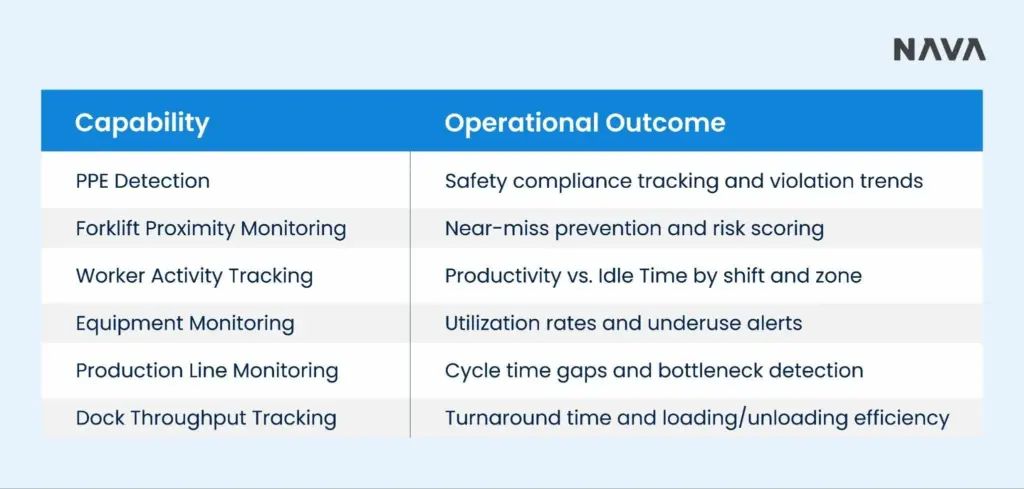
They stop at detection. An alert fires. Someone checks a dashboard. Nothing changes.
The result is alert fatigue. Operations teams stop trusting the system. The tool becomes a compliance checkbox rather than a decision engine.
Here is the difference in practice:
The second version drives action. The first one adds noise.
The best AI computer vision systems for manufacturing go beyond event detection and deliver shift-level, location-level, and team-level operational insights that operations leaders can actually use.
Not all AI computer vision platforms are built for the same manufacturing challenges. Different solutions focus on safety, productivity, operations, and operational observability.
These platforms focus on worker safety, PPE compliance, and hazard detection. They are the most common entry point for manufacturing buyers.
What they cover:
These go beyond safety and track production efficiency, workforce output, and equipment usage.
What they cover:
Best-fit buyers: Plant managers, Operations heads, Continuous improvement, and lean teams.
Because most manufacturers do not have just one problem, they have safety issues, productivity gaps, and compliance pressure, all running in parallel.
Point solutions solve one thing. Unified platforms cover the full operational picture from a single interface.
NAVA Software's Vision AI is built for exactly this. It runs on existing CCTV infrastructure and covers safety, workforce productivity, dock operations, equipment utilization, compliance, and inventory insights on a single platform.
The Snapshot PoC model ($10,000 to $25,000) lets manufacturers connect live camera feeds and see insights within days, not months. No rip-and-replace required.
Comparing Leading AI Computer Vision Solutions for Manufacturing
Here is a comparison of leading AI computer vision platforms for manufacturing based on deployment speed, operational coverage, PoC flexibility, and scalability across industrial operations.
| Platform | Best For | Deployment Speed | PoC Model | Unified Coverage |
| NAVA Vision AI | Safety + Operations + Productivity | Days to weeks | Yes ($10K-$25K) | Yes |
| Intenseye | Large-scale safety compliance | Months | No | No |
| Visionify | Mid-market safety | Weeks | Yes | Partial |
| Protex AI | Enterprise safety | Weeks to months | Limited | No |
It depends on your latency requirements, data privacy constraints, and infrastructure budget.
| Factor | Cloud | Edge |
| Scalability | High. Add sites without hardware changes. | Medium. Each site needs a local computer. |
| Latency | Higher. Data travels to remote servers. | Low. Processing happens on-site. |
| Infrastructure Cost | Lower upfront. Ongoing subscription. | Higher upfront. Lower recurring |
| Data Privacy | Depends on provider and data policies. | On-premise. No data leaves the site. |
| Deployment Complexity | Lower. Vendor manages infrastructure. | Higher. Requires on-site setup. |
Cloud-based Vision AI sends video data to remote servers for processing. It scales fast and keeps infrastructure lean. The tradeoff is latency and data transfer costs.
Edge AI deployment processes data locally, at or near the camera. This is critical for high-speed production lines where a two-second alert delay has real operational consequences.
Most modern platforms support a hybrid model: edge processing for real-time alerts, cloud for trend analysis and reporting. This is the setup most manufacturing operations should target.
| Deployment Stage | Typical Cost Range - 2026 |
| Trial / Snapshot PoC | $10,000 to $25,000 |
| Mid-Sized Single Site Rollout | $50,000 to $150,000 |
| Enterprise Multi-Site Deployment | $200,000 and above, annually |
Pricing models vary significantly across vendors:
What adds to the total cost beyond licensing?
NAVA's Snapshot model is designed to eliminate this friction at the start. Connect existing feeds, validate ROI in weeks, then decide on full rollout with real data, not a sales deck.
Most manufacturers do not see ROI from AI detection alone. The fastest operational gains usually come from improved active tracking of safety risks, workforce productivity, bottlenecks, equipment utilization, and workflow inefficiencies.
Documented near-miss reduction directly lowers OSHA recordable incident rates. Fewer incidents mean lower workers' compensation costs and reduced insurance premiums. This is typically the fastest ROI signal, often visible within 60 days of deployment.
Visibility into actual vs idle time drives smarter scheduling and deployment decisions. Operations that track this objectively typically report 10 to 20% productivity improvements within the first quarter of full deployment.
Tracking forklift and loader idle time often reveals 25 to 40% underutilization. That data directly informs capital expenditure decisions, lease renewals, and fleet sizing.
Visual audit trails replace manual documentation. Compliance checks that previously took days can run in hours, with verifiable visual evidence attached to every record.
Three reasons come up consistently across failed implementations:
NAVA Vision AI Solution addresses these PoC failures by starting with measurable operational outcomes, not just detection alerts. Its Snapshot PoC model helps manufacturers define clear KPIs, connect insights to existing workflows, and track trend-based improvements across safety, productivity, and efficiency from the beginning.
Before you sign anything, run through this checklist with every vendor:
Most manufacturers are not short on cameras. They are short on what those cameras actually tell them.
The platforms that generate real ROI are the ones that move past detection and deliver operational intelligence: shift-level data, risk trends, productivity benchmarks, and compliance trails that hold up in an audit.
Start with a PoC. Define your KPIs first. Pick the use case with the highest operational friction and measure it.
Ready to See What Your Cameras Are Missing? Book a Vision AI Snapshot assessment with NAVA Vision AI.
Connect your existing cameras and start uncovering operational insights across safety, productivity, bottlenecks, and workflow efficiency in days, not months.


