Blog
What Is AI Visual Inspection? How Manufacturers Detect Defects in Real Time
By NAVA Software· July 20, 2026· 7 min read
Summarize this post with

Loading insights...
LoadingSummarize this post with
What if every defect was caught before it became a claim dispute? This blog breaks down how AI visual inspection works and why manual checks are statistically failing manufacturers. It covers the industries ditching human inspectors for real-time image-based detection. At the center of it is DamageVision AI, a purpose-built system that creates an audit trail no one can argue with.
Manual visual inspection misses up to 25% of defects on high-speed production lines. Human fatigue and inconsistency are not edge cases. They are the baseline.
AI defect detection now processes thousands of images per minute at accuracy rates manual checks cannot reach. In 2026, it is the operational standard, not an experiment.
The fix is straightforward: deploy image-based AI quality inspection at entry and exit points. Every unit gets checked. Every anomaly is logged. Every dispute has evidence.
Keep reading to learn how AI visual inspection works, where it outperforms human inspection, which industries are adopting it fastest, and how automated visual inspection with AI fits your operation today.
AI visual inspection is an automated quality control process that uses cameras, machine learning, and computer vision algorithms to detect defects in products, materials, or assets in real time.
It replaces the human eye on the production line. A camera captures an image. The AI model analyzes it. If a defect is detected, the system flags it, logs it, and triggers whatever action you have configured.
That could mean stopping a conveyor, routing a product to a secondary check, or filing an automated incident report. The detection happens in milliseconds. The record is permanent.
AI visual inspection is not a single technology. It is a combination of three components working together.
The more data the model is trained on, the better it gets. Most modern systems use deep learning models, specifically convolutional neural networks, which are designed to recognize visual patterns at a granular level.
Some systems run entirely on edge AI computer vision hardware at the inspection point. Others send data to a cloud model. The best setups combine both: edge processing for speed, cloud for retraining and reporting.
| Technology | What It Does |
| Convolutional Neural Networks | Identifies patterns in image data to detect defects |
| Edge Computing | Processes inspection data on-site for real-time results |
| High-Speed Cameras | Captures images at production line speeds without blur |
| Cloud Model Retraining | Improves accuracy over time using new defect data |
| Automated Audit Trails | Logs every inspection result with a timestamped image record |
Manual inspection is not just slow. It is statistically unreliable. Human inspectors have been shown to miss 20 to 30% of defects under standard production conditions, according to research from the Quality Management Journal.
Fatigue compounds the problem. Inspection accuracy drops measurably after two hours of continuous checking.
| Metric | Manual Inspection | AI Visual Inspection |
| Defect detection rate | 75 to 80% | 97 to 99% |
| Inspection speed | Limited by human throughput | Thousands of units per minute |
| Consistency | Degrades with fatigue | Consistent across all shifts |
| Audit trail | Paper-based, incomplete | Fully digital, timestamped |
| Cost at scale | Increases with headcount | Fixed after initial deployment |
According to MarketsandMarkets, the global AI quality inspection market is projected to reach $19.7 billion by 2027, growing at 7.7% CAGR. Manufacturers are not testing this technology anymore. They are deploying it at scale.
The sectors that moved first were the ones with the highest cost-per-defect ratios. Automotive, electronics, pharmaceuticals, and food processing all had strong financial reasons to eliminate manual inspection gaps.
By 2026, the adoption curve has shifted. Logistics, freight, and supply chain operations are now where most of the new deployments are happening. The economics are clear: every undetected damage event at a loading dock is a potential claim dispute with no evidence either way.
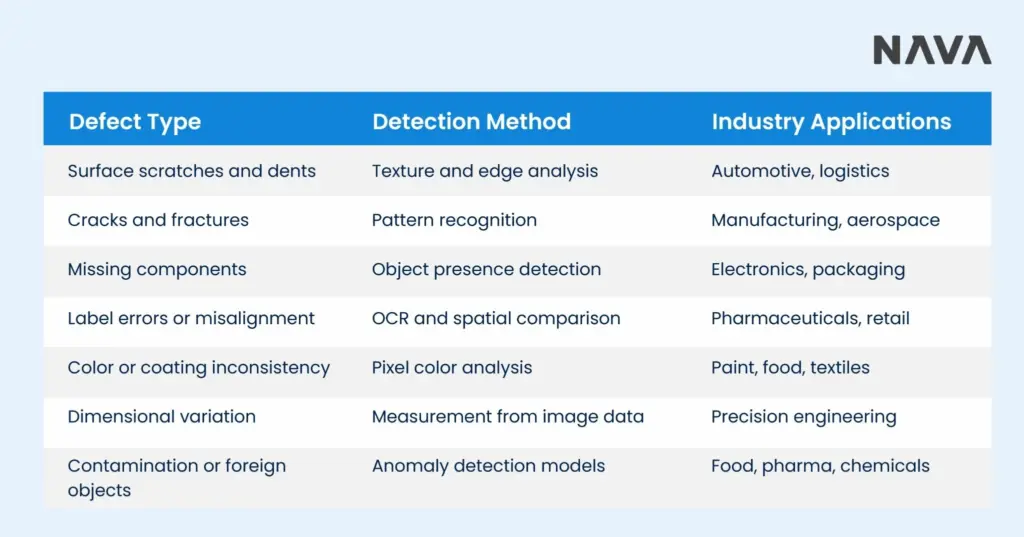
The range of detectable defects depends on the quality of the training data and the resolution of the camera setup. In general, well-configured AI quality inspection systems detect the following without human involvement.
Freight damage is one of the most expensive and underreported problems in logistics. When a trailer arrives with prior damage, the question of accountability starts immediately. Without a visual record taken at that exact moment, disputes go nowhere.
This is exactly what automated visual inspection AI solves in freight and logistics environments. Image capture at arrival and departure, combined with AI defect detection, creates an indisputable visual timeline.
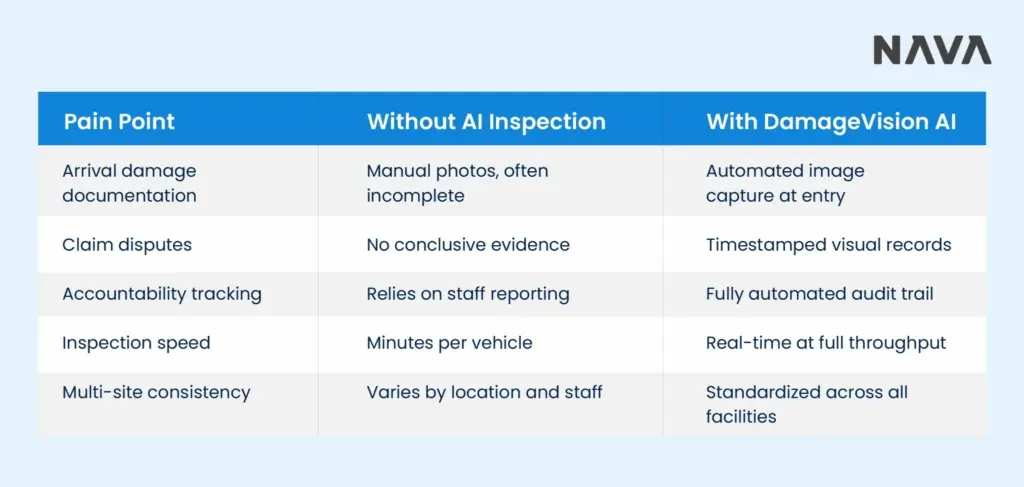
DamageVision AI is a purpose-built system for this problem. It identifies exterior damage on trailers, containers, freight, and pallets the moment they arrive or leave a facility. The system establishes image-based evidence of damage status at every touchpoint, which means claim disputes get resolved faster, accountability is traceable, and operations run audit-ready without extra labor.
The core value is not just detection. It is the audit trail. Every image is timestamped, geotagged, and stored automatically. No manual documentation. No disputed handoffs.
Buying AI visual inspection is not the same as buying a camera system. You are buying a detection model, a data pipeline, and an audit infrastructure. Here is a practical checklist before you sign anything.
If a vendor cannot answer those questions with specifics, treat it as a signal. A demo environment is not the same as an operational environment. Push for proof from a comparable real-world deployment.
If your facility is still relying on manual checks or incomplete photo documentation at dock entry points, you are operating with a gap that will produce claim disputes. DamageVision AI closes that gap with fully automated, image-based damage detection that starts working from day one.
Schedule a zero-cost assessment. Bring your current inspection process. We will show you exactly where automated visual inspection AI fits and what the evidence trail looks like in practice.