Blog
AI Damage Detection in Warehouses: How Computer Vision Identifies Damaged Goods
By NAVA Software· October 6, 2026· 12 min read
Summarize this post with

Loading insights...
LoadingSummarize this post with
Every damaged pallet that ships costs you a customer. AI damage detection turns your existing cameras into a 24/7 quality gate, catching defects at the dock and leaving a visual record for every claim. Test it on your own goods with a NAVA proof of concept.
A pallet arrives at Dock 4 with a crushed carton corner. Nobody catches it at reception, so it goes into storage, gets picked three weeks later, and ships to a customer who rejects it on arrival. Now your team is arguing with the carrier about a damage claim with no photo, no timestamp, and no proof of where the damage happened.
This happens in warehouses every day. The cost shows up in several places: rejected shipments, return processing, write-offs, claim disputes, and customer relationships that take one more hit each time.
Manual inspection can't keep up with modern throughput. Inspectors get tired, standards vary between shifts, and high-volume periods force teams to choose between speed and thoroughness.
This blog explains how the technology works, where it fits in warehouse operations, and what to evaluate before you choose a solution.
AI damage detection is the use of computer vision solutions to find visible damage on pallets, cartons, packages, and products as they move through a facility. Cameras capture the goods, AI models analyze the images, and the system flags anything that doesn't match an acceptable condition.
The difference from manual inspection is not only speed. It is consistency, coverage, and the data trail each detection leaves behind.
| Factor | Manual Inspection | AI Damage Detection |
| How damage is found | Depends on human attention | Uses computer vision and models |
| Consistency | Varies by inspector, shift, and fatigue | Applies the same criteria to every item |
| Performance at high volume | Slows down or skips checks | Monitors continuously |
| Coverage | Spot checks and sampling | Every item that passes a camera |
| Documentation | Manual reports, often incomplete | Automated alerts with image evidence and timestamps |
| Use in claim disputes | Hard to prove when damage occurred | Visual record tied to a location and time |
| Insight into root causes | Limited and anecdotal | Damage patterns by supplier, lane, zone, or process |
Manual inspection is reactive. Someone finds damage after it has already caused a problem, often at the customer's dock.
AI-powered damage detection moves quality checks upstream. It flags damage at the point it enters your facility or occurs inside it, so your team can act before the item moves further down the chain.
Most computer vision damage detection systems follow the same four-stage workflow.
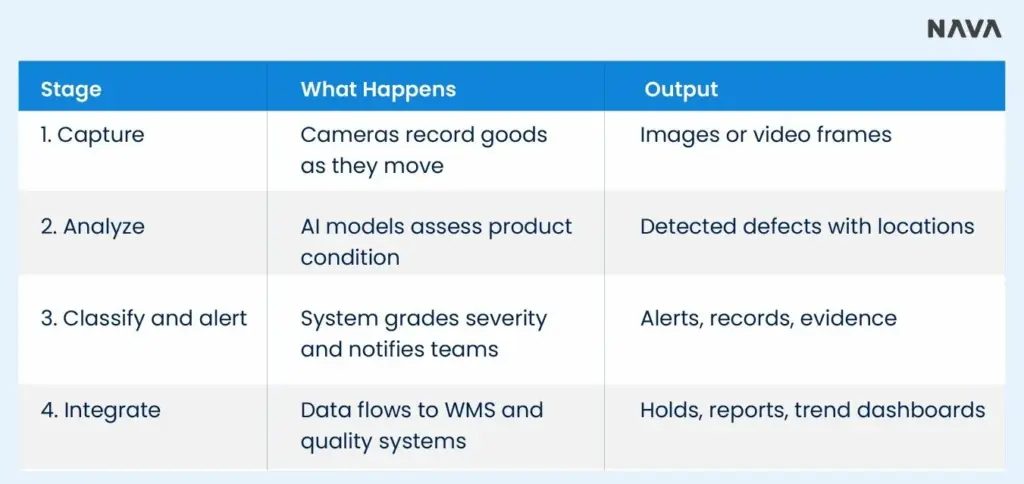
Once images are captured, computer vision models examine each item for signs of damage. Trained models can identify:
Product damage detection models learn what "normal" looks like for your goods and flag deviations. The more representative the training images, the better the model performs in your specific environment.
Damage data creates the most value when it connects to the systems your team already uses. Common integration points include:
| System | What Integration Enables |
| Warehouse Management System (WMS) | Place inventory on hold, update item status, trigger inspection tasks |
| Inventory platforms | Adjust available stock to reflect damaged units |
| Quality management systems | Log nonconformances and route corrective actions |
| Reporting dashboards | Track damage trends across shifts, zones, and sites |
Without integration, damage alerts become one more screen to watch. With it, detection triggers the next step in your process.
1. Detecting Damaged Goods During Receiving
Receiving is where accountability is decided. If damage isn't documented at the dock, you often absorb the cost even when a supplier or carrier caused it.
AI damage detection at receiving helps identify:
Catching damage here protects your inventory accuracy. It also gives you timestamped evidence to support supplier chargebacks and carrier claims.
2. Inspecting Goods Before Shipping
Outbound inspection is your last chance to stop a damaged product from reaching a customer. Automated checks at pack stations or dock doors act as a final quality gate.
This reduces customer complaints and returns, and it improves shipment accuracy. It also creates proof that goods left your facility in acceptable condition, which matters when a customer reports damage on arrival.
3. Monitoring Automated Warehouse Operations
Automation increases speed, but it can also create damage at scale. A misaligned diverter or a gripper with the wrong pressure setting can damage hundreds of items before anyone notices.
Computer vision helps monitor:
When damage clusters at one point in an automated line, the data points your maintenance team to the equipment causing it.
4. Quality Control in Cold Storage and Specialty Warehouses
Some goods carry higher stakes when damage goes unnoticed.
| Sector | Why Damage Detection Matters |
| Food and beverage | Compromised packaging can lead to spoilage, contamination, or recalls |
| Pharmaceuticals | Damaged seals or containers can affect product integrity and compliance |
| Electronics | High unit values make each damaged item costly |
| Fragile goods | Glass, ceramics, and precision items break under routine handling |
In cold storage, manual inspection is also harder on staff. Automated visual checks reduce the time people spend inspecting goods in freezer environments.
1. Reduce Manual Inspection Effort
Visual checks are repetitive and time-consuming. AI handles routine scanning, so inspectors spend their time on flagged exceptions instead of reviewing thousands of undamaged cartons.
Your team shifts from searching for problems to deciding what to do about them. That is a better use of experienced staff.
2. Improve Damage Identification Accuracy
A model applies the same inspection criteria at 3 a.m. on a Saturday as it does at 10 a.m. on a Tuesday. That consistency is hard to achieve with manual inspection across shifts, sites, and seasonal staff.
It also reduces dependence on individual inspectors. When an experienced inspector leaves, their judgment leaves with them, but a trained model stays in place.
3. Prevent Shipping Damaged Products
Every damaged item caught before dispatch avoids a chain of costs: return shipping, reprocessing, replacement, and customer service time. It also protects the customer relationship, which is harder to price but easier to lose.
Outbound detection turns quality from a promise into a verified checkpoint.
4. Create Data-Driven Quality Insights
This is where AI damage detection pays off over the long term. Each detection adds to a dataset you can analyze.
| Analysis Dimension | Question It Answers |
| By supplier | Which vendors send the most damaged inbound goods? |
| By carrier or lane | Which routes or partners cause transit damage? |
| By location | Which dock doors, aisles, or zones see the most incidents? |
| By product type | Which SKUs or packaging formats fail most often? |
| By process stage | Does damage happen at receiving, putaway, picking, or packing? |
| By time | Do incidents spike during certain shifts or peak periods? |
These patterns reveal recurring operational issues. You can renegotiate with suppliers, retrain teams, redesign packaging, or fix equipment based on evidence rather than assumptions.
Not every Vision AI solution fits every operation. There are damage vision solutions like Vimaan, Datature, NAVA, etc., that help you detect damage and maximize the efficiency of your inventory and warehouse operation in different ways. The right choice depends on camera infrastructure, integration requirements, and the damage scenarios you need to detect.
Use these criteria to compare vendors.
1. Detection Capabilities
Start with what the system can see. Before evaluating vendors, it helps to understand how AI visual inspection works in practice. Then ask:
Request a demonstration using your own images, not a vendor's curated dataset.
2. Integration With Existing Warehouse Operations
A strong model that doesn't fit your environment will stall at the pilot stage. Evaluate:
| Criterion | What to Ask |
| Camera compatibility | Does it work with our existing CCTV or IP cameras, or does it need new hardware? |
| WMS integration | Can it push holds and status updates into our WMS? |
| API availability | Is there an API for custom workflows and reporting? |
| Deployment requirements | Edge, cloud, or hybrid? What network and compute does it need? |
Hardware requirements often decide total cost and time to value. A solution that runs on existing cameras removes the largest capital expense from the project.
3. Scalability Across Locations
A pilot at one dock door is different from a rollout across ten facilities. Consider:
Ask how the vendor handles model adaptation when you add a new site or product line.
4. Real-Time Alerts and Reporting
Detection only helps if the right person sees it in time to act. Look for:
Check how alerts reach your floor teams. A dashboard nobody opens during a busy shift won't stop a damaged pallet from shipping.
NAVA's Damage Vision AI is built for warehouses that want damage detection without a hardware overhaul. It runs on your existing CCTV, IP, and RTSP cameras, so you can start at the docks and lanes you already monitor.
Damage Vision AI is part of a broader NAVA Vision AI suite. Operations that want wider visibility can pair it with Dock Vision AI for dock activity, InventoryVision AI for stock monitoring, or Safety Vision AI for workplace safety, all on the same camera infrastructure.
| NAVA Advantage | What It Means for Your Warehouse |
| Works with existing cameras | Lower upfront cost and faster deployment |
| Proof-of-concept approach | Validate detection on your goods before a full rollout |
| Available on AWS Marketplace | Simpler procurement through existing AWS agreements |
| Multi-product suite | Expand from damage detection into dock, inventory, and safety use cases |
A POC lets your team test Damage Vision AI against real damage scenarios in your facility. You see the results before you commit to scale.

NAVA Damage Vision AI is designed for warehouses that want to validate AI-based inspection using their existing camera infrastructure before committing to a larger rollout.
Damaged goods cost you at every stage: at receiving, in storage, on the outbound dock, and in the customer relationship. Computer vision services give your team consistent coverage, visual evidence, and the data to fix the root causes.
The fastest path is to start where damage hurts most, validate on your own goods, and scale from there.
See how Damage Vision AI can help your warehouse identify damaged goods automatically, using the cameras you already have. Talk to the NAVA Vision AI team about a proof of concept for your facility.