Blog
6 Computer Vision Use Cases in Manufacturing Safety
By Satish· July 21, 2026· 11 min read
Summarize this post with

Loading insights...
LoadingSummarize this post with
The biggest safety risks on a manufacturing floor are often the ones nobody sees until it is too late. This blog explores how NAVA Vision AI uses computer vision to detect PPE violations, near misses, equipment issues, and unsafe behavior in real time helping manufacturers improve safety, reduce downtime, and stay audit ready across every shift.
A near miss happens at a press line. The operator doesn't report it. Too much friction, not sure it counts. The supervisor was at the other end of the floor. The safety log stays clean.
Three months later, the same interaction produces a recordable injury.
This is the core problem with traditional manufacturing safety programs: they were designed for a different pace. Periodic audits, manual spot-checks, and end-of-shift walkarounds. These methods catch what they're designed to catch. But the gap between checks is where most incidents originate.
This article covers six specific use cases where vision AI is deployed on plant floors today. Each section explains what the system detects, why it matters operationally, what outcomes have been measured, and where the real constraints are.
Camera-based systems are trained to detect specific objects, behaviors, and conditions in real time. Not generic surveillance. Purpose-trained models for specific events: a missing hard hat, a worker entering an exclusion zone, a leaking seal.
In most deployments, these systems run on existing camera infrastructure. No rip-and-replace. The value comes from what the software detects and what it connects to, not the hardware.
• EHS platforms for incident logging and corrective actions
• CMMS and maintenance systems for equipment anomalies
• SCADA/OT environments in some configurations
• Operations dashboards for real-time visibility
Vision data only changes outcomes when it connects to the workflows where action happens. Detection without a closed-loop workflow is footage, not a safety program.
Computer vision in manufacturing is primarily used to identify operational and safety risks in real time, helping teams move from reactive incident response to continuous monitoring and faster corrective action.
| Use Case | Primary Risk Addressed | Who Acts On it |
| PPE Compliance Monitoring | OSHA citations, injury exposure | EHS Manager, Supervisors |
| Restricted Zone & Proximity Detection | Struck-by fatalities, crush incidents | Safety Team, Operations |
| Near Miss Detection & Capture | Unreported precursor events | EHS Manager, Safety Lead |
| Ergonomics & Posture Analysis | MSDs, lost-workday injuries | EHS, Industrial Engineers |
| Equipment & Asset Condition Monitoring | Unplanned downtime, equipment failures | Maintenance, Operations |
| Regulatory Compliance & Audit Readiness | OSHA citations, insurance exposure | EHS Director, Risk/Legal |
A common starting point for manufacturing and industrial facilities.
Continuously monitors PPE compliance across shifts and work areas. Detects workers missing required PPE or wearing incorrect gear for specific zones, including:
Runs automatically without manual inspection.
PPE violations are among the most common OSHA issues. Manual spot checks miss many day-to-day behaviors, while continuous monitoring provides a clearer view of compliance, recurring gaps, and high-risk areas.
Effective deployments rely on zone-specific rules and alert tuning. Most facilities need 2–4 weeks of optimization to reduce false alerts and build trust in the system.
SafetyVision AI gives safety teams continuous visibility into workplace behavior, helping facilities identify risks earlier, improve compliance, and strengthen day-to-day safety operations.
Helps facilities monitor high-risk interactions between workers and equipment in real time across manufacturing plants, warehouses, and industrial sites.
Struck-by incidents remain a leading cause of manufacturing fatalities. Traditional supervision cannot monitor every area at all times, while real-time detection enables faster intervention before incidents occur.
The most effective deployments combine alerts with physical safety controls. such as:
Real-time intervention at the point of entry is far more effective than delayed notifications after a violation occurs.
DamageView AI extends proximity monitoring beyond static zone detection by analyzing how workers and equipment move throughout the facility in real operating conditions.
The platform continuously monitors forklift activity, worker movement, blind-spot hazards, and congestion points to identify potential collision risks before incidents occur.
• Forklift movement patterns
• Worker proximity to moving equipment
• High-risk intersections and traffic flow
• Congestion points inside facilities and yards
• Blind spot hazards and unsafe driving behavior
• Near misses and recurring operational risks
• Real-time collision risk alerts
• Visibility into unsafe equipment interactions
• Behavioral trend analysis for operators and traffic flow
• Continuous monitoring using existing camera infrastructure
• Actionable safety insights to improve warehouse and yard operations
A high-impact safety use case for facilities with chronic reporting gaps.
Automatically captures close-call events that often go unreported, including:
Creates timestamped records without relying on manual reporting or supervisor observation.
Most near misses are never formally reported due to reporting friction, uncertainty, or fear of blame. Yet near misses are among the strongest indicators of future incidents, revealing hazardous conditions before injuries occur.
Successful deployments focus on automated, low-friction event capture and clear workflows for reviewing, escalating, and resolving detected incidents before they result in recordable injuries.
A rapidly growing use case in high-repetition manufacturing and assembly environments.
Continuously identifies:
Monitors activity across entire shifts, not just during scheduled assessments.
Musculoskeletal disorders are a leading source of lost-workday injuries in manufacturing. Traditional ergonomic assessments provide only periodic snapshots, often after cumulative strain has already caused injury.
The most effective deployments combine continuous monitoring with ergonomic review processes and workstation improvements driven by observed worker behavior, rather than relying solely on periodic estimates.
Helps facilities identify visible warning signs before they become failures, safety incidents, or costly downtime events.
Many equipment failures show warning signs before breakdowns occur. Continuous monitoring helps close the gap between scheduled inspections, improving both operational reliability and workplace safety.
The most effective deployments integrate with existing maintenance and CMMS workflows. Accurate performance depends on equipment-specific model training, baseline calibration, and understanding normal operating conditions to minimize false alerts.
DamageView AI extends visual condition monitoring to inbound freight, trailers, containers, and facility assets at receiving and shipping operations.
The platform identifies damage the moment assets arrive or leave the facility, helping operations teams document conditions immediately and reduce disputes later in the process.
• Exterior trailer and container damage
• Freight and pallet condition issues
• Visible impact, dent, and structural damage
• Loading and unloading related incidents
• Asset condition changes during facility movement
• Automated visual inspection records
• Time-stamped image-based documentation
• Reduced claim disputes and investigation time
• Greater accountability across shipping and receiving operations
• Continuous audit trails using existing camera infrastructure
Helps facilities maintain continuous, searchable records of workplace conditions, safety compliance, and operational activity.
Regulators increasingly expect proof that safety policies are actively followed, not just documented. Continuous monitoring provides verifiable records that improve audit readiness, incident investigations, and operational transparency.
Successful deployments require clear data retention policies, controlled access permissions, and governance practices aligned with legal and compliance requirements. Multi-site organizations should establish standardized evidence handling and retention procedures before rollout.
ComplianceVision AI extends continuous monitoring beyond compliance and safety into perimeter protection, access control, and high value asset monitoring.
The platform continuously monitors sensitive operational areas to identify suspicious activity, unauthorized access, and potential theft related events in real time.
• High value inventory zones
• Loading docks and shipping areas
• Parking lots and secured perimeters
• Restricted access points
• Unauthorized entry and suspicious movement patterns
• Activity around sensitive operational assets
• Real time alerts for suspicious activity
• Continuous visual audit trails for investigations and reporting
• Improved visibility across facility access points and high risk areas
• Faster incident review using searchable event records
• Greater operational accountability across security and asset protection workflows
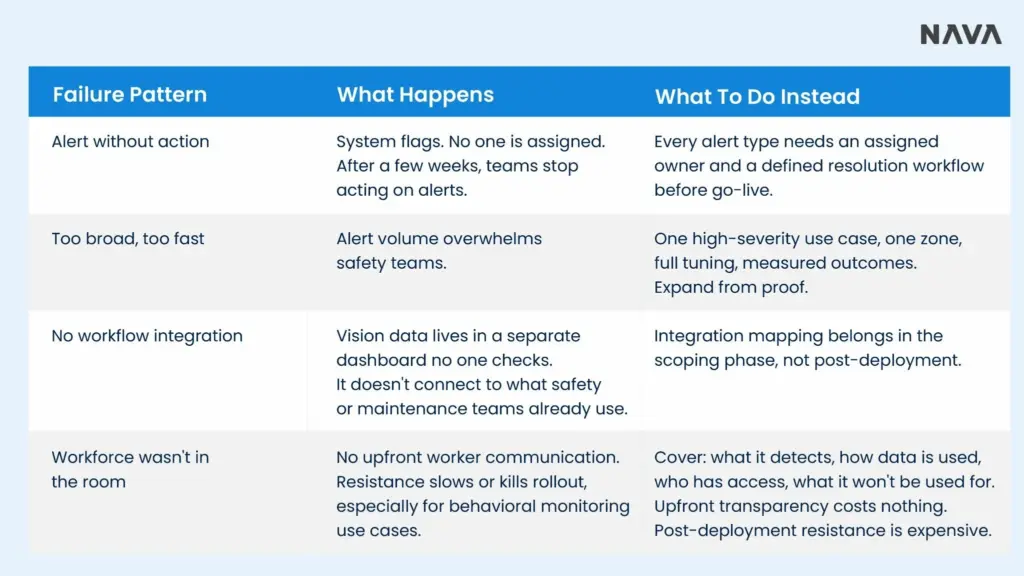
The use cases above produce results in real facilities. But deployments fail for reasons unrelated to the technology. These are the four patterns seen most often.
Computer vision in manufacturing is no longer about whether hazards can be detected. The real challenge is whether those detections lead to action.
PPE violations, near misses, restricted-zone events, ergonomic risks, and equipment issues only improve safety outcomes when they are routed into structured corrective action workflows.
Nava closes this gap by connecting real-time computer vision detections directly to assignment, resolution tracking, and reporting — turning alerts into measurable operational improvements.
Book a demo to see how Nava Vision AI Solutions deploys across manufacturing environments and supports phased implementation based on your facility’s highest-priority risks.