Blog
EHS Observation Software vs. Vision AI: What Actually Improves Safety Outcomes?
By NAVA Software· July 9, 2026· 8 min read
Summarize this post with

Loading insights...
LoadingSummarize this post with
Most safety platforms can detect hazards, but very few ensure those hazards actually get resolved. This blog compares traditional EHS observation software with Vision AI and explains why safety outcomes depend on closing the gap between detection and corrective action. Learn how Nava Vision AI combines real-time hazard detection with built-in workflows that track, assign, and verify resolutions in one connected platform.
A camera flags a worker without a hard hat. The alert fires. Nobody sees it until Tuesday. By then, three more shifts had run through the same zone.
This is not a detection problem. The camera worked. It is a workflow problem — and most safety platforms are not built to solve it.
EHS observation software and Vision AI are the two dominant tools safety teams are buying right now. Both generate findings. Neither alone guarantees those findings will get resolved.
This post maps where each category breaks down, what the research says about which inputs actually predict fewer incidents, and what a closed-loop safety platform has to do to move the needle.
EHS observation software is built around human-initiated reporting. A worker or supervisor observes a condition or behavior, logs it through a structured form, and the platform routes it into a corrective action workflow.
The model depends entirely on humans choosing to report. In most facilities, observation volume is low relative to actual hazard exposure. A 2023 National Safety Council report found that near miss reporting rates remain significantly below actual incident rates in most manufacturing environments, indicating substantial underreporting.
High observation counts without corresponding corrective action closure rates — sometimes called "checkbox safety" — are a known failure mode. The data accumulates. The hazards do not get fixed.
Vision AI platforms use computer vision models running on existing camera infrastructure, to detect hazards without human initiation. Detection happens continuously, at scale, across every covered zone simultaneously.
Most Vision AI safety platforms stop at the alert. They flag the event, generate a notification, and the workflow ends. There is no native corrective action module. No assignment. No closure tracking. No audit trail connecting detection to resolution.
Safety teams receiving these alerts typically do one of three things: manually transcribe them into a separate EHS system, forward them by email or Slack and hope someone follows up, or stop reviewing them entirely because there is no structured way to act on the volume.
Detection without resolution is documentation, not safety management.
Both categories share the same structural failure at different points in the workflow.
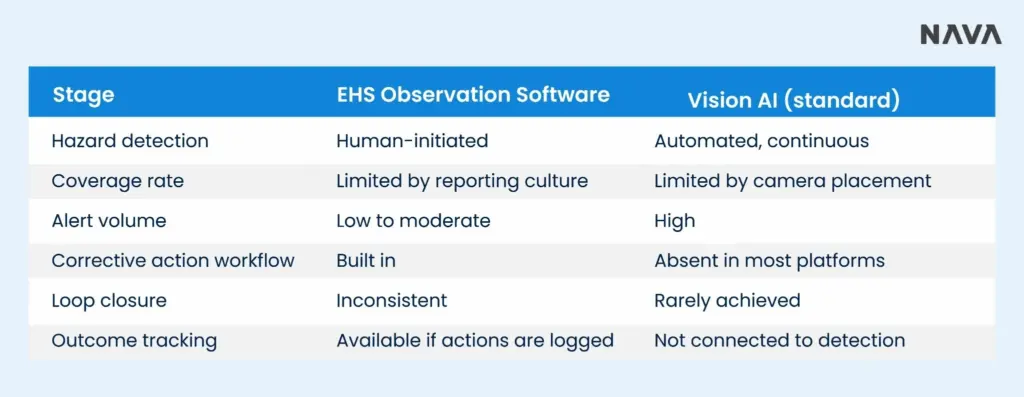
The observation-to-action gap is the primary reason structured safety programs stall. Data generation is not the bottleneck. Follow-through is.
OSHA's guidance on effective safety programs identifies hazard prevention and control including corrective action tracking as a core element of any program that actually reduces incidents. Detection is a prerequisite. It is not the outcome.
A closed-loop safety platform connects detection to resolution in a single traceable workflow. The five components that define a functional loop:
1. Detection : automated or human-initiated identification of a hazard or near miss
2. Capture : structured documentation of the finding, tied to location, time, and
category
3. Assignment : routing to a responsible owner with a defined deadline
4. Resolution : corrective action taken and documented
5. Learning : trend analysis that feeds back into program design
Most platforms handle one or two of these stages. EHS observation software covers stages 2 through 5 but depends on humans to initiate stage 1. Standard Vision AI platforms handle stage 1 but stop before stage 2.
But Nava Vision AI is built around the full cycle. Camera-detected hazards automatically generate structured near miss records that enter a corrective action workflow assigned, tracked, and closed within the same platform. No manual transcription. No parallel systems.
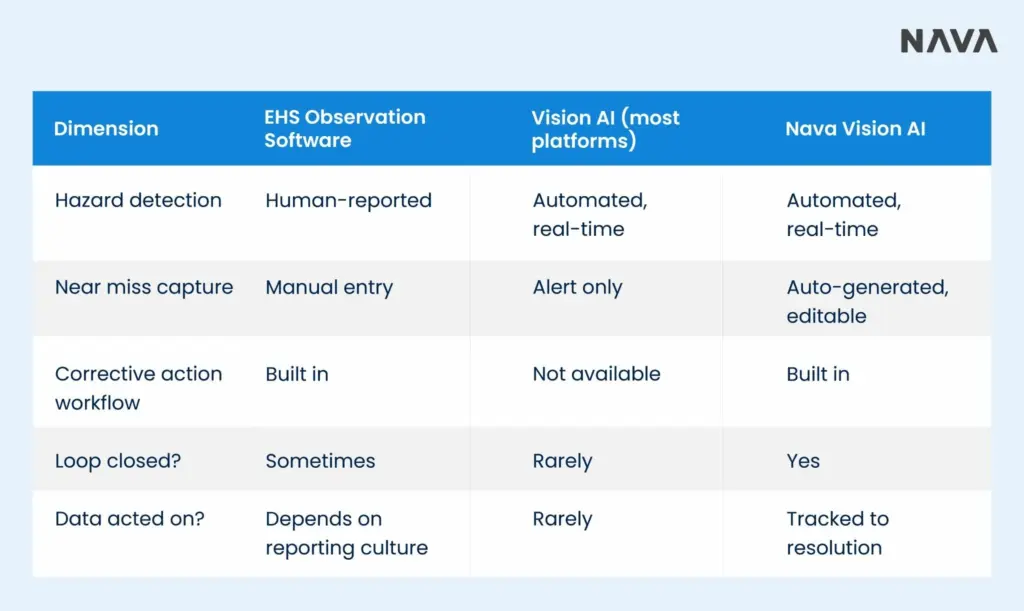
The distinction with Nava Vision AI is not detection capability, it is what happens after detection. It does not replace an existing observation program. It closes the gap that observation
programs leave open: the unresolved findings that camera alerts generate but most platforms cannot route to action.
The distinction between leading and lagging indicators matters here.
Lagging indicators: injury rates, lost time incidents, workers' compensation costs
measure failures after they occur. Leading indicators measure the activities that predict
those failures: hazard identification rates, near miss capture, corrective action closure rates,
and observation-to-action ratios.
The metric that most directly predicts outcomes is corrective action closure rate
specifically, the percentage of identified hazards that reach verified resolution within a
defined timeframe. Programs with structured corrective action workflows resolve hazards
significantly faster than those routing findings through informal channels.
Before selecting a platform, identify the stage where your current program loses
momentum.
Your program has an observation culture problem. Focus on near miss reporting training,
anonymous reporting channels, and leadership engagement before layering technology.
EHS observation software will help structure what gets reported.
Your program has a workflow problem. Vision AI is generating findings that have no
structured path to resolution. You need a platform that connects detection to corrective
action natively, not two systems bridged by email.
Your program has a closure problem. Observation volume is not the constraint. Resolution
rate is. A closed-loop platform with corrective action tracking and trend reporting is the fix.
Nava Vision AI is built specifically for the second and third scenarios: facilities where camera
coverage exists but the workflow between detection and resolution is broken or missing.
These questions reveal whether a platform closes the loop or stops at detection:
Nava provides direct answers to all four. Most standard Vision AI platforms address one.
The question is not whether EHS observation software or Vision AI produces better data with AI data security solutions.
Both can. The question is what happens to that data after it is generated.
EHS observation software gives you a workflow with no guaranteed detection. Vision AI
gives you detection with no guaranteed workflow. The gap between them is where hazards
go unresolved.
The metric that predicts outcomes is corrective action closure rate. Any platform you
evaluate should be measured against it.
See how Nava closes the loop from real-time hazard detection to resolved corrective
action: Book A Demo