Blog
Warehouse Safety Compliance in 2026: How Vision AI Replaces Manual Audits and Near-Miss Reporting
By NAVA Software· August 14, 2026· 7 min read
Summarize this post with

Loading insights...
LoadingSummarize this post with
NAVA Vision AI transforms warehouse safety from reactive audits to real-time protection using your existing CCTV infrastructure. This blog explores how the platform automatically detects PPE violations, forklift near-misses, unsafe behavior, and restricted zone breaches before they become costly incidents. Learn how warehouses can improve compliance, reduce safety risks, and stay audit-ready 24/7 without adding extra hardware or headcount.
A forklift passes within a meter of a worker. Nobody reports it. Three weeks later, that same scenario costs $42,000.
This is not a hypothetical. It is happening across warehouse floors right now, on shifts with no supervisor present, in blind spots your cameras capture but nobody reviews.
Manual audits cover 10% of active operations at best. In 2026, OSHA and insurers expect continuous, documented monitoring, not clipboards.
NAVA's Vision AI runs on your existing CCTV, logging every near-miss, PPE violation, and restricted zone breach automatically. No new hardware. No extra headcount.
Here is how it works.
Manual audits apply a sampling method to a continuous problem. A supervisor walking the floor twice per shift covers perhaps 10% of active operations. The other 90% is unmonitored.
The structural flaw runs deeper than time. Workers behave differently when they know an audit is happening. Violations that do get logged are documented hours after the event. And near-misses? Most never get reported at all.
| Manual Audit Problem | Business Impact |
| Infrequent inspections | Violations persist unresolved |
| Near-misses go unreported | Root causes never addressed |
| PPE checks are spot-checks | Inconsistent compliance across shifts |
| Post-hoc incident reports | Incomplete evidence for investigations |
Checklist-based workflows make this worse. A printed form completed once per shift is a compliance artifact. It is not a safety program. Vision AI changes the equation entirely.
Here is the uncomfortable reality of warehouse near-miss reporting: workers do not report them, and supervisors often do not encourage them to.
Why? Fear of blame. Paperwork burden. A culture that treats near-misses as close calls rather than early warnings. The result is that safety teams make decisions on incomplete data while the same hazards keep showing up.
What does a missed near-miss actually cost? Consider this chain of events:
Vision AI closes this gap by logging the event the moment it occurs. No worker report needed. No supervisor judgment call. A forklift within 2 meters of a pedestrian generates a timestamped log, a camera reference, and an incident classification automatically.
Safety teams can finally make decisions based on what is actually happening across every shift.
The technology works on the cameras already installed in your facility. No new infrastructure. No rip-and-replace. Here is the four-step process:
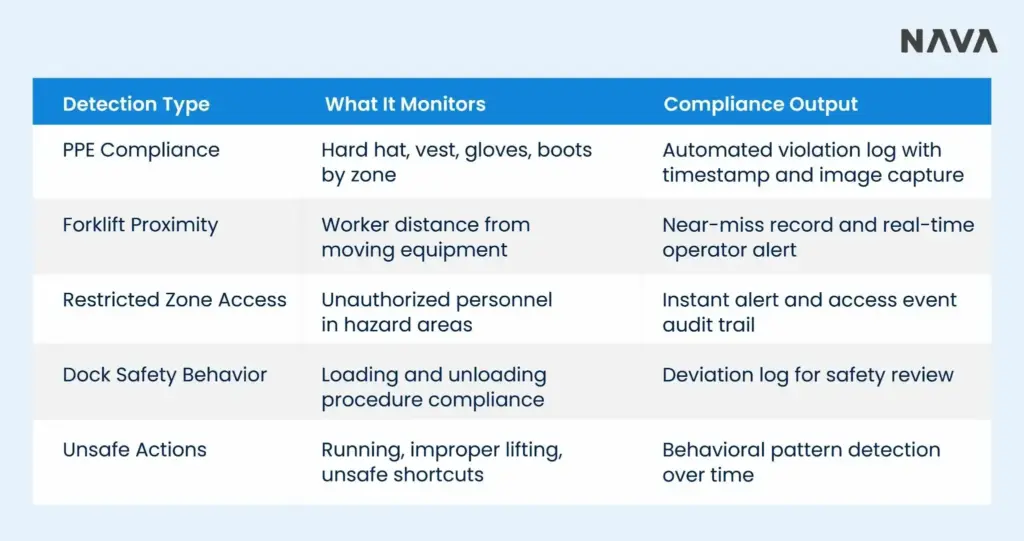
Most computer vision vendors cover one or two detection scenarios. A real forklift near-miss involves proximity, speed, zone mapping, and pedestrian behavior simultaneously. Monitoring one variable in isolation misses the full picture.
NAVA's Vision AI Solution suite runs on your existing CCTV without camera replacement:
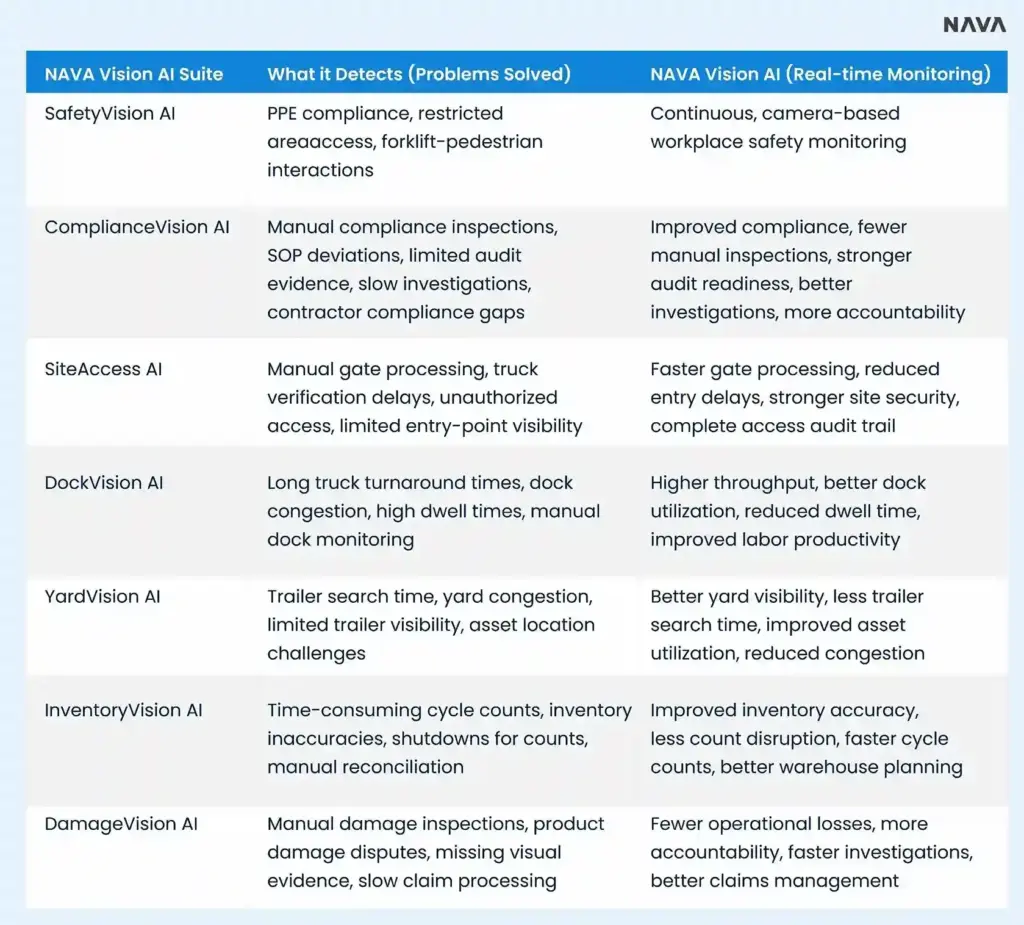
Onboarding follows a consistent four-step process across all Nava Vision AI Solutions: Connect existing CCTV, deploy on edge or cloud, automate alerts into existing operational systems, and track ROI against pre-deployment baselines.
Use this to assess whether your current program meets what regulators and insurers now expect. The gap between manual and Vision AI programs is not a feature comparison. It is an operational readiness gap.
| Compliance Area | Manual Program | Vision AI Program |
| PPE monitoring | Spot checks only | Continuous, zone-specific, logged |
| Near-miss capture | Worker self-report | Automated detection with timestamped log |
| Forklift safety | Periodic operator review | Real-time proximity alerts and near-miss record |
| Restricted zone control | Physical signage | AI-triggered alerts and access event audit trail |
| Audit readiness | Manual documentation | Auto-generated compliance reports |
| Incident root cause | Post-incident investigation | Pre-incident behavior pattern analysis |
Vision AI is a detection and documentation tool. It is not a complete safety program on its own. Best results come from pairing it with the right operational practices.
For the full regulatory framework, refer to the OSHA Warehouse Safety Guidelines and the NSC Workplace Safety Performance report.
The financial case for Vision AI is simple. One recordable incident costs an average of $42,000 in direct costs. Indirect costs, including productivity loss, investigation time, and insurance impact, typically run three to five times that figure.
Vision AI deployment costs less than a single recordable incident. What safety managers are tracking after deployment:
Qualified facilities can access a zero-cost proof of concept to establish pre-deployment baselines before committing to full rollout.
Manual audits had their place. In 2026, the warehouse safety compliance standard has shifted. Facilities using Vision AI are not just catching more violations. They are building a continuous safety record that holds up to regulatory scrutiny and reduces incident costs structurally.
NAVA Vision AI deploys on your existing CCTV infrastructure. No new hardware. No rip-and-replace. A zero-cost proof of concept is available for qualified facilities.
A Vision AI deployment costs less than that. Stop calculating risk on incomplete data. Talk to a NAVA specialist today and get a facility-specific ROI estimate within 48 hours.