Blog
2026 Guide to AI-powered Personal Protective Equipment Tracking & Compliance Detection
By Rakesh· June 10, 2026· 8 min read
Summarize this post with

Loading insights...
LoadingSummarize this post with
This guide explores how AI-powered Vision AI, specifically NAVA’s SafetyView AI, converts existing camera feeds into a 24/7 automated safety layer. By shifting from reactive incident reporting to real-time proactive detection, industrial leaders are eliminating "blind spots," reducing OSHA liability, and protecting their most valuable asset: their people.
Personal protective equipment (PPE) is the last line of defense between workers and workplace hazards. From helmets and gloves to respirators and safety footwear, personal protective equipment reduces exposure to risks that cannot be eliminated through engineering controls.
In most workplaces, personal protective equipment policies are clearly defined. Workers are trained, equipment is available, and compliance is expected.
Yet in reality, compliance with personal protective equipment is inconsistent.
Hard hats come off briefly. Gloves are skipped. High-visibility vests are removed in the heat.
These are not awareness issues; they are enforcement gaps.
Monitoring personal protective equipment in the workplace across every worker, zone, and shift is not scalable through manual supervision. As a result, safety teams rely on periodic checks and post-incident reviews, leaving critical blind spots.
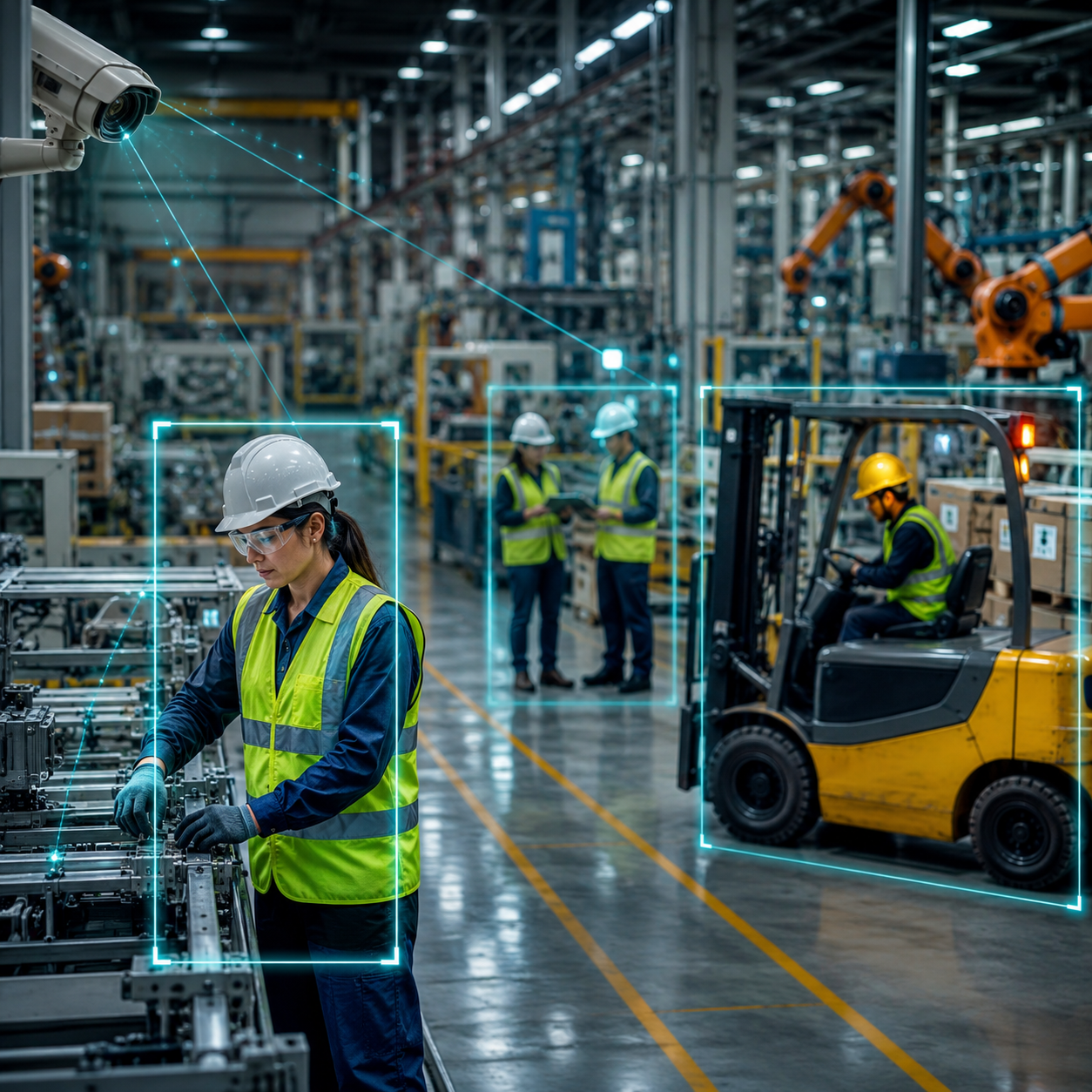
AI-powered personal protective equipment tracking changes this by enabling real-time, continuous compliance monitoring using existing camera infrastructure.
So, let us start!
To understand why computer vision is a step change rather than an incremental improvement, it helps to understand what the technology is actually doing at the model level, without the marketing fluff.
At a technical level, modern PPE detection systems combine multiple capabilities.
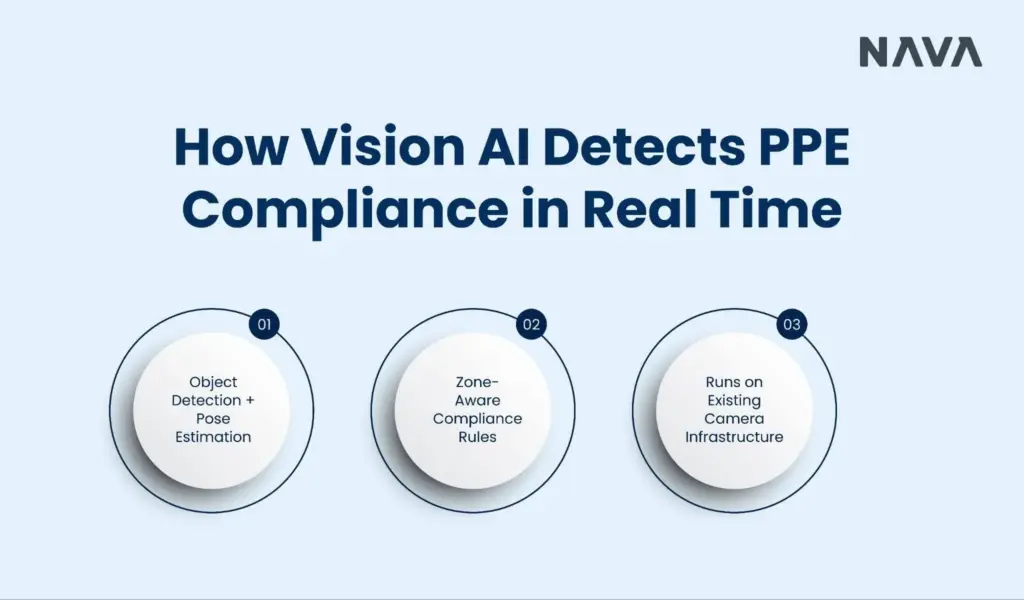
The system doesn’t just detect PPE—it understands how it is being used.
It identifies:
This ensures:
Not all areas require the same PPE.
Each camera feed is mapped to a specific zone with predefined rules:
When a worker enters a zone, the system validates compliance instantly.
If there’s a gap:
The key advantage: policy and detection are decoupled
Your safety team controls:
One of the biggest barriers to adoption has traditionally been hardware cost.
Modern systems like NAVA’s SafetyView AI are designed to work with:
This means:
You’re not installing new systems.
You’re activating intelligence on top of what already exists.
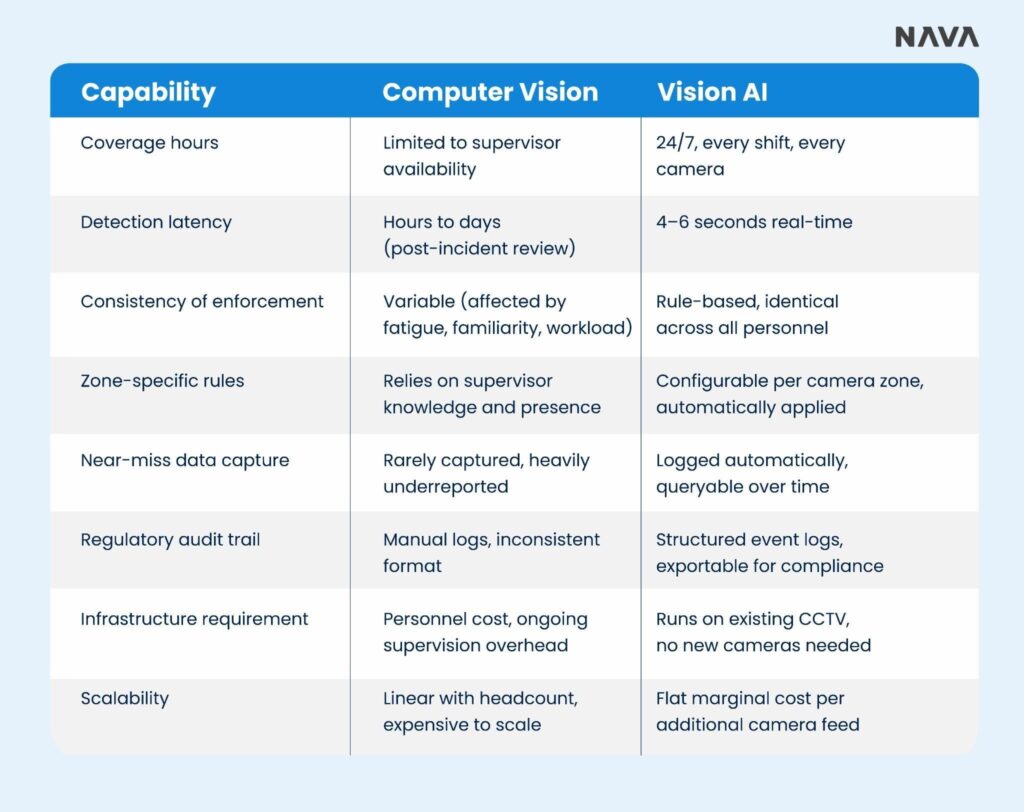
This section is worth being concrete about, because the gap between human observation and machine detection is wider than most safety managers expect until they run a pilot.
A single AI deployment can monitor every camera feed simultaneously. A facility with 60 cameras gets 60 simultaneous, unblinking observers. Each one processes every frame, every second, across every shift. No camera is "less watched" because it's in a corner of the facility that's inconvenient for a supervisor to reach.
Human observers are subject to alert fatigue, familiarity bias (overlooking routine violations from known workers), and the natural tendency to focus on more dynamic events. AI detection is rule-based in its enforcement: the ruleset is applied identically to the CEO walking the floor as to a contractor on their first day. Compliance is compliance.
This is arguably the highest-value capability that gets the least attention in vendor demos.
Near-miss events like the above are captured and logged even when no injury occurs. Over time, your near-miss dataset becomes a risk map of your facility. You can see which zones, which shifts, and which workflows consistently produce PPE gaps before a serious incident validates the pattern.
"The value of AI-powered safety monitoring isn't just in the alerts it fires. It's in the data it accumulates. The pattern recognition that tells you where your next incident is going to come from before it happens."
SafetyView AI NAVA is a computer vision platform built specifically for industrial workplace safety.
It is not a general-purpose vision system adapted for safety. It was purpose-built for the use cases that matter in manufacturing, logistics, and warehousing environments.
Identifies the presence and correct positioning of hard hats, distinguishing a properly worn hat from one carried or placed nearby.
Validates high-visibility vests in active use across all lighting conditions, including high-contrast and low-light environments.
Detects glove presence on both hands, with zone-specific triggering for chemical handling, machinery, and sharp-edge work areas.
Validates PPE footwear compliance at entry points and zone transitions, reducing exposure in high-risk floor areas.
Monitors respiratory PPE compliance in chemical, pharmaceutical, and food manufacturing environments.
Eye protection monitoring for machining, welding, and lab environments where small-particle and chemical splash risks exist.
Detects and alerts when pedestrians enter active forklift operating zones, which are among the leading causes of serious workplace injury.
Monitors entry to machinery exclusion zones, high-voltage areas, and other access-controlled spaces without requiring physical barriers.
Detects environmental hazard indicators (spills, obstructions, open floor hatches) that create slip-and-fall exposure.
Flags unsafe manual handling postures (overreaching, poor lift mechanics) that contribute to musculoskeletal injury over time.
While avoiding OSHA fines is a clear win, the strategic impact of vision AI goes deeper:
Before beginning an evaluation of any AI-powered PPE monitoring solution, it's worth pressure-testing your existing environment against these points:
Safety culture matters. Training matters. Leadership commitment matters. But treating PPE compliance as purely a behavioral or cultural challenge ignores the system's reality: humans cannot monitor every person in every zone across every shift with the consistency that a serious safety program requires.
AI-powered PPE detection doesn't replace safety culture. It gives that culture an enforcement infrastructure that actually scales, one that operates continuously, generates auditable records, surfaces risk patterns before they become incidents, and does all of this on the camera infrastructure you already own.
The question isn't whether your facility can afford to evaluate this technology. It's whether your current approach, whatever it is, is actually catching violations in real time, every shift, in every zone.
If the honest answer is no, that gap has a cost. It's just that you haven't been able to see it clearly until now.
Ready to see how SafetyView AI works in your environment? [Schedule a Zero-Cost Snapshot PoC Today]


