
Blog
Types of Computer Vision AI Companies and Where NAVA Vision AI Fits in
By Rakesh· July 27, 2026· 12 min read
Summarize this post with

Loading insights...
LoadingSummarize this post with
Everyone sells "AI computer vision." Almost nobody delivers operational outcomes. There are five types of companies in this market, and four of them will hand you a dashboard and call it done. This piece breaks down who actually does what, where most buyers go wrong, and why the category you choose matters more than any feature list.
Computer vision is not a product. It is a capability.
At its core, it is the ability for machines to interpret visual input in camera feeds, images, and video frames and extract structured meaning from them.
Whether that means reading a license plate, detecting a forklift approaching a worker, or flagging a damaged trailer, the underlying mechanism is the same: a trained model processes pixel data and returns a decision.
What makes this market confusing is that "AI computer vision solutions" means completely different things depending on who is selling them.
A chip manufacturer calls it computer vision. A warehouse automation startup calls it computer vision. A deep learning research lab calls it computer vision. They are not solving the same problem.
So before you evaluate any vendor, you need to understand the category they actually sit in.
Not all computer vision AI companies operate the same way or solve the same problem. The market is layered. Each category handles a different part of the value chain, and buying from the wrong one is expensive.
Here is how the five categories break down, what each one delivers, and where each one stops.
The infrastructure layer. They build the physical kit.
Who they are
These companies design and manufacture smart cameras, edge compute devices, industrial sensors, and vision-enabled endpoints. Their primary product is the device itself. Some bundle basic detection firmware on top, but the hardware is always the core business. You buy from them when you need the physical infrastructure to exist at all.
Examples: Axis Communications, Bosch Security Systems, Hikvision, Hanwha Vision
| What they sell High-resolution cameras with onboard processing, thermal imaging systems, edge AI chips, and basic object detection firmware bundled with hardware. | What they don't sell Operational workflows, domain-specific AI models, API integration with your WMS, TMS, or YMS, outcome tracking, or anything that happens after the camera is installed. |
Key insight: Vendor lock-in is the core risk. Once you deploy proprietary smart cameras at scale, your AI model options narrow significantly. The camera vendor controls what runs on their hardware, which limits your ability to swap models or platforms later without replacing infrastructure.
The intelligence layer. They build the models, not the solutions.
Who they are
These companies develop the core AI architectures that power everything downstream. Think large vision-language models, image segmentation frameworks, zero-shot object detection, and open-source model releases that other companies fine-tune and deploy. Their work is foundational, and without it, none of the other categories would function.
Examples: OpenAI (CLIP), Meta AI (SAM, Segment Anything, DINOv2), Google DeepMind, Hugging Face (model repository and frameworks)
| What they sell Pre-trained vision models, APIs for image classification and segmentation, research toolkits, fine-tuning frameworks, and open-source model weights. | What they don't sell Deployment on your physical site, integration with your operational systems, accountability for outcomes, domain calibration for industrial environments, or support for operations teams. |
Key insight: This category is building the raw intelligence that others commercialize. The gap between a foundation model and a working deployment at a logistics site is significant. A model that can identify any object with 90% accuracy in a controlled benchmark can perform very differently in a dusty warehouse at 3 am with forklift exhaust in the air.
The API layer. They make vision capabilities accessible to developers.
Who they are
These are the companies building the developer infrastructure layer that others build products on top of. Cloud vision APIs, MLOps pipelines, model training environments, labeling tools, inference hosting, and monitoring platforms.
They make it possible for engineering teams to build computer vision applications without training models from scratch. They are the scaffolding, not the building.
Examples: AWS Rekognition, Google Cloud Vision API, Microsoft Azure Computer Vision, Roboflow (data and training infrastructure), Scale AI (data labeling)
| What they sell Scalable cloud inference APIs, model training pipelines, automated labeling tools, real-time inference hosting, pre-built detection endpoints for faces, objects, text, and scenes. | What they don't sell Pre-built operational use cases for logistics, manufacturing, or industrial environments. A generic API does not know what a dock door is, what a pallet jack looks like in motion, or why a worker standing near a conveyor belt matters. |
Key insight: AWS Rekognition can tell you there is a person in a frame. It cannot tell you that a person is standing in a restricted forklift zone at dock 7 with no PPE, and that the dock door behind them opened 40 seconds ago with a trailer still reversing.
The product layer. They build platforms for specific industries.
Who they are
These companies build complete software products for a specific industry, with computer vision as one capability layer among many. They wrap the AI into a polished product experience with dashboards, reports, user management, and integrations.
The vision component serves the product, not the other way around. They are the most accessible entry point for non-technical buyers because the product experience handles the complexity.
Examples: Samsara (fleet and logistics), Veritone (media and entertainment AI), Placer.ai (retail foot traffic analytics), Evolv Technology (security screening)
| What they sell A packaged SaaS subscription, ready-made dashboards, mobile apps, compliance reports, and integrations with popular fleet or retail management platforms. | What they don't sell Deep customization for your specific facility layout, edge deployment on your existing cameras, integration with legacy operational systems built ten years ago, or use cases outside their product template. |
Key insight: Vertical SaaS works well when your operations match their model. They break down the moment your use case sits outside the template they built for.
The outcomes layer. They deploy AI into live operations and measure results.
Who they are
This is the smallest category and the one closest to actual operations. Operational AI integrators deploy AI computer vision development services directly into industrial environments.
They work with your existing camera infrastructure, build or fine-tune models for your specific operational events, integrate outputs into your live systems, and hold themselves accountable to operational metrics rather than just detection accuracy.
The output is not a dashboard or an API. It is a decision your operating system makes automatically.
Examples: NAVA Software Solutions, specialist AI deployment firms working in logistics, manufacturing, energy, and warehousing
| What they sell Deployed AI outcomes: reduced gate dwell time, automated vehicle identification, real-time safety alerts, dock throughput analytics, and damage records with visual audit trails. | What they don't sell Generic platform APIs, off-the-shelf SaaS subscriptions, or research model access. This category is not selling software. It is deploying operational intelligence. |
Key insight: This is the only category where the question 'what is my ROI and when will I see it' gets a real answer. The model runs on your site, against your operational events, connected to your systems. If gate throughput does not improve in 60 days, that is a measurable failure, not a product roadmap issue.
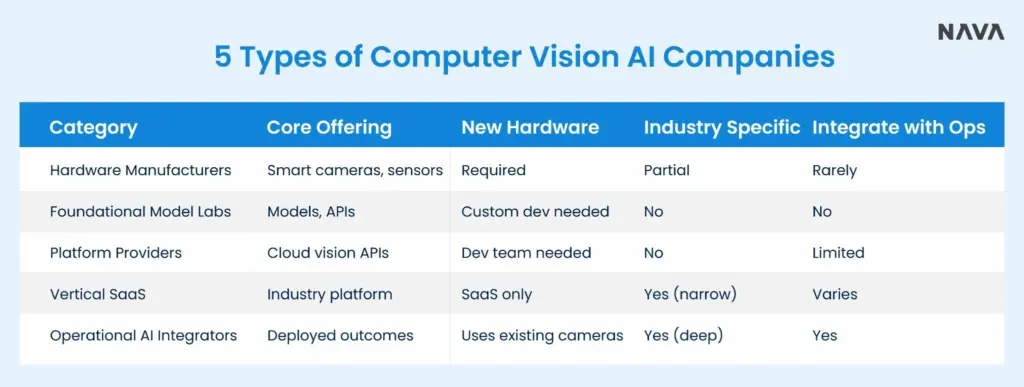
Here is what I see happen repeatedly in procurement conversations.
A logistics company issues an RFP for AI computer vision development company services. Three vendors respond. One is a hardware reseller bundling a smart camera with basic OCR. One is a SaaS platform built for retail foot traffic. One is an operational integrator who has deployed in similar facilities.
The buyer scores all three against the same rubric because the category distinction was never made.
The result?
A contract signed with a vendor whose product requires $400,000 in new camera infrastructure, delivers license plate reads with 82% accuracy in poor lighting, and has no API for their existing YMS.
The category you buy from matters more than the feature list.
The companies in this category share characteristics that separate them from everyone else.
This is what AI and computer vision solutions should look like in an industrial context. Not a demo. Not a capability. A running system producing data that your operations team can act on the same day it goes live.
NAVA Vision AI sits in the operational AI integrator category. That classification matters because it defines what they actually deliver versus what most AI computer vision companies promise.
The operational model is straightforward: connect existing CCTV infrastructure, deploy edge and cloud models calibrated to the specific facility, route alerts and analytics into WMS/TMS/YMS systems already in use, and track ROI against defined operational metrics.
The solution suite covers six distinct operational problems:
The AWS-native architecture removes procurement friction. All solutions are available on AWS Marketplace, which allows deployment within existing cloud agreements.
The Agentic Intelligence layer, built on AWS Bedrock, moves beyond alerting into autonomous decision-making: slot allocation, yard positioning, and compliance logging, without requiring manual operator input.
None of this requires a camera upgrade. That single constraint removal is what separates NAVA from hardware-dependent vendors and why the category distinction matters so much when evaluating AI computer vision development services.
Computer vision is not a differentiator. Knowing which layer of the market you are buying from is.
Every category covered here does something real. Hardware manufacturers build the infrastructure. Research labs build intelligence. Platform providers make it accessible. Vertical SaaS makes it usable. But none of them are accountable to your gate throughput numbers at the end of Q3.
That accountability gap is exactly where operational AI integrators exist.
If your objective is a working system, one that reads plates in rain, flags a PPE violation before a shift supervisor has to, and routes a damage record directly into a claim dispute before a driver leaves the yard, then the procurement question is not "which AI vendor has the best demo." It is "which vendor category is even capable of delivering that outcome?"
NAVA sits at the outcomes layer because that is where the problem actually lives. Not in the model. Not in the API. In the dock, at the gate, on the floor.
NAVA offers a zero-cost POC. If your facility runs CCTV and you have an operational problem you are currently solving manually, that is the starting point. Contact Now