Blog
Best PPE Detection Software in 2027: Features, Accuracy & How to Choose
By NAVA Software· October 14, 2026· 14 min read
Summarize this post with

Loading insights...
LoadingSummarize this post with
A supervisor walks the line at 7 a.m., and every worker wears a hard hat. By 10 a.m., two operators at the press brake have pushed their safety glasses up to read a work order, and a forklift driver has left his vest in the cab. No one sees any of it.
That gap between inspections is where PPE detection software earns its place. It watches the camera feeds you already run and flags missing protective equipment while the shift is still in progress.
This guide explains how AI PPE detection works and compares six platforms buyers shortlist in 2027. It also gives you a test plan to check accuracy on your own floor before you sign anything.
The table summarizes what each vendor documents in its own public materials. It does not mean the capability works equally well across vendors, which is why the proof-of-concept section later in this guide matters.
| Software | Best For | PPE / Safety Focus | Deployment |
| NAVA Vision AI | Manufacturing & industrial sites | PPE + broader safety monitoring | Existing CCTV; cloud/edge |
| Voxel AI | Workplace & site intelligence | PPE + unsafe behavior + corrective actions | Existing CCTV |
| Intenseye | Enterprise EHS | PPE + unsafe acts and conditions | Existing CCTV; cloud/hybrid / on-prem |
| Protex AI | Behavioral safety + PPE | PPE + behavior + near misses | Existing cameras; edge |
| viAct | Broad industrial computer vision | PPE + safety modules | Existing cameras; cloud / on-prem / hybrid |
| Visionify | Manufacturing PPE monitoring | PPE + safety scenarios | Existing IP/CCTV; edge |
NAVA Vision AI builds computer vision software for industrial operations, and applies it to real plant problems such as PPE detection and workplace safety monitoring through SafetyVision AI.
Teams can start with PPE compliance on the cameras they already have, then expand into wider safety monitoring without adding new hardware.
SafetyVision AI detects missing helmets, vests, gloves, and boots in real time, and each event gives safety teams visual proof they can review, coach from, and track over time.
The same camera network can also support unsafe behavior detection, restricted-area monitoring, near-miss visibility, and incident investigation.
Sites with limited connectivity can run detection at the edge instead of sending every video stream to the cloud, which matters on plant floors where cloud streaming is too slow or not permitted.
| Capability | What it means on the floor |
| Detecting required PPE | Real-time detection of helmets, vests, gloves, and boots, per NAVA's AWS listing |
| Identifying PPE violations | Rules are built from your own safety policies, PPE requirements, and hazard maps, so a violation reflects your standards, not a generic template |
| Monitoring defined areas continuously | Each camera watches its assigned zone on every shift, including nights and weekends when supervision is thin |
| Capturing evidence of safety events | Detected events give safety teams visual proof for coaching, audits, and investigations |
| Supporting real-time safety monitoring | Teams learn about a missing hard hat during the shift, not in next week's audit |
NAVA’s AWS Marketplace listing names helmets, vests, gloves, and boots. If you also need safety glasses or harnesses, ask NAVA Vision AI to test them on your cameras during the proof of concept
Most plants start with PPE because the rule is clear and the business case is easy to explain. The bigger return comes when the same cameras and models cover more of your workplace safety risk picture.
| Use case | What the system watches for | Who acts on it |
| PPE compliance | Missing helmets, vests, gloves, boots in required zones | Shift supervisors, EHS |
| Unsafe behavior | Climbing, running, phone use, and no-PPE behavior, per NAVA's listing | Supervisors, safety coaches |
| Restricted-area violations | People entering monitored hazard or exclusion zones | EHS, operations |
| Worker safety | Near-miss behavior around equipment and vehicles | EHS leadership |
| Operational visibility | Dock, yard, and inventory activity through NAVA's DockVision AI, YardVision AI, and InventoryVision AI | Operations, logistics |
| Incident investigation | Recorded events that show what happened before an incident | EHS, HR, legal |
Do you need a new camera system to start AI-based PPE monitoring?
In most plants, no. NAVA Vision AI deploys on existing CCTV, IP, and RTSP cameras. That makes the first phase a software and configuration project rather than a capital purchase.
Existing cameras still need a quick audit. Check these four points before the first deployment:
Start with one production area that has a known PPE problem and clear rules. NAVA Vision AI lists SafetyVision AI on AWS Marketplace with a zero-cost proof-of-concept option, so you can check results before committing a budget.
Voxel positions itself as a broad site intelligence platform that spans workplace safety and wider operational risk. Its coverage ranges from ergonomic risk and vehicle and equipment hazards to spills, obstructions, and blocked exits. Its pitch centers on speed of deployment and site-specific accuracy, though those accuracy figures are vendor-stated and worth verifying on your own cameras.
| Area | What Voxel documents |
| Safety monitoring | Detection of required PPE and other workplace safety conditions |
| Existing cameras | Works with existing CCTV camera networks |
| Real-time monitoring | Violations surface to site teams as they occur |
| Accuracy claim | Models fine-tuned to each site (vendor-stated) |
| Broader site intelligence | Ergonomic risk, vehicle and equipment hazards, spills, obstructions, and blocked exits |
| Analytics and action | Dashboards, multi-site trends, daily summaries, and corrective actions that can be assigned and tracked |
Best fit: Multi-site organizations that want PPE detection as one input into a wider risk and corrective-action program.
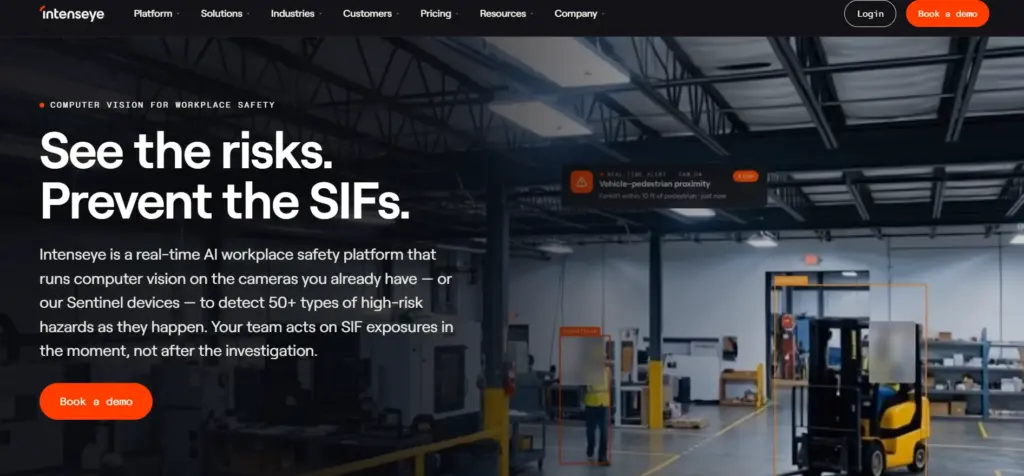
Intenseye is an EHS platform built around computer vision. Its Core AI module detects a range of unsafe acts and conditions, including PPE compliance.
| Area | What Intenseye documents |
| PPE detection | Hard hats, reflective vests, eye protection, gloves, hearing muffs, masks and respiratory equipment, aprons, and sleeves |
| Configurability | Parameters such as color, fit, and task-specific requirements |
| Unsafe acts and conditions | Housekeeping, area controls, vehicle controls, behavioral safety, and hygiene categories |
| EHS analytics | Reporting and workflow suite, compliance checklists, Safety Score, and a Leading Indicators module |
| Deployment | Connects to existing CCTV; cloud, private cloud, or hybrid on-premises options |
| On-site alerts | Integrations with smart plugs and network speakers for audio or visual alerts |
Best fit: Enterprises with a mature EHS function that want one platform for detection, leading indicators, and workflow.
Protex AI is a workplace safety platform that works with existing CCTV. Its focus is on behavior and near-miss monitoring, alongside PPE compliance.
| Area | What Protex AI documents |
| Behavioral safety | Configurable rule engine for unsafe behaviors unique to each facility |
| Near-miss detection | Vehicle and pedestrian near misses, proximity to dangerous machinery, speed limits |
| Cameras and processing | Works with most modern camera systems with no minimum camera requirement; edge processing keeps video on-site |
| Safety insights | Real-time dashboards and a generative AI layer, Protex Intelligence, for safety analysis |
| Reported outcome | Reported outcome | Case studies on safety performance improvements (vendor-reported) |
Best fit: Teams that see PPE as one symptom of a behavioral safety problem and want near-miss data alongside it.
viAct describes its approach as scenario-based video intelligence, using pre-built AI modules that run on existing cameras. The company started in construction and also serves industrial sites.
| Area | What viAct documents |
| AI video analytics | Pre-built modules covering PPE, unsafe behavior, ergonomic risk, environmental hazards, and near misses |
| PPE detection | PPE monitoring module that runs on existing cameras |
| Industrial use cases | Danger zones, fall risks, forklift proximity, fire and smoke, housekeeping |
| Multiple modules | Several modules can run on the same camera network without adding cameras |
| Deployment options | Edge devices, IoT wearables, drones, and the viHUB dashboard |
Best fit: Organizations with mixed sites, including construction or remote locations, that want one vendor for many computer vision scenarios.
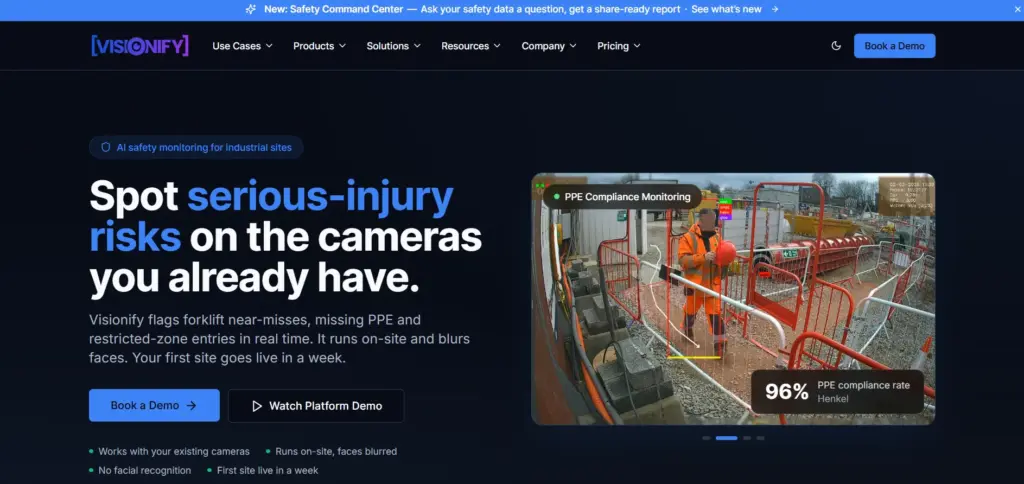
Visionify offers VisionAI, a safety platform that connects to existing CCTV in manufacturing, warehousing, and logistics. Its coverage includes PPE compliance alongside other workplace safety scenarios.
| Area | What Visionify documents |
| PPE detection | PPE compliance monitoring for workplace safety |
| Manufacturing focus | Used in manufacturing environments |
| Existing cameras | Compatible with existing CCTV systems |
| Compliance | Audit-ready compliance reports |
| Other safety detection | Forklift and pedestrian conflicts, restricted zones, slips and falls, spills, smoke, and fire |
| Analytics | Violation trends, high-risk zones, and benchmarking across shifts and sites |
Best fit: Manufacturers that want a PPE-first deployment with a fast start and room to add adjacent safety scenarios.
Feature lists across these vendors overlap heavily. The decision usually comes down to three things:
Test Accuracy in Your Actual Environment
Don't rely on vendor demos. Demo footage is clean, well lit, and shot from ideal angles, and your plant is none of those things.
| Condition | Why it affects detection | How to test it |
| Lighting | Glare, shadows, and night shifts reduce contrast | Review events from day and night shifts separately |
| Worker movement | Motion blur hides small items | Include high-traffic aisles and moving workers |
| PPE colors and designs | Models trained on yellow hard hats may miss white or blue ones | Use every PPE variant your workers wear |
| Occlusion | Machines, racks, and coworkers block the view | Test at crowded stations and behind equipment |
| Camera angles | Overhead views hide faces and glasses | Test each mounting height you plan to use |
| Crowded production areas | Overlapping workers confuse person tracking | Test during shift change |
| Distance from camera | Small items vanish at range | Measure accuracy at near, mid, and far distances |
Measure two numbers:
| Ask the vendor | Why it matters |
| How quickly are violations detected? | A five-minute delay means the worker has moved on before anyone responds |
| Can alerts be configured? | Different zones and roles need different alert channels and thresholds |
| Is visual evidence captured? | Clips make coaching factual and support audits |
| Can events be searched later? | Investigations need fast retrieval by zone, time, and PPE type |
| Can recurring violations be identified? | Patterns by zone or shift point to root causes, such as PPE stored far from the line |
| Factor | Options | What to ask |
| Cameras | Existing vs new | Which of our current cameras are usable as installed? |
| Processing | Edge vs cloud vs hybrid | Where does video go, and how long is it stored? |
| Network | Local vs WAN bandwidth | What bandwidth does each stream need? |
| Installation time | Hours to weeks | What does a realistic first-site timeline look like? |
| Scalability | Per camera, per site | How do pricing and support change at 10x cameras? |
| Integration | EHS software, alerting, BI tools | Which systems connect out of the box? |
A focused proof of concept answers the only question that matters: does this system work on your floor, with your people and your cameras?
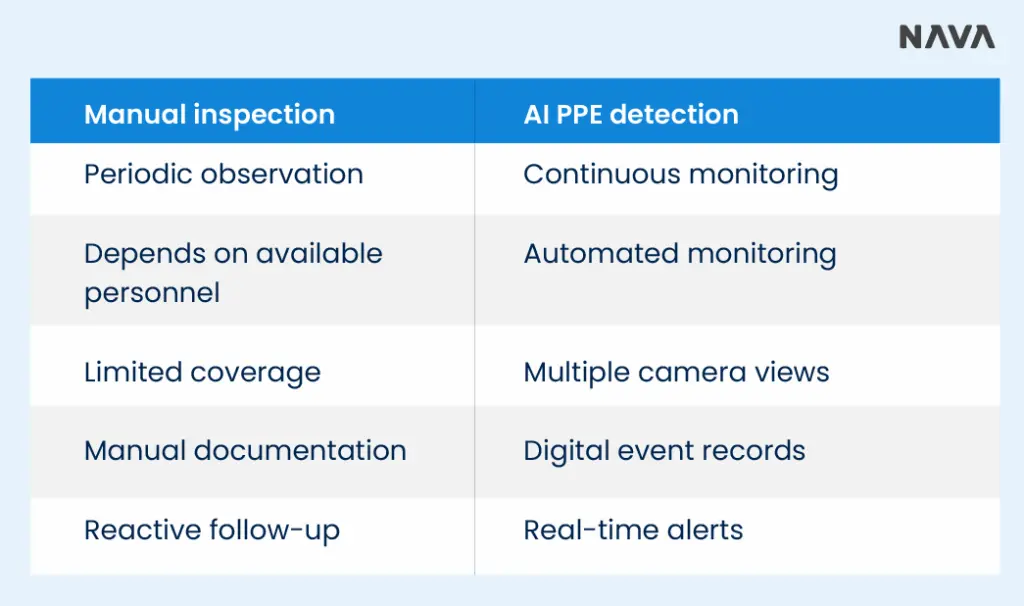
AI doesn't replace safety teams. It gives them consistent visibility across areas they can't watch all the time. Their hours then go into coaching and fixing root causes instead of walking the floor looking for problems.
No single platform wins for every plant. Match the vendor to your priority:
| Your priority | Consider |
| Manufacturing PPE monitoring | NAVA Vision AI / Visionify |
| Broader workplace intelligence | Voxel AI |
| Enterprise EHS monitoring | Intenseye |
| Behavioral safety | Protex AI |
| Broad industrial computer vision | viAct |
Best for: Manufacturing and industrial teams that want to move from periodic PPE checks to continuous, camera-based safety monitoring.
Every vendor in this guide can detect a missing hard hat in a demo. The differences show up in your plant: at the far end of an aisle, on the night shift, with a white helmet instead of a yellow one.
Define your PPE rules first. Then shortlist two or three platforms that fit your deployment constraints, and run each through the same proof of concept. Pick the system that catches the most real violations with the fewest false alerts and gives your team a clear way to act on them.
If manufacturing PPE compliance is your starting point and you want to use the cameras already on your floor, NAVA Vision AI is a practical place to begin that test. Contact our team to book a call and run a proof of concept with the cameras you already have.