Blog
Vision AI Solutions: 5 Real-World Deployments & ROI
By NAVA Software· June 29, 2026· 7 min read
Summarize this post with

Loading insights...
LoadingSummarize this post with
Vision AI solutions transform passive industrial camera feeds into active intelligence engines. By deploying deep learning models on existing infrastructure, organizations are moving from reactive incident review to real-time operational response.
A Vision AI solution transforms standard camera systems into real-time intelligence platforms that can detect, interpret, and act on events as they happen. Instead of passively recording footage, these systems use AI machine vision to convert video into actionable insights across safety, operations, and asset movement.
In industrial environments, traditional monitoring depends on human oversight, which is limited by fatigue, blind spots, and delayed response. As operations scale, this approach fails to provide consistent, real-time visibility into what’s actually happening on the floor.
This is where vision AI systems create measurable impact.
Rather than focusing on theoretical capabilities, this blog highlights five real-world deployments where vision AI solutions have already delivered tangible outcomes—from improved safety compliance to faster throughput and reduced operational losses.
The deployments described here run on existing CCTV camera networks. No new hardware is installed. That detail matters for ROI calculations and for understanding why the economics of vision AI have shifted so significantly in the last three years.
The Challenge
Manual safety audits are periodic and limited. On a massive manufacturing floor, ensuring every worker wears a helmet or stays out of restricted "red zones" 24/7 is impossible for human supervisors.
The Deployment
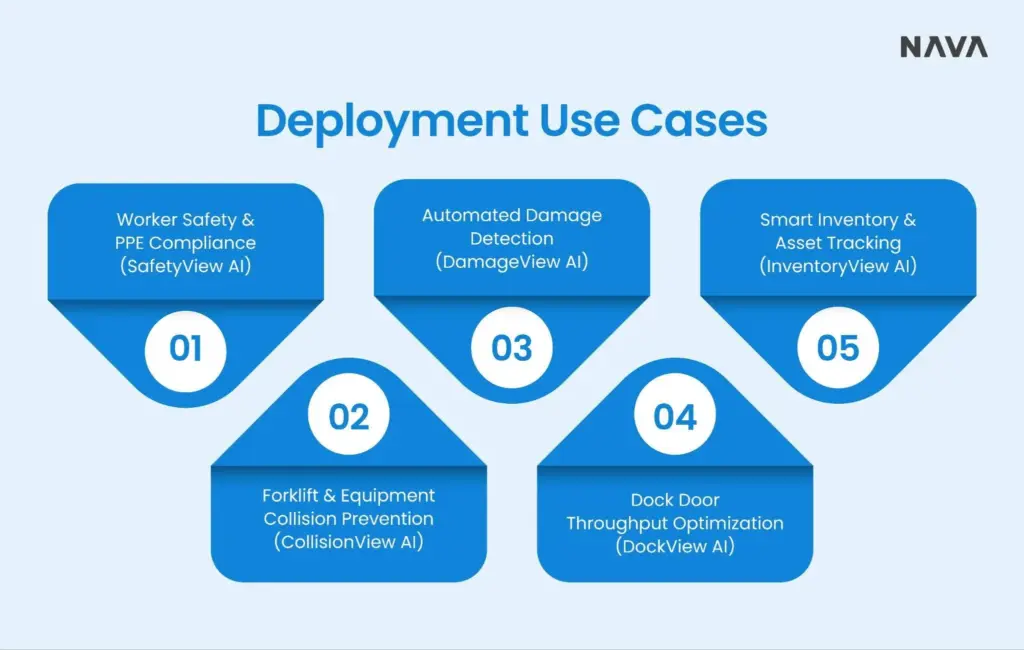
SafetyView AI continuously monitors the floor for PPE adherence (helmets, vests, gloves) and detects unauthorized access to hazardous zones or proximity to heavy machinery.
Measurable Outcome
Real-time WhatsApp or SMS alerts sent to managers with incident screenshots, enabling instant intervention before an accident occurs.
The Challenge
Forklift accidents are among the costliest safety violations in logistics. Traditional proximity sensors often trigger "alarm fatigue" by beeping at everything.
The Deployment
CollisionView AI uses predictive path analysis to distinguish between a worker safely walking nearby and a high-risk collision course. It monitors blind spots and high-traffic intersections using existing IP cameras.
Measurable Outcome
The Challenge
Disputing freight damage claims is a manual, paperwork-heavy process. Identifying where damage occurred—at the gate, in the yard, or during transit—is often impossible without visual proof.
The Deployment
DamageView AI establishes an automated audit trail. As trailers or containers pass through entry/exit points, the AI scans for structural dents, scratches, or compromised seals, creating an indisputable visual record.
Measurable Outcome
The Challenge:
Warehouse managers often struggle with "dead time" at the dock—trailers sitting idle, slow loading cycles, or congestion that ripples through the supply chain.
The Deployment:
By deploying DockView AI, facilities automate the monitoring of trailer positioning and pallet movement. The AI identifies exactly when a trailer arrives, when loading starts, and if a dock remains inactive despite being scheduled.
Measurable Outcome:
The Challenge
Misplaced pallets and "ghost inventory" lead to shipment delays and lost revenue. Physical cycle counts are labor-intensive and stop operations.
The Deployment
InventoryView AI tracks the movement of cartons and pallets in real-time. It monitors staging areas and identifies misplaced items or slow-moving SKUs without requiring manual scanning.
Measurable Outcome
Most industrial operations rely on traditional monitoring methods that were not designed for real-time decision-making. Vision AI solutions change this by introducing continuous, automated intelligence.
| Capability | Traditional Systems | Vision AI Solutions |
| Monitoring Approach | Manual, human-dependent | Automated, AI-driven |
| Response Type | Reactive (after incidents) | Real-time (during events) |
| Data Availability | Limited or unstructured | Continuous, structured event data |
| Visibility | Partial (blind spots common) | Full coverage across zones |
| Scalability | Limited by the workforce | Scales across all camera feeds |
| Decision Support | Based on reports | Based on live insights |
Unlike point solutions that address isolated problems, NAVA Vision AI serves as a unified intelligence layer spanning safety, logistics, and operational workflows.
Most vision AI systems focus on a single use case: PPE detection, forklift safety, or surveillance analytics. NAVA takes a different approach. It integrates multiple AI capabilities into a single platform, giving operations teams a complete, real-time view of what’s happening across the facility.
1. Multi-Use Case Platform (Not a Single Tool)
From worker safety and forklift monitoring to dock operations and inventory tracking, NAVA consolidates multiple functions into one system. This eliminates the need for separate tools and fragmented data.
2. Works on Existing Infrastructure
NAVA Vision AI runs on your current CCTV/IP camera setup. There’s no need for new hardware, sensors, or large-scale installation projects, reducing both cost and deployment time.
3. Real-Time + Historical Intelligence
The platform doesn’t just detect events. It builds a structured data layer that helps teams:
4. Faster Time to Value
Because deployment is lightweight, organizations can start seeing the following:
5. Built for Operations, Not Just Monitoring
NAVA goes beyond visibility. It connects insights to action—helping teams improve throughput, reduce delays, and enhance safety simultaneously.
Refer to our case studies for more information.

The transition from traditional surveillance to Vision AI solutions marks a pivotal shift in how industrial operations are managed. It is no longer enough to have a recording of what went wrong; the goal is to have a system that prevents the error from occurring in the first place.
By deploying NAVA’s Vision AI suite, enterprises are effectively bridging the gap between physical actions and digital data. Whether it is reducing the high cost of equipment collisions, streamlining dock door cycles, or ensuring every worker returns home safely, the measurable outcomes are clear: higher safety, lower waste, and optimized throughput.
The technology is no longer a "future" prospect. It is a current competitive advantage. Organizations that leverage their existing camera infrastructure to build a proactive, AI-driven environment will not only protect their bottom line but also set the standard for operational excellence in the digital age.
Is your facility ready to eliminate its blind spots and improve operational visibility?
Explore the full capabilities of NAVA Vision AI and transform your cameras into your most valuable operational assets.
See how Vision AI works on your existing camera setup.


