Blog
A Guide to What Is Vision AI & How It Works and Where It’s Deployed
By Rakesh· June 9, 2026· 9 min read
Summarize this post with

Loading insights...
LoadingSummarize this post with
Vision AI is an AI system that uses deep learning models to analyze video streams frame-by-frame and across time, detect operational events and behavioral anomalies, and convert those observations into structured, real-time outputs such as alerts, event logs, and integration signals for enterprise systems like EHS, MES, WMS, TMS, and ERP.
Across most industrial facilities, a robust camera infrastructure is already in place for surveillance and monitoring, covering aisles, dock doors, production lines, and access points.
In most operations, video feeds route to a Network Video Recorder (NVR) or Video Management System (VMS) and sit there. Retrieval happens after an incident. Sometimes for quarterly safety audits. Rarely for anything in real time.
As a result, teams often detect delays, safety risks, and productivity gaps only after they have started affecting performance.
This guide explains what Vision AI is, how it works in practical environments, how it differs from traditional computer vision, and where it is already improving safety, throughput, and operational visibility using infrastructure that many facilities already have.
Vision AI is the transition from passive video recording to active operational intelligence.
It enables industrial systems to analyze live video feeds, interpret complex human and vehicle behaviors, and convert visual data into high-value operational outputs, such as real-time safety alerts, productivity metrics, and automated workflow triggers.
For operations leaders, the value isn't the "AI" itself; it’s the ability to eliminate blind spots. While traditional CCTV provides a historical record of what went wrong, Vision AI provides a real-time stream of what is happening now and what needs to change.
Traditional monitoring systems are "dumb" archives. They store footage that is rarely seen unless an incident occurs. Vision AI transforms this existing infrastructure into a continuous data stream, categorizing observations into structured events that integrate directly with your ERP, WMS, or EHS systems.
Consider the complexities of Facility Entry and Site Access Intelligence. In a traditional setup, a camera simply records a vehicle arriving.
When that same camera is powered by NAVA Vision AI, the system becomes a strategic asset that:
In this scenario, your infrastructure remains the same. What changes is your speed of decision-making. By converting visual pixels into measurable performance KPIs, Vision AI turns "security footage" into your most powerful tool for safety, productivity, and bottom-line efficiency.
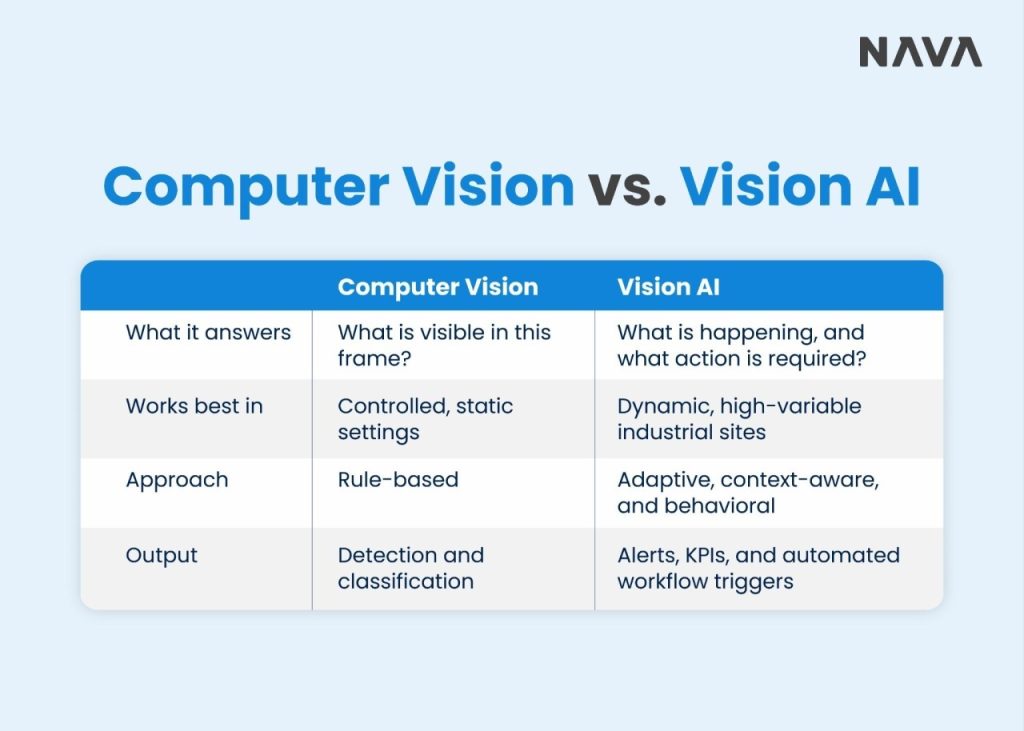
While the terms are often used interchangeably, the operational difference is significant for B2B industrial environments. Vision AI builds on computer vision, but the difference between the two becomes clear in how operations use them.
To operate reliably in complex manufacturing and logistics hubs, Vision AI follows a sophisticated four-stage pipeline:
Through this progression, Vision AI moves from observation to action, becoming part of how operations are monitored, automated, and managed.
To operate reliably in real environments, Vision AI must handle variability, scale, and complexity. This reliability is enabled by a combination of underlying technologies:
Together, these capabilities allow Vision AI to function reliably in real industrial environments, not just controlled settings.
As Vision AI adoption matures, its role is moving beyond detecting individual events. Early deployments focused on identifying specific occurrences, which is useful but only captures part of the value.
Teams now focus on building a continuous, structured view of operations that captures patterns over time, generates measurable insights, and triggers workflows across the facility.
In this model, Vision AI functions as a real-time system of record for physical operations, capturing events as they happen and making them available across systems.
The NAVA Vision AI platform enables this by feeding real-time visual signals into enterprise systems and aligning digital records with actual conditions on the floor.
This shift changes how teams make decisions, moving operations from delayed, report-driven processes to real-time operational awareness.
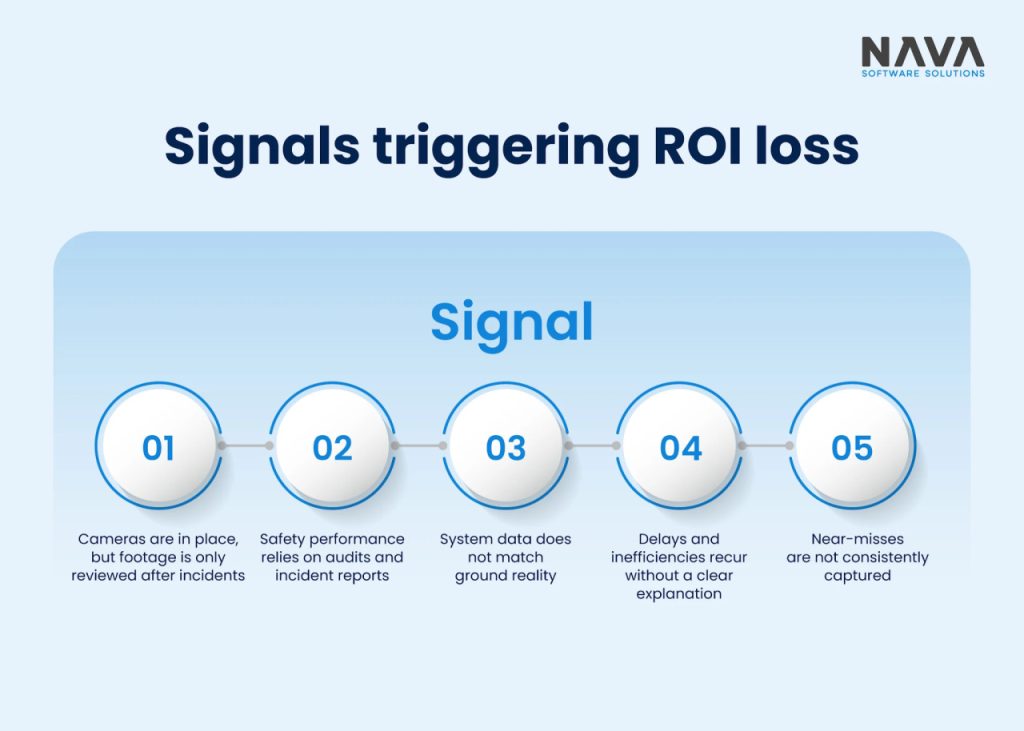
If your facility exhibits the following "signals," you are likely losing significant ROI due to a lack of visual data:
| Signal | What It Indicates |
|---|---|
| Cameras are in place, but footage is only reviewed after incidents | Existing camera infrastructure is not contributing to real-time operational decisions |
| Safety performance relies on audits and incident reports | Early risk signals are not being detected or acted on in time |
| System data does not match ground reality | Physical operations are not accurately reflected in enterprise systems |
| Delays and inefficiencies recur without a clear explanation | Root causes are not visible, so issues repeat without resolution |
| Near-misses are not consistently captured | Actual risk exposure is higher than reported safety metrics |
If several of these conditions exist, the problem is not a lack of data, but the inability to act on that data at the right time.
In practice, Vision AI delivers measurable operational value, but it also depends on a few key conditions to work effectively in real environments.
At its core, Vision AI brings consistency to how operations are measured and managed.
It ensures the same delay is measured consistently across shifts and the same safety risk is detected regardless of supervision, reducing variability over time and improving decision-making. This leads to better visibility, faster response, improved compliance, and reduced operational inefficiencies.
It also creates a time-stamped visual record of events, supporting audits, compliance, and dispute resolution.
To make Vision AI effective in real environments, a few conditions need to be in place:
We don't just detect objects; we deliver Operational Outcomes.
Vision AI is not about adding another system to your stack. It makes existing systems more reliable by aligning them with what is actually happening on the ground.
In industrial and logistics operations, delays, safety risks, and inefficiencies rarely come from a lack of data. They emerge from the gap between what systems report and what actually happens across facilities, production lines, and dock operations.
Vision AI addresses this gap by converting continuous video streams into structured, time-stamped operational events that systems can act on in real time.
This shift changes how operations are managed. Teams no longer need to rely on delayed reports or assumptions. Instead, they can respond as situations develop and base decisions on verified, real-time activity.
Over time, this leads to more consistent execution across shifts, better visibility into recurring issues, and faster resolution of operational bottlenecks.
Ready to eliminate your operational blind spots? [Schedule a Zero-Cost Snapshot PoC Today]


