Blog

  • 2026 Guide to AI-powered Personal Protective Equipment Tracking & Compliance Detection

    2026 Guide to AI-powered Personal Protective Equipment Tracking & Compliance Detection

    Quick Summary

    This guide explores how AI-powered Vision AI, specifically NAVA’s SafetyView AI, converts existing camera feeds into a 24/7 automated safety layer. By shifting from reactive incident reporting to real-time proactive detection, industrial leaders are eliminating “blind spots,” reducing OSHA liability, and protecting their most valuable asset: their people.

    Personal protective equipment (PPE) is the last line of defense between workers and workplace hazards. From helmets and gloves to respirators and safety footwear, personal protective equipment reduces exposure to risks that cannot be eliminated through engineering controls.

    In most workplaces, personal protective equipment policies are clearly defined. Workers are trained, equipment is available, and compliance is expected.

    Yet in reality, compliance with personal protective equipment is inconsistent.

    Hard hats come off briefly. Gloves are skipped. High-visibility vests are removed in the heat.

    These are not awareness issues; they are enforcement gaps.

    Monitoring personal protective equipment in the workplace across every worker, zone, and shift is not scalable through manual supervision. As a result, safety teams rely on periodic checks and post-incident reviews, leaving critical blind spots.

    AI-powered personal protective equipment tracking changes this by enabling real-time, continuous compliance monitoring using existing camera infrastructure.

    So, let us start!

    How Vision AI Detects PPE Compliance in Real Time

    To understand why computer vision is a step change rather than an incremental improvement, it helps to understand what the technology is actually doing at the model level, without the marketing fluff.

    At a technical level, modern PPE detection systems combine multiple capabilities.

    1. Object Detection + Pose Estimation

    The system doesn’t just detect PPE—it understands how it is being used.

    It identifies:

    • The worker
    • Body position and keypoints
    • Spatial relationship between PPE and the person

    This ensures:

    • A hard hat on a shelf is ignored
    • Gloves in hand don’t count as compliance
    • Improperly worn equipment is flagged

    2. Zone-Aware Compliance Rules

    Not all areas require the same PPE.

    Each camera feed is mapped to a specific zone with predefined rules:

    • Loading bays → hi-vis + footwear
    • Chemical zones → gloves + face protection
    • Restricted areas → full compliance

    When a worker enters a zone, the system validates compliance instantly.

    If there’s a gap:

    • An alert is triggered
    • The event is logged
    • Supervisors are notified

    The key advantage: policy and detection are decoupled

    Your safety team controls:

    • Rules
    • Thresholds
    • Zone requirements

    3. Runs on Existing Camera Infrastructure

    One of the biggest barriers to adoption has traditionally been hardware cost.

    Modern systems like NAVA’s SafetyView AI are designed to work with:

    • Existing CCTV cameras
    • IP camera networks
    • NVR-based systems

    This means:

    • No hardware overhaul
    • No operational disruption
    • Faster deployment

    You’re not installing new systems. 

    You’re activating intelligence on top of what already exists.

    What AI Catches That Humans Miss

    This section is worth being concrete about, because the gap between human observation and machine detection is wider than most safety managers expect until they run a pilot.

    Volume and simultaneity

    A single AI deployment can monitor every camera feed simultaneously. A facility with 60 cameras gets 60 simultaneous, unblinking observers. Each one processes every frame, every second, across every shift. No camera is “less watched” because it’s in a corner of the facility that’s inconvenient for a supervisor to reach.

    Consistency

    Human observers are subject to alert fatigue, familiarity bias (overlooking routine violations from known workers), and the natural tendency to focus on more dynamic events. AI detection is rule-based in its enforcement: the ruleset is applied identically to the CEO walking the floor as to a contractor on their first day. Compliance is compliance.

    Near-miss capture

    This is arguably the highest-value capability that gets the least attention in vendor demos. 

    • A worker entering a forklift path
    • A hand reaching toward a machine guard without gloves
    • Someone moving through a pinch-point zone

    Near-miss events like the above are captured and logged even when no injury occurs. Over time, your near-miss dataset becomes a risk map of your facility. You can see which zones, which shifts, and which workflows consistently produce PPE gaps before a serious incident validates the pattern.

    “The value of AI-powered safety monitoring isn’t just in the alerts it fires. It’s in the data it accumulates. The pattern recognition that tells you where your next incident is going to come from before it happens.”

    Traditional Compliance Monitoring vs. AI-Powered Detection

    CapabilityManual / CCTV ReviewAI-Powered Detection
    Coverage hoursLimited to supervisor availability24/7, every shift, every camera
    Detection latencyHours to days (post-incident review)4–6 seconds real-time
    Consistency of enforcementVariable (affected by fatigue, familiarity, workload)Rule-based, identical across all personnel
    Zone-specific rulesRelies on supervisor knowledge and presenceConfigurable per camera zone, automatically applied
    Near-miss data captureRarely captured, heavily underreportedLogged automatically, queryable over time
    Regulatory audit trailManual logs, inconsistent formatStructured event logs, exportable for compliance
    Infrastructure requirementPersonnel cost, ongoing supervision overheadRuns on existing CCTV, no new cameras needed
    ScalabilityLinear with headcount, expensive to scaleFlat marginal cost per additional camera feed

    What SafetyView AI From NAVA Actually Monitors

    SafetyView AI NAVA is a computer vision platform built specifically for industrial workplace safety. 

    It is not a general-purpose vision system adapted for safety. It was purpose-built for the use cases that matter in manufacturing, logistics, and warehousing environments. 

    • Hard Hat Detection

    Identifies the presence and correct positioning of hard hats, distinguishing a properly worn hat from one carried or placed nearby.

    • Hi-Vis Vest Detection

    Validates high-visibility vests in active use across all lighting conditions, including high-contrast and low-light environments.

    • Glove Detection

    Detects glove presence on both hands, with zone-specific triggering for chemical handling, machinery, and sharp-edge work areas.

    • Safety Boot / Footwear

    Validates PPE footwear compliance at entry points and zone transitions, reducing exposure in high-risk floor areas.

    • Face Mask & Respirator

    Monitors respiratory PPE compliance in chemical, pharmaceutical, and food manufacturing environments.

    • Safety Glasses & Goggles

    Eye protection monitoring for machining, welding, and lab environments where small-particle and chemical splash risks exist.

    • Forklift–Pedestrian Risk

    Detects and alerts when pedestrians enter active forklift operating zones, which are among the leading causes of serious workplace injury.

    • Restricted Zone Access

    Monitors entry to machinery exclusion zones, high-voltage areas, and other access-controlled spaces without requiring physical barriers.

    • Slip, Trip & Fall Risks

    Detects environmental hazard indicators (spills, obstructions, open floor hatches) that create slip-and-fall exposure.

    • Ergonomic Risk Detection

    Flags unsafe manual handling postures (overreaching, poor lift mechanics) that contribute to musculoskeletal injury over time.

    The Business Impact: ROI Beyond the Fine

    While avoiding OSHA fines is a clear win, the strategic impact of vision AI goes deeper:

    • Insurance Leverage: Data-backed proof of a “Zero-Accident” culture can be used to negotiate lower workers’ comp premiums.
    • Labor Retention: In a competitive labor market, a demonstrably safer workplace is a key differentiator for hiring and retaining skilled floor talent.
    • Engineering Scalability: Because this is built on a modular AI framework, your investment in PPE tracking today is the foundation for DockView AI (logistics efficiency) or AssemblyLine AI (production monitoring) tomorrow.

    Is Your Facility Ready? A Practical Readiness Checklist

    Before beginning an evaluation of any AI-powered PPE monitoring solution, it’s worth pressure-testing your existing environment against these points:

    • Camera coverage: Are your highest-risk zones covered by existing CCTV with adequate resolution? AI detection works best at 1080p or higher, with cameras positioned to capture full-body frames, not just wide-angle coverage of large spaces.
    • Network access: Can camera feeds be accessed by an edge processing unit or cloud endpoint? This is the most common technical constraint in legacy facilities.
    • PPE policy documentation: Is your zone-by-zone PPE requirement documented in a format that can be translated into system rulesets? Vague or inconsistently applied policies need to be resolved before automation can enforce them reliably.
    • Alert ownership: Who receives a PPE violation alert, and what’s their expected response? Define this before deployment, not after. Alerts without a response protocol quickly become noise.
    • Baseline compliance data: Do you have a sense of your current compliance rate? A PoC without a baseline makes it harder to measure the system’s impact over time.

    Final Thought: PPE Compliance Is an Engineering Problem

    Safety culture matters. Training matters. Leadership commitment matters. But treating PPE compliance as purely a behavioral or cultural challenge ignores the system’s reality: humans cannot monitor every person in every zone across every shift with the consistency that a serious safety program requires.

    AI-powered PPE detection doesn’t replace safety culture. It gives that culture an enforcement infrastructure that actually scales, one that operates continuously, generates auditable records, surfaces risk patterns before they become incidents, and does all of this on the camera infrastructure you already own.

    The question isn’t whether your facility can afford to evaluate this technology. It’s whether your current approach, whatever it is, is actually catching violations in real time, every shift, in every zone. 

    If the honest answer is no, that gap has a cost. It’s just that you haven’t been able to see it clearly until now.

    Ready to see how SafetyView AI works in your environment? [Schedule a Zero-Cost Snapshot PoC Today]

    FAQs

    What is personal protective equipment (PPE)?

    Personal protective equipment (PPE) refers to safety gear worn by workers to minimize exposure to workplace hazards. It includes items such as helmets, gloves, safety glasses, respirators, high-visibility clothing, and protective footwear used across industries including manufacturing, construction, and logistics.

    What are the main types of personal protective equipment?

    The main types of personal protective equipment include head protection (helmets), eye and face protection (goggles and face shields), hand protection (gloves), respiratory protection (masks and respirators), body protection (hi-vis clothing), and foot protection (safety boots). The required PPE depends on the specific workplace hazards.

    Why is PPE compliance important in the workplace?

    PPE compliance is critical because it directly reduces the risk of injuries, exposure to hazardous materials, and workplace accidents. Non-compliance can lead to serious incidents, regulatory penalties, and increased operational costs.

    What are the common challenges in PPE compliance?

    Common challenges include inconsistent enforcement, lack of real-time monitoring, worker behavior (e.g., temporarily removing PPE), and limited visibility across large facilities. Manual supervision often fails to catch violations as they happen.

    How does AI help in PPE tracking and compliance monitoring?

    AI-powered PPE tracking uses computer vision to analyze camera feeds in real time and detect whether workers are wearing the required equipment correctly. It enables continuous monitoring, instant alerts for violations, and data-driven insights to improve workplace safety and compliance.

  • A Guide to What Is Vision AI & How It Works and Where It’s Deployed

    A Guide to What Is Vision AI & How It Works and Where It’s Deployed

    Quick Summary

    Vision AI is an AI system that uses deep learning models to analyze video streams frame-by-frame and across time, detect operational events and behavioral anomalies, and convert those observations into structured, real-time outputs such as alerts, event logs, and integration signals for enterprise systems like EHS, MES, WMS, TMS, and ERP.

    Across most industrial facilities, a robust camera infrastructure is already in place for surveillance and monitoring, covering aisles, dock doors, production lines, and access points. 

    In most operations, video feeds route to a Network Video Recorder (NVR) or Video Management System (VMS) and sit there. Retrieval happens after an incident. Sometimes for quarterly safety audits. Rarely for anything in real time.

    As a result, teams often detect delays, safety risks, and productivity gaps only after they have started affecting performance.

    This guide explains what Vision AI is, how it works in practical environments, how it differs from traditional computer vision, and where it is already improving safety, throughput, and operational visibility using infrastructure that many facilities already have.

    What is Vision AI & How is it Used in Industrial Operations?

    Vision AI is the transition from passive video recording to active operational intelligence. 

    It enables industrial systems to analyze live video feeds, interpret complex human and vehicle behaviors, and convert visual data into high-value operational outputs, such as real-time safety alerts, productivity metrics, and automated workflow triggers.

    For operations leaders, the value isn’t the “AI” itself; it’s the ability to eliminate blind spots. While traditional CCTV provides a historical record of what went wrong, Vision AI provides a real-time stream of what is happening now and what needs to change.

    From Passive Recording to Actionable Intelligence

    Traditional monitoring systems are “dumb” archives. They store footage that is rarely seen unless an incident occurs. Vision AI transforms this existing infrastructure into a continuous data stream, categorizing observations into structured events that integrate directly with your ERP, WMS, or EHS systems.

    Real-World Impact: Optimizing Facility Flow & Movement

    Consider the complexities of Facility Entry and Site Access Intelligence. In a traditional setup, a camera simply records a vehicle arriving.

    When that same camera is powered by NAVA Vision AI, the system becomes a strategic asset that:

    • Enforces PPE Compliance: Automatically detects if personnel are missing helmets, high-visibility vests, or required safety gear before they enter high-risk zones.
    • Monitors Exclusion Zones: Triggers instant alerts if a pedestrian enters a restricted “red zone” or gets dangerously close to moving machinery or heavy vehicles.
    • Detects Unsafe Behaviors: Identifies high-risk actions in real-time, such as speeding on-site, improper manual lifting, or unauthorized person-on-deck scenarios.
    • Prevents Docking Accidents: Monitors vehicle-to-dock alignment and proximity, providing visual or audible warnings to prevent “creep” or structural collisions.
    • Automates Incident Reporting: Provides immediate, time-stamped video evidence of near-misses, allowing for objective safety audits without relying on self-reporting.

    In this scenario, your infrastructure remains the same. What changes is your speed of decision-making. By converting visual pixels into measurable performance KPIs, Vision AI turns “security footage” into your most powerful tool for safety, productivity, and bottom-line efficiency.

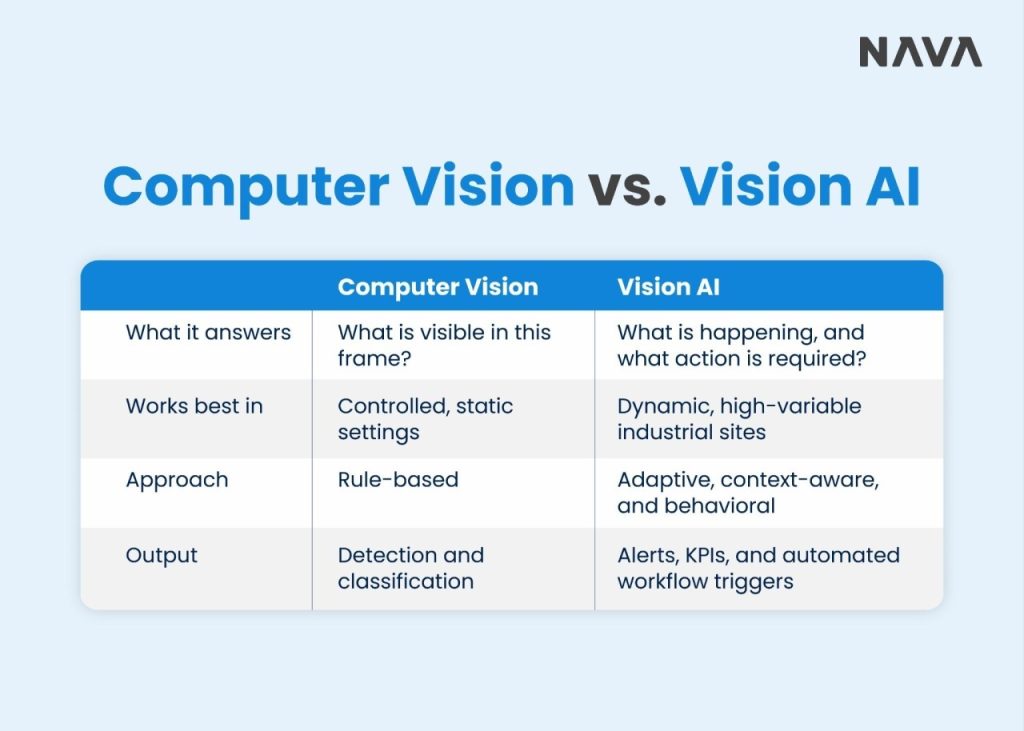
    Vision AI vs. Computer Vision

    While the terms are often used interchangeably, the operational difference is significant for B2B industrial environments. Vision AI builds on computer vision, but the difference between the two becomes clear in how operations use them.

    A comparison table representing what computer vision does and how vision AI is different.

    How the Vision AI Pipeline Drives Value

    To operate reliably in complex manufacturing and logistics hubs, Vision AI follows a sophisticated four-stage pipeline:

    • Ingestion & Normalization: Standardizes feeds from existing facility cameras, ensuring reliable detection even in low-light warehouses or high-glare outdoor loading docks.
    • Scene Understanding: Dynamically identifies personnel, heavy machinery (forklifts, AGVs), and hazardous “red zones,” mapping the spatial relationship between workers and moving equipment.
    • Safety Analytics: Moves beyond simple motion detection to recognize dangerous behaviors, such as a worker entering a vehicle’s blind spot or a forklift operating without a safety spotter.
    • Real-Time Intervention: Converts visual data into immediate alerts. Signals are sent to floor managers or integrated with site sirens and automated shut-off systems to prevent an accident before it occurs.

    Through this progression, Vision AI moves from observation to action, becoming part of how operations are monitored, automated, and managed.

    To operate reliably in real environments, Vision AI must handle variability, scale, and complexity. This reliability is enabled by a combination of underlying technologies:

    • Deep learning models: Form the analytical core and enable accurate recognition of objects, behaviors, and interactions.
    • Vision transformers: Capture relationships across entire scenes, improving contextual understanding.
    • Multimodal integration: Connects visual signals with enterprise systems, making discrepancies between observed activity and expected system data visible and actionable.
    • Edge processing: Enables real-time response by processing video closer to where it is generated, reducing latency and avoiding dependence on constant cloud transfer.

    Together, these capabilities allow Vision AI to function reliably in real industrial environments, not just controlled settings.

    From Detection to Operational Intelligence

    As Vision AI adoption matures, its role is moving beyond detecting individual events. Early deployments focused on identifying specific occurrences, which is useful but only captures part of the value.

    Teams now focus on building a continuous, structured view of operations that captures patterns over time, generates measurable insights, and triggers workflows across the facility.

    In this model, Vision AI functions as a real-time system of record for physical operations, capturing events as they happen and making them available across systems.

    The NAVA Vision AI platform enables this by feeding real-time visual signals into enterprise systems and aligning digital records with actual conditions on the floor.

    This shift changes how teams make decisions, moving operations from delayed, report-driven processes to real-time operational awareness.

    Is Your Operation Ready for Vision AI?

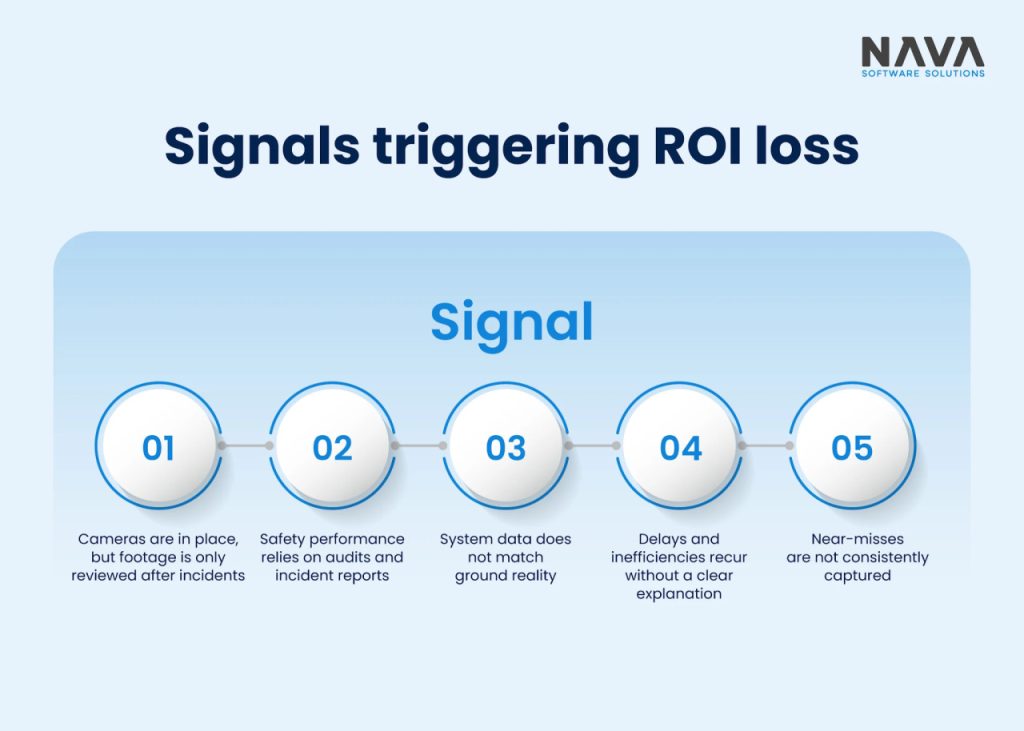
    If your facility exhibits the following “signals,” you are likely losing significant ROI due to a lack of visual data:

    • The “Post-Incident” Trap: You only check cameras after something breaks or someone gets hurt.
    • The System Mismatch: Your system says a task is “complete,” but the physical reality on the floor says otherwise.
    • Unexplained Delays: Recurring bottlenecks in Site Access or Asset Movement that manual logs can’t explain.
    • Hidden Risks: You suspect “near-misses” are happening daily, but you have no data to prove where or why.
    Image representing signals triggered due to a lack of insight into real-time data
    SignalWhat It Indicates
    Cameras are in place, but footage is only reviewed after incidentsExisting camera infrastructure is not contributing to real-time operational decisions
    Safety performance relies on audits and incident reportsEarly risk signals are not being detected or acted on in time
    System data does not match ground realityPhysical operations are not accurately reflected in enterprise systems
    Delays and inefficiencies recur without a clear explanationRoot causes are not visible, so issues repeat without resolution
    Near-misses are not consistently capturedActual risk exposure is higher than reported safety metrics

    If several of these conditions exist, the problem is not a lack of data, but the inability to act on that data at the right time.

    Benefits and Deployment Considerations

    In practice, Vision AI delivers measurable operational value, but it also depends on a few key conditions to work effectively in real environments.

    What Vision AI Delivers

    At its core, Vision AI brings consistency to how operations are measured and managed.

    It ensures the same delay is measured consistently across shifts and the same safety risk is detected regardless of supervision, reducing variability over time and improving decision-making. This leads to better visibility, faster response, improved compliance, and reduced operational inefficiencies.

    It also creates a time-stamped visual record of events, supporting audits, compliance, and dispute resolution.

    What to Plan For

    To make Vision AI effective in real environments, a few conditions need to be in place:

    • Camera coverage: Critical zones must be clearly visible to ensure accurate monitoring.
    • System integration: Closer alignment with existing systems enables stronger workflow support and more effective decision-making.
    • Workforce governance: This needs early attention, especially in environments where monitoring affects employees.
    • Ongoing adaptation: Performance improves over time as models adapt to the specific environment and operating conditions.

    Why Choose NAVA Vision AI?

    We don’t just detect objects; we deliver Operational Outcomes.

    • Plug-and-Play (Snapshot Model): Start with a low-friction PoC using your existing cameras. See insights in days, not months.
    • Hardware Agnostic: No need for expensive new sensor arrays. We leverage your current CCTV infrastructure.
    • Enterprise-Scale: Built to integrate with your current tech stack (SAP, Oracle, BlueYonder, etc.) and scale across 50+ global sites.

    Conclusion

    Vision AI is not about adding another system to your stack. It makes existing systems more reliable by aligning them with what is actually happening on the ground.

    In industrial and logistics operations, delays, safety risks, and inefficiencies rarely come from a lack of data. They emerge from the gap between what systems report and what actually happens across facilities, production lines, and dock operations.

    Vision AI addresses this gap by converting continuous video streams into structured, time-stamped operational events that systems can act on in real time.

    This shift changes how operations are managed. Teams no longer need to rely on delayed reports or assumptions. Instead, they can respond as situations develop and base decisions on verified, real-time activity.

    Over time, this leads to more consistent execution across shifts, better visibility into recurring issues, and faster resolution of operational bottlenecks.

    Ready to eliminate your operational blind spots? [Schedule a Zero-Cost Snapshot PoC Today]

    Frequently Asked Questions

    Does Vision AI require replacing my current cameras? 

    No. Our platform is designed to layer on top of existing IP camera infrastructure, maximizing your current security investment.

    What problems does Vision AI help solve in industrial and logistics operations?

    Vision AI helps teams use existing camera footage to improve visibility into operations, identify delays and safety risks earlier, and reduce recurring inefficiencies. Common use cases include dock monitoring, bottleneck detection, PPE compliance, and improving visibility across production, warehouse, and yard operations.

    How is Vision AI different from traditional computer vision?

    Computer vision focuses on identifying what is visible in a scene, such as people, vehicles, or objects. Vision AI goes further by analyzing activity over time, identifying patterns, and turning those observations into alerts, metrics, and actions tied to operations.

    Where does Vision AI deliver the most value? 

    Vision AI often delivers the most value in areas where limited visibility creates measurable cost or risk, such as dock operations, production flow, safety monitoring, and asset utilization.

    How does Vision AI work with systems like EHS, WMS, TMS, ERP, or MES? 

    Vision AI can integrate with enterprise systems by converting visual activity into structured, time-stamped events and operational signals that support workflows, alerts, and decision-making.

    What should teams evaluate before adopting Vision AI? 

    Teams typically evaluate operational pain points, camera coverage, integration needs, governance considerations, priority use cases, and where real-time visibility could improve performance or reduce risk.

    How does Vision AI adoption typically scale across operations? 

    Many deployments begin with a focused use case, such as safety or dock monitoring, and expand across facilities and workflows as organizations validate value.

    Does Vision AI replace existing systems or work with them? 

    Vision AI is typically used to extend the value of existing camera infrastructure and enterprise systems by adding real-time operational intelligence on top of existing infrastructure.

  • Digital Transformation

    Digital Transformation

    A Step-by-Step Guide for Enterprises

    Digital transformation is more than a trend; it’s a critical step for enterprises aiming to stay competitive, resilient, and customer-focused in today’s dynamic business landscape. However, for many organizations, embarking on this journey can be daunting, with challenges ranging from legacy systems to cultural resistance and cybersecurity concerns.

    1. Define a Clear Vision and Goals

    Before diving into digital transformation initiatives, it’s crucial to establish a clear vision of what you want to achieve. This involves aligning digital transformation goals with your overall business objectives.

    Best Practices:

    • Enhancing Customer Experience: Leveraging digital tools to provide personalized and seamless customer interactions.
    • Optimizing Operations: Automating manual processes and improving efficiency across departments.
    • Data-Driven Decision Making: Using data analytics to gain insights into customer behavior, market trends, and operational performance.

    2. Assess Your Current Digital Maturity

    Digital transformation requires a comprehensive understanding of your organization’s current digital maturity. Conduct an internal audit to assess the existing technology stack, data capabilities, and workforce readiness.

    Best Practices:

    • Technology Infrastructure: Identify legacy systems that need modernization and assess cloud readiness.
    • Data Capabilities: Evaluate data storage, quality, and accessibility to determine readiness for advanced analytics.
    • Organizational Readiness: Assess the digital skills of your workforce and identify training needs.

    3. Develop a Phased Roadmap

    A well-structured roadmap breaks down the digital transformation journey into manageable phases, allowing you to measure progress and adapt to changing needs.

    Best Practices:

    • Short-Term Goals: Quick wins like automating repetitive tasks or implementing a customer relationship management (CRM) system.
    • Mid-Term Goals: Introducing more complex initiatives such as data analytics and integration of cloud-based solutions.
    • Long-Term Goals: Advanced transformation projects like AI-driven automation, predictive analytics, and end-to-end process reengineering.

    4. Secure the Right Technology Partners

    Choosing the right technology partners is crucial to a successful transformation. Experienced partners like NAVA Software Solutions provide the expertise, tools, and frameworks to ensure a smooth digital transformation journey.

    Best Practices:

    • Industry Experience: Look for partners with experience in your sector who understand specific regulatory and operational challenges.
    • Flexibility and Scalability: Ensure that their solutions can scale with your business and adapt to changing needs.
    • Security and Compliance: Choose partners who prioritize cybersecurity and compliance to protect sensitive data.

    5. Build a Data-Driven Culture

    One of the most significant benefits of digital transformation is the ability to make data-driven decisions. However, transforming data into actionable insights requires a cultural shift where data is at the heart of every decision.

    Best Practices:

    • Encourage Data Literacy: Provide training and tools that empower employees to understand and use data in their daily roles.
    • Establish Data Governance: Implement data governance policies to ensure data quality, security, and accessibility.
    • Leverage Advanced Analytics: Use data analytics and business intelligence tools to gain deeper insights into customer needs, market trends, and operational performance.

    6. Invest in Workforce Transformation

    Digital transformation isn’t just about technology; it’s also about people. Upskilling your workforce is essential for maximizing the value of new tools and systems.

    Best Practices:

    • Digital Literacy: Ensure that employees are comfortable using new technologies and tools.
    • Cybersecurity Awareness: Train employees on best practices for data protection and security.
    • Change Management: Equip leaders with change management skills to foster a culture of adaptability and innovation.

    7. Focus on Security and Compliance

    As enterprises adopt digital tools, maintaining security and compliance becomes increasingly complex. Digital transformation introduces new risks that need to be addressed proactively.

    Best Practices:

    • Implement Strong Access Controls: Limit access to sensitive data based on roles and responsibilities.
    • Regularly Update Security Protocols: Ensure that all systems, from cloud platforms to mobile devices, follow the latest security standards.
    • Monitor Compliance: Stay updated on industry regulations and ensure that all digital transformation initiatives meet compliance requirements.

    8. Measure Success and Continuously Improve

    Digital transformation is a continuous journey, not a one-time project. To achieve sustained success, establish key performance indicators (KPIs) to measure the impact of transformation initiatives.

    Best Practices:

    • Operational Efficiency: Reduction in manual processes and time saved.
    • Customer Satisfaction: Improvements in customer satisfaction scores or net promoter scores.
    • Revenue Growth: Increase in revenue as a result of new digital products or services.

    Conclusion

    Embarking on a digital transformation journey requires careful planning, skilled partners, and a clear vision. With a comprehensive suite of solutions, NAVA Software Solutions supports enterprises in every phase of digital transformation, from initial assessments and roadmap creation to technology implementation and ongoing support.

    NAVA’s industry expertise, end-to-end support, and commitment to security make us an ideal partner for organizations seeking to navigate the complexities of digital transformation confidently and effectively. Contact us today to learn how we can help you build a resilient, data-driven, and customer-centric enterprise.

  • Compliance and Data Security GCC

    Compliance and Data Security GCC

    The Importance of Compliance and Data Security in GCC

    As businesses expand globally, Global Capability Centers (GCCs) have become essential for scaling operations, managing costs, and accessing skilled talent. However, with this growth comes the challenge of maintaining strict compliance and data security standards across different geographies, especially as GCCs handle sensitive data and intellectual property.

    Why Compliance and Data Security Matter in GCCs

    1. Protecting Sensitive Data and Intellectual Property

    GCCs handle sensitive customer, financial, and proprietary data across regions governed by diverse privacy regulations like GDPR and CCPA. Ensuring compliance and implementing robust data security measures protect organizations from breaches, misuse, and unauthorized access.

    2. Sustaining Client Trust and Business Reputation

    Clients rely on GCCs to maintain the confidentiality of their data. Strong security and compliance practices not only prevent breaches but also reinforce client confidence, preserving trust, reputation, and long-term business relationships.

    3. Avoiding Costly Penalties and Legal Consequences

    Failure to comply with global regulations can result in severe financial penalties and legal repercussions. Establishing strong compliance policies helps GCCs mitigate these risks and maintain credibility in an increasingly regulated environment.

    Best Practices for Ensuring Compliance and Data Security in GCCs

    1. Challenges of Compliance and Data Security in GCCs

    Navigating Varied Global Regulations

    Best Practices:

    • Navigating Varied Global Regulations: Operating across multiple countries means GCCs must navigate diverse regulatory requirements, each with its own specific compliance demands. For example, while GDPR mandates strict data privacy controls, other regions may have looser requirements or entirely different focuses. Ensuring compliance across all operational geographies requires a detailed understanding of each regulatory environment and continuous monitoring of changing laws.
    • Managing Distributed Data and Access Control: GCCs often handle vast amounts of distributed data, which can be accessed by teams across various locations. Managing access to sensitive data and ensuring that only authorized personnel have access becomes challenging with a geographically dispersed workforce. Without stringent access control, GCCs risk unauthorized access and data breaches.

    2. Conduct Comprehensive Risk Assessments

    A proactive approach to compliance and data security begins with a comprehensive risk assessment to identify potential vulnerabilities.

    Best Practices:

    • Data Mapping: Identify where sensitive data resides, who has access to it, and how it’s being used.
    • Gap Analysis: Evaluate current security measures against regulatory requirements to determine gaps in compliance.
    • Risk Prioritization: Rank potential risks to address the most critical vulnerabilities first.
    • Regular Risk Assessments: Regular risk assessments allow GCCs to stay ahead of evolving threats and regulatory changes, enabling them to adapt security measures accordingly.

    3. Implement Role-Based Access Control

    Restricting data access based on roles is crucial for safeguarding sensitive information.

    Best Practices:

    • Define User Roles: Classify user roles and assign access levels based on job responsibilities.
    • Regularly Review Access Rights: Periodically audit access rights to ensure they remain aligned with current roles and responsibilities.
    • Monitor Access Logs: Track data access logs to detect any suspicious activity and maintain a secure environment.

    4. Strengthen Data Encryption and Endpoint Security

    Encryption is one of the most effective ways to protect data in transit and at rest.

    Best Practices:

    • Use End-to-End Encryption: Protect data at every stage of its lifecycle, from creation to storage and sharing.
    • Secure Endpoints: Implement endpoint protection software on all devices accessing GCC data, including laptops, tablets, and mobile phones.
    • Multi-Factor Authentication (MFA): Add an extra layer of security by requiring two or more forms of verification to access sensitive data.

    5. Implement a Data Loss Prevention (DLP) Program

    A Data Loss Prevention (DLP) program is essential for monitoring and controlling the transfer of sensitive data across networks.

    Best Practices:

    • Content Filtering: Identify and block sensitive content from being sent outside the organization.
    • User Behavior Monitoring: Track and analyze employee actions to detect suspicious behavior.
    • Data Transfer Restrictions: Limit the ability to transfer sensitive data outside of the network, ensuring data stays within secure environments.

    6. Establish a Comprehensive Incident Response Plan

    Even with robust security measures, incidents may still occur.

    Best Practices:

    • Preparation and Training: Equip employees with the knowledge and skills to recognize and report security incidents.
    • Containment and Eradication: Define processes to contain breaches and eliminate threats promptly.
    • Recovery and Review: Implement measures to recover from incidents and analyze them to improve future security.

    7. Regularly Conduct Compliance Audits and Training

    Compliance is an ongoing process that requires continuous evaluation and adaptation.

    Best Practices:

    • Schedule Quarterly Compliance Audits: Review compliance processes regularly to ensure adherence to evolving regulations.
    • Conduct Employee Training: Provide training sessions on data security best practices, compliance standards, and recognizing cybersecurity threats.
    • Evaluate Third-Party Vendors: Assess vendors and partners to ensure they meet your compliance and security standards.

    Conclusion

    As organizations continue to expand through GCCs, the importance of compliance and data security cannot be overstated. By implementing comprehensive security measures, conducting regular compliance audits, and fostering a culture of vigilance, GCCs can protect sensitive data, meet regulatory requirements, and build lasting client trust.

    At NAVA Software Solutions, we understand the unique challenges facing GCCs and offer tailored compliance and data security solutions that empower organizations to scale confidently and securely. Contact us today to learn how our expertise can support your GCC’s growth and protect your critical assets.

  • Intelligent Automation

    Intelligent Automation

    Leveraging Intelligent Automation for Cost-Efficient Operations

    In an increasingly competitive global market, organizations are constantly seeking ways to improve efficiency, reduce costs, and enhance productivity. Intelligent Automation (IA), which combines artificial intelligence (AI) with automation technologies like Robotic Process Automation (RPA), is proving to be a transformative solution for achieving these goals.

    Reducing Operational Downtime with Predictive Maintenance

    Intelligent automation, when integrated with IoT and AI, enables predictive maintenance for critical equipment. By monitoring asset health in real-time and predicting potential failures, IA allows companies to perform timely maintenance, reducing downtime and minimizing repair costs. Predictive maintenance is especially beneficial for industries with complex machinery, such as manufacturing and utilities. Example: A manufacturing company implemented predictive maintenance powered by IA, reducing equipment downtime by 50% and saving on costly emergency repairs. This also improved production efficiency, resulting in lower operating costs and higher profitability.

    1. How Intelligent Automation (IA) Drives Cost Efficiency and Operational Excellence

    Intelligent Automation (IA) combines Artificial Intelligence (AI) and Robotic Process Automation (RPA) to streamline operations, reduce costs, and improve efficiency across industries.

    Best Practices:

    • Automating High-Volume, Low-Value Tasks: IA automates repetitive, time-consuming tasks like data entry, invoice processing, and report generation, reducing manual effort and increasing accuracy. Example: A retail company used RPA to automate order fulfillment, cutting operational costs by 40% and improving order accuracy.
    • Optimizing Supply Chain and Inventory Management: IA enhances supply chain processes such as order processing, inventory management, and demand forecasting. Example: An e-commerce company used IA to forecast demand accurately, reducing inventory costs by 25% and preventing overstock or stockouts.
    • Enhancing Customer Service with AI-Powered Bots: AI-driven chatbots handle large volumes of customer inquiries efficiently, improving satisfaction while reducing staffing costs. Example: A telecom company implemented AI chatbots, reducing call center costs by 35% and improving response times.
    • Improving Compliance and Risk Management: IA ensures regulatory compliance through automated data collection, audits, and reporting. Example: A financial institution used RPA for compliance checks, reducing compliance costs by 20% and minimizing regulatory risks.

    2. Implementing Intelligent Automation: A Step-by-Step Approach

    To maximize IA’s benefits, organizations must implement it strategically with a focus on business goals, scalability, and workforce alignment.

    Best Practices:

    • Identify High-Impact Processes for Automation: Focus on automating repetitive, resource-heavy, and low-value tasks that offer measurable efficiency improvements.
    • Develop a Clear Automation Roadmap: Create a phased implementation roadmap that aligns automation goals with business objectives to ensure a smooth transition.
    • Choose the Right IA Technology and Partner: Select appropriate IA tools such as RPA and AI analytics, and collaborate with experienced partners like NAVA Software Solutions.
    • Train Employees and Ensure Change Management: Invest in employee upskilling and promote a transparent communication strategy to ensure workforce alignment and acceptance.
    • Monitor and Optimize Automation Efforts: Continuously track IA performance using KPIs like cost savings, efficiency, and accuracy, refining the approach as needed.

    3. Success Stories

    Real-world examples demonstrating how organizations achieved significant efficiency and cost savings through Intelligent Automation.

    Best Practices:

    • Case Study 1: Cost Savings through Invoice Automation: A large retail company automated its invoice processing with RPA, reducing processing time by 70% and cutting costs by 35%, enabling the finance team to focus on strategic initiatives.
    • Case Study 2: Enhancing Customer Service Efficiency with AI Chatbots: A telecommunications company implemented AI chatbots for routine inquiries, reducing call center costs by 30% and improving customer satisfaction through faster responses.

    Conclusion

    Intelligent automation is a powerful tool for organizations looking to enhance cost efficiency, improve productivity, and create a more agile workforce. By automating repetitive tasks, streamlining supply chains, and improving customer service, IA enables companies to achieve their operational goals and drive sustainable growth. At NAVA Software Solutions, we specialize in intelligent automation tailored to the unique needs of each organization. Contact us today to explore how IA can transform your operations, reduce costs, and unlock new levels of efficiency.

  • Product Dev FinTech

    Product Dev FinTech

    Why Agile Product Development is Essential for FinTech Innovation

    In the fast-paced world of financial technology (FinTech), innovation is crucial for staying competitive. With evolving customer demands and emerging technologies, FinTech companies must adapt quickly and efficiently. Agile product development enables them to deliver value faster, respond to market changes, and continuously innovate. Unlike traditional methods, Agile offers a flexible, iterative framework that aligns with the dynamic FinTech landscape. This blog explores why Agile development is vital for FinTech innovation and the key benefits it provides.

    The Importance of Agile in the FinTech Landscape

    FinTech demands speed, security, and personalization, which traditional development struggles to meet. Agile enables iterative development, continuous feedback, and flexibility, aligning perfectly with FinTech’s need for rapid innovation and customer-centric solutions.

    1. Key Drivers of Agile Adoption in the FinTech Industry

    Agile methodologies are transforming how FinTech organizations innovate, comply with regulations, and meet evolving customer needs in a competitive digital landscape.

    2. How Agile Product Development Drives FinTech Innovation

    Agile methodologies empower FinTech organizations to innovate rapidly while maintaining compliance, flexibility, and customer focus. The following sections outline how Agile enables speed, collaboration, and adaptability in FinTech development.

    Best Practices:

    • Accelerates Time-to-Market: In FinTech, speed is often a competitive advantage. Agile enables teams to deliver product features faster through iterative sprints, allowing MVPs or new features to be released quickly, gather feedback, and improve continuously. Example: A FinTech startup using Agile can release a prototype of a digital wallet feature in just a few sprints to validate the concept before full investment.
    • Facilitates Collaboration: Agile promotes collaboration among cross-functional teams such as IT, legal, risk management, and customer support, ensuring product success through shared expertise. Example: A FinTech company developing a lending platform can bring developers, financial analysts, legal advisors, and UX designers together in regular sprint meetings for an integrated approach.
    • Supports Regulatory Compliance: Agile’s iterative nature helps FinTech companies meet evolving regulatory requirements by integrating compliance checks into each sprint. Example: When new data protection laws arise, Agile teams can update their application within the next sprint to ensure compliance without disrupting development.
    • Enhances Customer-Centric Development: Agile emphasizes continuous customer feedback, enabling FinTech teams to build user-friendly, relevant, and responsive products. Example: A FinTech firm developing a mobile banking app can use Agile to test new features with users and refine them based on real feedback.
    • Enables Flexibility: Agile allows FinTech firms to adapt quickly to new technologies such as blockchain, AI, and machine learning by integrating them incrementally. Example: A FinTech company exploring blockchain for secure transactions can use Agile to prototype features and decide whether to scale or pivot based on user feedback.

    3. Key Benefits of Agile for FinTech Companies

    Agile perfectly aligns with FinTech’s need for speed, innovation, and adaptability while ensuring compliance and customer satisfaction.

    Best Practices:

    • Faster Innovation and Product Iteration: Agile enables rapid innovation, helping FinTech companies test ideas, learn from feedback, and quickly launch new features for a competitive edge.
    • Improved Risk Management: Frequent testing and iteration in Agile allow early issue detection, ensuring product accuracy, security, and compliance.
    • Enhanced Customer Engagement and Satisfaction: Agile enhances customer satisfaction by integrating real-time feedback into development, improving user experience and loyalty.
    • Cost Efficiency and Resource Optimization: Agile allows dynamic scaling of team size and resources based on project needs, optimizing cost and efficiency.

    4. Success Story: How Agile Helped a FinTech Company Launch Faster and Adapt to Market Demands

    A FinTech company specializing in digital payments used Agile to launch a new contactless payment feature quickly and effectively.

    Best Practices:

    • Background: The company faced high demand for a contactless payment feature but struggled with slow traditional development methods.
    • Solution: By restructuring into Agile pods and using sprints, the team delivered an MVP within two months and iterated based on user feedback.
    • Results: 40% Faster Time-to-Market, Enhanced Customer Satisfaction through continuous improvements, and Increased Market Share by launching early and meeting user needs.

    5. Best Practices for Adopting Agile in FinTech

    To successfully adopt Agile, FinTech organizations must align culture, strategy, and processes to support iterative, collaborative, and compliant development.

    Best Practices:

    • Start with a Clear Product Vision and Roadmap: Establish a product vision that aligns with customer needs and business goals, ensuring teams stay focused on delivering value.
    • Embrace Continuous Customer Feedback: Incorporate regular feedback sessions, user testing, and surveys into the Agile process to make customer-centric improvements at every iteration.
    • Cultivate a Culture of Collaboration and Transparency: Encourage open communication and teamwork across functions to enable developers, designers, compliance officers, and product managers to collaborate effectively.
    • Prioritize Security and Compliance Checks: Integrate security and compliance into every sprint to ensure that the product remains compliant with FinTech regulations and avoids costly rework.

    Conclusion

    Agile product development is essential for driving innovation and maintaining a competitive edge in the FinTech industry. By enabling faster time-to-market, fostering customer-centric development, and providing the flexibility needed to integrate new technologies, Agile aligns perfectly with the demands of FinTech. Companies that embrace Agile can continuously innovate, delivering products that meet customer needs, regulatory standards, and market demands. At NAVA Software Solutions, we specialize in implementing Agile methodologies tailored to the unique needs of FinTech companies. Contact us today to discover how we can help your organization unlock its full potential with Agile-driven innovation.

  • Regulatory Energy Company

    Regulatory Energy Company

    Meeting Regulatory Challenges in the Energy and Utility Sector Through Digital Transformation

    The energy and utility sector is a highly regulated industry where companies must adhere to strict compliance standards for environmental protection, safety, data security, and customer rights. Digital transformation is emerging as a powerful enabler for energy and utility companies, offering tools to streamline compliance, manage data effectively, and ensure operational transparency.

    Why Digital Transformation is Essential for Regulatory Compliance

    Regulatory compliance in the energy and utility sector covers a wide range of areas, from emissions tracking and health and safety standards to data privacy and cybersecurity. Traditional methods of managing compliance often rely on manual processes, spreadsheets, and outdated systems that can lead to errors, inefficiencies, and increased risk of non-compliance. Digital transformation enables energy and utility companies to automate compliance tasks, collect and analyze data in real time, and gain visibility into their operations, making it easier to stay compliant with industry standards.

    Best Practices for Implementing Digital Transformation in the Energy and Utility Sector

    1. Key Drivers of Digital Transformation in Regulatory Compliance:

    Digital transformation is reshaping how organizations in the energy and utility sector ensure compliance. The following key drivers emphasize the importance of adopting modern tools and processes to maintain regulatory alignment and operational excellence.

    Best Practices:

    • Increasing Complexity of Regulations: As governments and regulatory bodies impose stricter environmental and safety standards, companies need digital tools to track, document, and report compliance activities accurately.
    • Data-Driven Decision-Making: With access to vast amounts of operational data, companies can leverage digital solutions to gain insights that support compliance and operational improvements.
    • Enhanced Transparency and Accountability: Digital platforms enable companies to maintain clear records, enhancing transparency and enabling efficient audits.
    • Cybersecurity and Data Protection: With increased focus on data privacy, digital solutions help secure sensitive customer and operational data, reducing the risk of breaches and fines.

    2. Best Practices for Implementing Digital Transformation in the Energy and Utility Sector

    To effectively achieve regulatory compliance through digital transformation, organizations must adopt strategic best practices that align technology initiatives with compliance objectives.

    Best Practices:

    • Align Digital Transformation Goals with Compliance Needs: Define clear objectives for digital transformation that align with regulatory requirements and prioritize compliance-related projects.
    • Invest in Scalable Technology Solutions: Choose technology solutions that can grow with the company, adapting to new regulations and expanding operations while ensuring continuous compliance.
    • Foster a Compliance-Centric Culture: Train employees to understand the importance of compliance in their roles, promoting awareness of regulatory standards and best practices.
    • Partner with Experts for Seamless Implementation: Work with digital transformation partners who understand the regulatory landscape and can provide tailored solutions for the energy and utility sector.

    Conclusion

    Meeting regulatory challenges in the energy and utility sector is no easy task, especially in an environment of complex, evolving requirements. Digital transformation provides energy and utility companies with the tools to streamline compliance, enhance data security, and proactively manage risks, building a foundation for operational excellence.

    At NAVA Software Solutions, we specialize in helping energy and utility companies navigate digital transformation to meet regulatory demands effectively. Contact us today to learn how our solutions can support your compliance goals and drive operational success in the digital age.

  • Leveraging AI for Product Modernization: A Guide for Enterprise Competitiveness

    Leveraging AI for Product Modernization: A Guide for Enterprise Competitiveness

    In today’s fast-paced digital landscape, enterprises must continuously innovate to maintain a competitive edge. Traditional products and systems, while effective, can become liabilities if they lack the flexibility to adapt to changing market demands. AI-driven product modernization offers enterprises a powerful approach to enhance their offerings, improve operational efficiency, and exceed customer expectations. By integrating artificial intelligence (AI) into legacy systems, companies can revitalize their products, unlocking new capabilities and positioning themselves for long-term growth.

    This white paper explores the advantages of AI-driven product modernization, key technologies and strategies, and best practices for successful implementation.

  • Build-Operate-Transfer (BOT) Models – Scaling Global Operations with Minimal Risk

    Build-Operate-Transfer (BOT) Models – Scaling Global Operations with Minimal Risk

    As enterprises expand globally, setting up new operations in foreign markets can be complex, costly, and risk-laden. The Build-Operate-Transfer (BOT) model has emerged as an effective approach to scaling global operations, allowing companies to enter new markets with reduced risk, streamlined processes, and controlled costs. By leveraging the BOT model, companies can establish offshore or nearshore operations with the support of a trusted partner, who builds and operates the center initially before transferring full ownership and control to the client.

    This white paper outlines the BOT model as a strategic framework for global expansion, covering its benefits, key phases, best practices, and an industry success story.

  • Cloud Transformation Strategies for Scalable and Resilient Global Operations

    Cloud Transformation Strategies for Scalable and Resilient Global Operations

    As organizations expand globally, scalability, resilience, and agility are key requirements for operational success. Cloud transformation offers a powerful approach to achieving these goals, enabling companies to leverage flexible resources, reduce operational costs, and enhance data security across regions. Moving to the cloud, however, requires careful planning to address challenges related to regulatory compliance, data security, and cross-border operations.

    This white paper outlines best practices for cloud migration, focusing on strategies to ensure scalability, data security, and compliance.