Blog
How AI Is Transforming Workplace Safety in 2026: From Reactive Checklists to Real-Time Prevention
By NAVA Software· July 3, 2026· 8 min read
Summarize this post with

Loading insights...
LoadingSummarize this post with
Most workplace safety programs still measure risk after an incident has already occurred. In 2026, AI-powered computer vision changes the fundamental equation, detecting risk the moment it appears, not weeks later in an incident report. If your facility already has cameras, you already have everything you need to stop reacting and start preventing.
It's 3:47 PM. A forklift operator cuts through a pedestrian walkway, no collision, but close. The worker nearby doesn't report it. The supervisor doesn't see it. By Monday morning, if anyone mentions it at all, it becomes an anecdote in a safety meeting, a corrective action item in a spreadsheet, and eventually, a statistic in a quarterly report.
That is how workplace safety has worked for the last 40 years. Document the near-miss. Review it later. Write a policy. Hope it doesn't happen again.
The problem isn't intention. Most EHS managers are deeply committed to their workforce.
The problem is architecture. A system built on periodic human observation, paper logs, and scheduled audits cannot respond to a risk that takes less than three seconds to become an injury.
According to the U.S. Bureau of Labor Statistics, private industry employers reported approximately 2.6 million non-fatal workplace injuries in the most recent reporting period. A significant share of these occur in logistics, warehousing, and manufacturing settings where manual supervision cannot scale across every shift and zone.
That is where NAVA Vision AI changes workplace safety. Using existing CCTV infrastructure, NAVA Vision AI continuously monitors facilities for PPE violations, forklift-pedestrian proximity risks, restricted zone breaches, and unsafe behavior as events happen — not after an incident report is filed.
In this blog, we will explore how NAVA Vision AI is helping manufacturing, warehousing, and logistics teams move from reactive safety inspections to real-time risk prevention across every shift and facility.
Computer vision AI doesn't replace the safety officer; it gives them eyes on the entire facility, simultaneously, every second of every shift. What previously required continuous human presence now happens continuously and automatically, against a consistent standard that doesn't get tired, distracted, or habituated.
Vision AI monitors live CCTV feeds continuously. It does not take breaks, get fatigued, or miss the 3 AM shift. Here is what changes when AI is applied to workplace safety monitoring:
The outcome: EHS leaders shift from reading incident reports to preventing the incidents that generate them.
The table below breaks down where the two approaches diverge operationally:
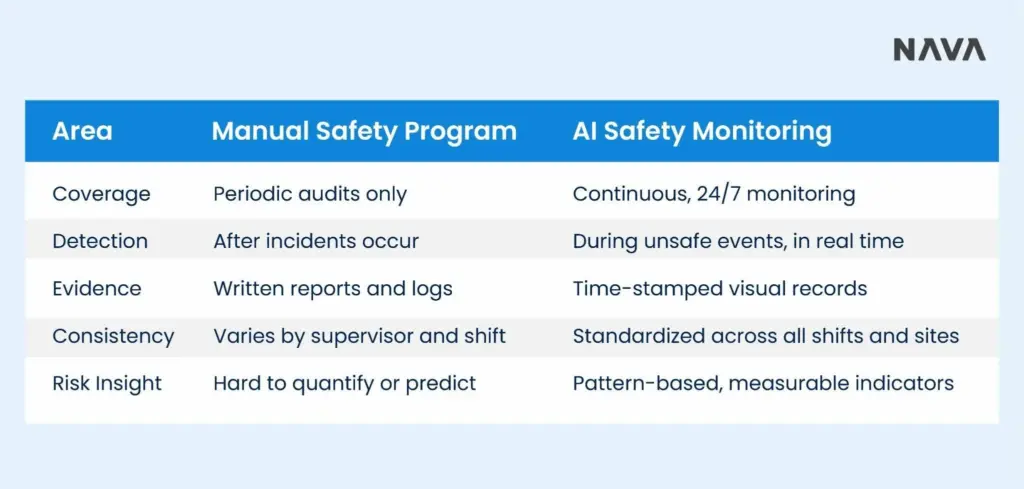
The core difference is timing. Manual programs measure risk after the fact. AI measures risk as it builds.
Most EHS programs currently track lagging indicators, meaning injury rates and after-the-fact reports. AI introduces leading indicators that tell you where risk is building before an incident is recorded.
| KPI | What It Measures |
| PPE Compliance Rate | Tracks the percentage of workers wearing required protective equipment per zone and shift. |
| Near-Miss Frequency | A leading indicator. Measures risk before an incident is recorded. |
| Restricted Zone Breaches | Counts unauthorized entries into high-risk areas per day or week. |
| Forklift Proximity Alerts | Flags unsafe proximity between moving equipment and workers in real time. |
| Response Time | Measures how quickly supervisors act after an unsafe event is detected. |
| Audit Documentation Time | Reduced when AI auto-generates time-stamped visual records. |
| Recurring Risk Hotspots | Identifies zones or shifts where unsafe behavior keeps repeating. |
Not all workplace safety inspection software is built for industrial environments. Before committing to a deployment, run through this checklist:
Any platform that cannot answer yes to most of these questions is either a generic solution or one not built for real industrial operations.
This is not just a compliance conversation. Every preventable incident carries a cost. Think about what one serious workplace injury triggers:
AI safety monitoring does not eliminate risk entirely. But it reduces the frequency of preventable events and builds a documented compliance trail.
For operations leaders running multi-site facilities, this also solves a consistency gap. What gets enforced on Site A is not always enforced on Site B. Vision AI standardizes monitoring across every location.
The business case is direct: fewer incidents mean less downtime, lower compensation costs, and stronger evidence during audits. Safety tied to operational cost is a conversation every CEO engages with.
Most industrial operations already have camera infrastructure in place. The problem is not the lack of visibility tools. The problem is that nearly all video data remains operationally unused.
NAVA Vision AI transforms existing CCTV systems into real-time operational intelligence that helps enterprises reduce safety incidents, automate monitoring, improve throughput, and lower operational costs across logistics, warehousing, manufacturing, retail, and energy environments.
Instead of relying on manual supervision, delayed reporting, or reactive investigations, NAVA enables operations teams to detect, analyze, and respond to events as they happen.
NAVA SafetyVision AI is built on this principle. Deployed on a facility's existing CCTV infrastructure, no new cameras, no new hardware, no costly rip-and-replace, the system uses trained computer vision models to detect risk events in real time and route instant alerts to supervisors, control rooms, or site safety leads.
| "We already have cameras everywhere." | That's precisely why this works. SafetyVision AI connects to your existing CCTV network, no new hardware is required. Your cameras become intelligent. |
| "Won't this create tension on the floor?" | Framing matters. The system is positioned as worker protection, not surveillance. Alerts are coaching moments, not disciplinary triggers and that distinction is established in the rollout. |
| "How long does implementation take?" | A Proof of Concept typically runs within days of connection to existing infrastructure. You see live alerts and early data before committing to full-site deployment. |
| "We're OSHA compliant already." | Compliance is the floor, not the ceiling. OSHA compliance tells you your documentation is in order. SafetyVision AI tells you what's actually happening on the floor right now. |
Industrial operations are no longer struggling with a lack of cameras. They are struggling with a lack of operational intelligence from the cameras they already own.
NAVA Vision AI closes that gap by turning existing infrastructure into a scalable, real-time intelligence layer that improves safety, operational efficiency, compliance visibility, and cost control across the enterprise.
Workplace safety in 2026 is not a question of whether your policies are strong enough. It is a question of whether your visibility is.
Audits happen once a week. Incidents happen at 2 AM on a Tuesday. The gap between those two moments is exactly where Vision AI operates.
Companies already running CCTV infrastructure can turn that existing investment into a measurable safety layer. The shift from incident response to risk prevention does not require a full facility overhaul. It requires the right platform connected to the cameras you already have.
Ready to see what your cameras are missing? Schedule a Zero-Cost POC with NAVA SafetyVision AI
FAQs


