
Blog
5 Best Predictive Maintenance Software Platforms for Manufacturers
By Rakesh· August 11, 2026· 7 min read
Summarize this post with

Loading insights...
LoadingSummarize this post with
Your sensors can't see what your cameras already do. This guide compares 5 leading platforms, from sensor-driven tools like IBM Maximo and AVEVA to CMMS options like Fiix and Coast. It also breaks down NAVA's real-time vision AI approach, which uses existing cameras to catch issues from day one no new hardware required. Read on to find the right fit for your floor.
A single unplanned breakdown can cost a manufacturer thousands of dollars an hour in lost production, rushed repairs, and missed deadlines. For plant managers and reliability engineers, that risk never really goes away; it just gets more expensive to ignore.
That's why predictive maintenance has moved from "nice to have" to a core operational strategy, helping teams catch problems before they become costly failures. But not all predictive maintenance software solves this the same way.
Some traditional platforms rely on IoT sensors and machine learning, while others use real-time computer vision AI, and some blend analytics with automation.
This guide breaks down five leading predictive maintenance software platforms and helps you choose the best based on the ROI and right fit for your floor.
| Platform | Approach | Best For | Key Strength |
| NAVA | Real-time vision AI-based monitoring using existing cameras | Manufacturers wanting fast deployment without new hardware | Catches anomalies real-time; no sensor rollout, real-time insights |
| IBM Maximo | AI/ML-based predictive analytics (Maximo Predict, Health, Monitor) built into enterprise EAM. | Large, asset-intensive enterprises | Uses AI and machine learning to forecast asset failures by analyzing historical data, real-time sensor readings, and maintenance records |
| AVEVA | Sensor-driven predictive & prescriptive analytics (AVEVA Predictive Analytics / APM) | Process industries (oil & gas, power, chemicals) | Time-to-failure forecasting identifies asset anomalies weeks or months before failure, in a no-code environment |
| Fiix | CMMS + IoT sensor-based predictive maintenance (Asset Risk Predictor) | Mid-to-large manufacturers wanting CMMS + PdM in one | IoT-enabled sensors combined with AI help predict asset failures before they occur, reducing both downtime and over-maintenance |
| Coast | Mobile-first CMMS (work orders, PM scheduling); predictive is an add-on via hardware integration | SMB/mid-market teams wanting simple, flexible CMMS | Workflow flexibility: custom fields, custom views, automations, multi-site tools; predictive maintenance workflows possible by connecting to hardware systems |

NAVA takes a fundamentally different approach to predictive maintenance. Instead of relying on sensors and months of historical data, NAVA uses AI-powered computer vision solutions running on cameras manufacturers already have to deliver real-time predictive insights across equipment and operational areas.
Strengths:
Benefits for manufacturers:
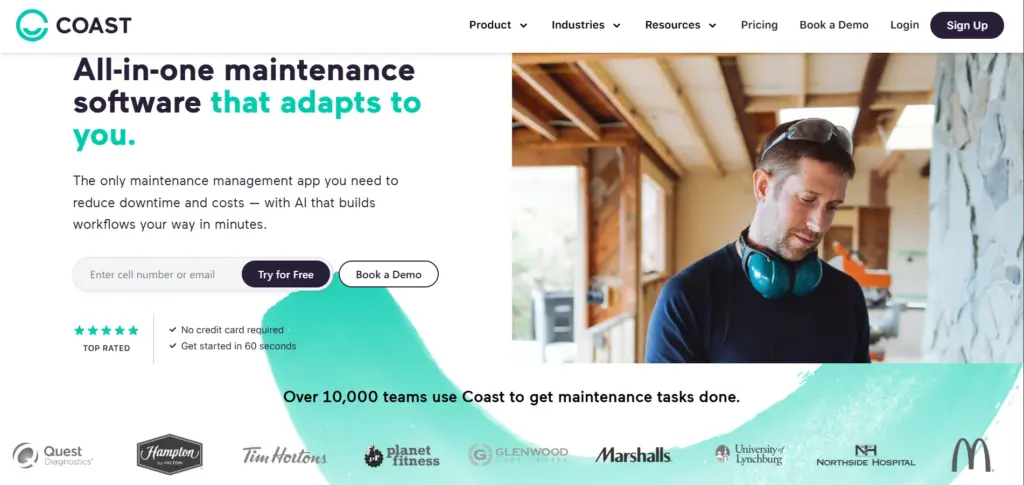
Coast is a mobile-first CMMS built for SMB and mid-market manufacturers wanting flexible, easy-to-adopt maintenance management. It centralizes work orders, preventive maintenance scheduling, and asset tracking. With predictive maintenance enabled by connecting to external hardware and sensor systems rather than being built in natively.
Strengths:
Limitation: Predictive capabilities aren't native; manufacturers need to invest in and integrate separate IoT hardware to unlock true predictive maintenance.
IBM Maximo is an enterprise-grade EAM platform suited for large, asset-intensive organizations across industries like oil & gas, utilities, and manufacturing.
Its predictive capabilities Maximo Predict, Health, and Monitor apply AI and machine learning to historical data, real-time sensor readings, and maintenance records to forecast asset failures.
Strengths:
Limitation: Implementation is resource-intensive, typically requiring dedicated IT and data science support for model configuration and maintenance.

AVEVA is built for process industries oil & gas, power, and chemicals where continuous, asset-intensive operations are the norm. Its Predictive Analytics and Asset Performance Management (APM) tools use sensor data and machine learning to forecast failures well in advance.
Strengths:
Limitation: The platform is purpose-built for heavy process plants, which can make it more infrastructure than a lighter discrete manufacturing line needs.
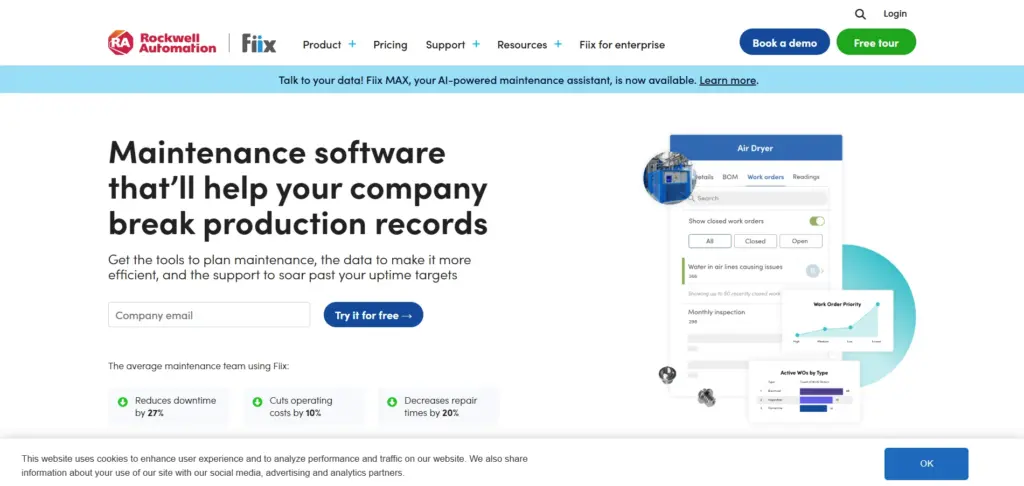
Fiix is a cloud-based CMMS suited for mid-to-large manufacturers that want predictive maintenance built into a broader maintenance management system. It combines work order management, preventive scheduling, and asset tracking with IoT-enabled sensors and AI-driven analytics that forecast failures before they occur.
Strengths:
Limitation: Predictive capabilities depend on IoT sensor deployment, requiring upfront hardware investment before full value is realized.
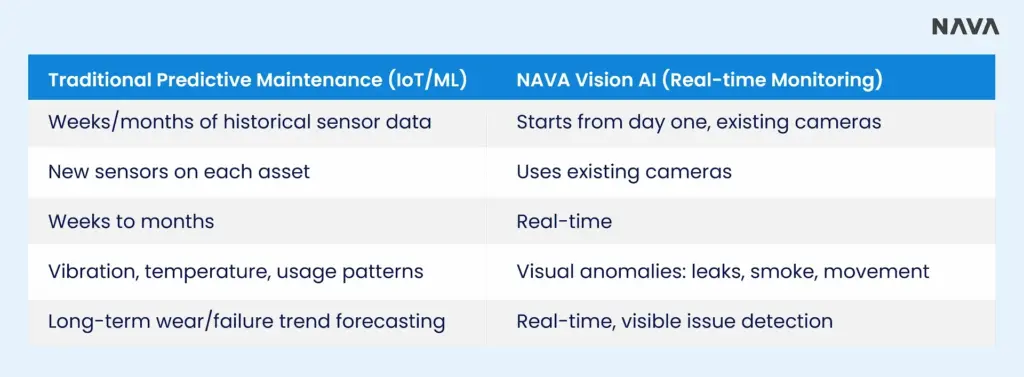
As the table shows, traditional predictive maintenance and real-time vision solve different parts of the same problem.
Sensor-based models are strong at forecasting long-term wear and mechanical degradation.
There's no single "best" predictive maintenance platform; the right choice depends on your assets, your existing infrastructure, and how much sensor investment you're ready to make.
IBM Maximo and AVEVA suit large, asset-intensive enterprises with the resources to build out full predictive programs. Fiix and Coast offer more accessible CMMS-based paths into predictive maintenance for growing manufacturers.
NAVA, meanwhile, offers a complementary route, turning cameras you already have into a real-time layer of visibility, without waiting months for a sensor-driven model to learn your equipment.
For most manufacturers, the strongest strategy isn't choosing one approach over another; it's understanding which pieces of the puzzle each platform solves, and building a maintenance program around the one that matches where your operation is today.