Blog
AI-Powered Video Analytics for Workplace Safety: How It Works, Key Features & ROI
By Rakesh· July 6, 2026· 10 min read
Summarize this post with

Loading insights...
LoadingSummarize this post with
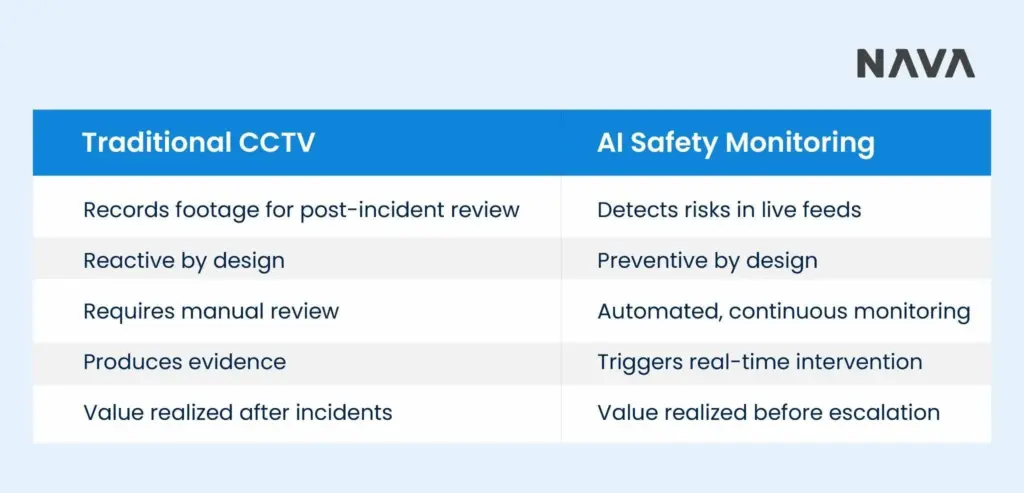
AI-powered video analytics uses computer vision models to monitor live video feeds, detect safety risks in real time, and trigger automated alerts. Unlike traditional CCTV, which records footage for post-incident review, AI video analytics identifies PPE non-compliance, unauthorized zone access, and unsafe equipment movement as they happen.
The problem with manufacturing, logistics, or construction sites today is that traditional CCTV installed at their sites is reactive. Incidents are reviewed after they happen, not prevented before they escalate.
Their existing workflows and security measures fail and cannot prevent an incident from happening. Manual monitoring creates fatigue. Supervisors miss violations. Footage reviews happen days or weeks after incidents, when context is already lost.
Now they are into deploying so-called AI-powered Video analytics solutions. What most companies fail to understand here is that deployment without calibrated alerts and defined KPIs turns AI systems into expensive background noise.
AI video analytics converts passive cameras into an active safety-monitoring infrastructure using existing hardware.
There are advanced AI video analytics solutions, such as Vision AI, that enhance workplace safety with real-time intelligent insights and alerts for PPE violations, forklift proximity risks, restricted-zone breaches, and more. They trigger alerts before incidents escalate.
Most facilities spend on cameras but not on visibility. PPE violations happen in real time. Reviews happen days later.
AI video analytics closes that gap. But only when deployed with the right KPIs, calibrated alert logic, and operational workflows from day one.
Read further to understand how Vision AI solutions reduce incident frequency, lower manual monitoring costs, speed up compliance reporting, and improve measurable response time across high-risk areas.
This article covers how AI video analytics works, which features actually matter, where companies waste budget, and how to calculate ROI before committing to deployment.
Most facilities have cameras everywhere. Very few have visibility.
Traditional CCTV was designed for evidence, not prevention. When an incident happens, the footage is there. But the incident already happened.
Manual monitoring makes this worse. A single operator watching eight to twelve feeds simultaneously will miss violations. Monitoring fatigue sets in within 20 minutes, a finding consistently supported by occupational safety research. PPE violations, forklift proximity risks, and unauthorized zone entries happen between glances.
Statistics: The Cost of Reactive Sfety Monitoring (2025-2026 Data)
| Metric | Finding | Source |
| Annual cost of workplace injuries (US) | $167 billion in lost productivity, medical costs, and administrative burden | NSC (2025) |
| Fatal occupational injuries (US, 2023) | 5,486 fatalities reported; transportation and material-moving account for the largest share | BLS (2024) |
| Average cost per nonfatal workplace injury | $44,000 in direct and indirect costs per event | NSC (2025) |
| PPE non-compliance contributes to injuries | Failure to use PPE is cited in 70% of eye and face injuries; OSHA ranks PPE violations among its top 10 annual citations. | OSHA (2025) |
AI-powered video analytics applies computer vision models to live or recorded video feeds to detect specific events, behaviors, and safety conditions automatically.
It is not security software. It is an operational infrastructure. The distinction matters for how teams configure, deploy, and measure it.
AI-powered video analytics is not replacing cameras. It is changing what those cameras can actually do operationally.
Instead of recording incidents for later review, the system detects risks, safety violations, and operational threats while they are happening.
Most facilities do not need new hardware. AI video analytics systems connect to existing IP cameras, CCTV networks, and edge devices.
This matters for budget and adoption. Facilities already have the infrastructure. The gap is in what that infrastructure is doing with the footage.
Computer vision models process live feeds continuously. They are trained to detect:
When a model identifies a risk condition, it flags it immediately. Examples include:
The system routes alerts through SMS, dashboard notifications, or direct escalation workflows. Incident logs are automatically created. Audit trails are maintained without manual data entry.
The features below matter because they reduce response time, improve accountability, and help facilities act before minor violations become operational disruptions.
Speed of detection is only part of the equation. What matters operationally is how fast alerts reach people who can act on them. Systems that route alerts through five approval steps before reaching a supervisor are not operational safety tools.
Manual PPE enforcement breaks at scale. A supervisor managing 40 workers across three zones cannot physically verify compliance every hour. AI monitoring does this continuously, without fatigue.
Warehouses and logistics hubs are the highest-risk environments for vehicle-pedestrian conflicts. AI models track forklift movement, pedestrian positions, and proximity thresholds simultaneously. That level of situational awareness is not achievable through manual observation.
Unauthorized zone entry is one of the most underreported safety violations. Most facilities rely on physical barriers or supervisor awareness. Neither scales to 24-hour operations across multiple shifts.
When incidents occur, documentation is immediate. Video clips, timestamps, alert logs, and response records are automatically generated. This reduces investigation time and strengthens insurance claims, audit preparation, and compliance reporting.
Where AI Video Analytics Delivers ROI
AI video analytics creates ROI when it reduces operational delays, safety incidents, manual monitoring hours, and compliance exposure at the same time.
The strongest deployments are not built around surveillance. They are built around measurable operational outcomes.
| Industry | Primary Use Case | ROI Driver |
| Manufacturing | PPE monitoring across production floors | Reduced incident frequency and OSHA citations |
| Warehousing | Forklift and pedestrian safety | Collision reduction and downtime prevention |
| Logistics | Dock and loading area monitoring | Fewer operational delays and faster compliance |
| Construction | Fall detection and zone access | Compliance improvement and insurance cost reduction |
| Industrial Facilities | Hazardous area monitoring | Reduced exposure incidents and audit readiness |
Most facilities focus ROI calculations on hardware cost. The more accurate calculation includes:
Downtime prevention through early-stage risk detection
KPI Measurement Framework
Any vendor who cannot tie their system to at least three of these KPIs should prompt harder questions before sign-off.
| KPI | Why It Matters | How To Measure |
| Incident frequency rate | Measures prevention effectiveness over time | Compare pre- and post-deployment rates monthly |
| PPE compliance rate | Tracks adherence at scale across all shifts | System-generated compliance percentage by zone |
| Alert response time | Measures the speed of operational intervention | Time from alert trigger to supervisor acknowledgment |
| Downtime hours | Shows the direct operational impact of incidents | Shift reports pre- vs. post-deployment |
| Manual monitoring hours | Tracks labor cost reduction | Supervisor hours reallocated from monitoring duties |
Common Deployment Mistakes
Most AI video analytics failures do not happen because the technology breaks. They happen because deployment decisions are made without operational planning.
The mistakes below are common, expensive, and usually discovered after the system is already live.
Most facilities already have sufficient coverage. Deployment costs inflate unnecessarily when this step is skipped.
Security software optimizes for recording. Safety software optimizes for prevention. Configuring one for the other creates the wrong alert logic from day one.
Alert fatigue is real. Systems generating 300 alerts per day for events requiring no action will be turned off or ignored within two weeks. Calibration is not optional. It is the difference between operational adoption and expensive abandonment.
If you cannot measure before, you cannot prove after. Incident frequency rates, PPE compliance levels, and manual monitoring hours should all be documented before deployment starts.
Most workplace safety systems generate footage, reports, and alerts. Very few improve operational response time in real environments.
SafetyVision AI is designed around reducing safety blind spots, improving intervention speed, and helping facilities act before incidents escalate.
SafetyVision AI converts passive CCTV systems into real-time operational safety infrastructure. The focus is not on surveillance volume. It is on measurable visibility and faster response cycles.
Most companies do not need new camera systems. SafetyVision AI integrates with existing hardware, reducing deployment friction, implementation cost, and operational disruption from day one.
SafetyVision AI is built for manufacturing, logistics, warehousing, and industrial facilities where PPE compliance, forklift movement, restricted-zone access, and worker safety require continuous monitoring at scale.
Operations teams do not need more surveillance footage. They need faster intervention, fewer incidents, and measurable accountability. SafetyVision AI is designed around that operational reality, not around dashboard aesthetics.
What the Next 3 Years Will Look Like
AI-driven compliance monitoring will shift from optional to expected. Insurance carriers are already moving toward operational data requirements for industrial facilities. That pressure will accelerate.
Real-time operational intelligence will become standard across tier-one manufacturers and logistics operators. Edge AI adoption will reduce latency and cloud dependency in high-throughput environments where network reliability is a constraint.
The biggest shift is not surveillance. It is operational visibility becoming measurable in real time, with direct accountability to safety, compliance, and insurance outcomes.
Traditional CCTV records what happened. AI video analytics prevents what is about to happen.
The value is not in watching more footage. It is in reducing preventable operational losses before they escalate into incidents, investigations, and facility shutdowns.
Most facilities already have cameras. The problem is that no one is watching in real time. That gap, between recording and responding, is where preventable losses accumulate.
Still reviewing footage after incidents rather than receiving alerts before them? Most facilities already have the cameras and workflows. The problem is operational visibility. That gap usually appears after deployment, not before it.
Schedule an operational assessment with SafetyVision AI to identify where your current setup leaves blind spots.


