Blog
Edge AI vs Cloud-Based Computer Vision: Which Is Right for Industrial Operations?
By Satish· July 14, 2026· 8 min read
Summarize this post with

Loading insights...
LoadingSummarize this post with
Cloud-only vision AI often breaks down in real industrial environments where decisions cannot wait. Latency, connectivity drops, and rising cloud costs turn real-time detection into delayed insights, causing missed events on fast-moving manufacturing and logistics floors.
This blog examines why so many computer vision deployments underperform when they move from demo to production. It breaks down the real performance gaps between cloud and edge systems using industrial use cases where speed and reliability directly impact safety and operations.
It also shows how edge and hybrid Vision AI solutions change the equation by processing data on-site in milliseconds while sending only key insights to the cloud. The result is faster responses, lower costs, and systems built to actually work on the plant floor, not just in theory.
Cloud vision AI sounds efficient on paper. Cameras stream video, a cloud model processes the frames, and the results are returned. In a controlled demo environment, that works fine.
In a real logistics yard or manufacturing floor, it does not.
Here is what actually happens:
Edge vision AI runs the AI inference model directly on a hardware device at the facility: a camera, a gateway device, or a dedicated edge compute unit such as an NVIDIA Jetson.
The model processes video locally, makes a decision in milliseconds, and sends only the relevant metadata (an event trigger, a bounding box coordinate, a vehicle ID) to the cloud or an on-premises system.
What does this mean operationally?
This is not just a speed upgrade. It is an architectural change that affects cost, security, and operational reliability simultaneously.
Edge AI and Cloud Vision AI solve the same problem in very different ways. One prioritizes speed and on-site decision-making, while the other relies on cloud-based centralized processing.
This difference directly impacts latency, cost, privacy, and real-time performance in industrial environments.
| Criteria | Edge Vision AI | Cloud Computer Vision |
| Detection Latency | Under 50 ms | 300-800+ ms |
| Bandwidth Usage | Minimal (metadata only) | High (full video streams) |
| Offline Operation | Yes | No |
| Data Privacy | Video stays on-site | Raw video sent offsite |
| Cloud Compute Cost | Low | Scales with camera count |
| Scalability | 1-1000+ sites | Limited by bandwidth/cost |
| Model Updates | Remote push | Centralized, easier to manage |
| Best For | Real-time critical events | Batch analysis, archival AI |
Not every computer vision use case requires edge processing. But certain operational scenarios make cloud-only approaches unworkable.
YardVision AI at facility gates must read plates, verify vehicle authorization, and trigger gate movement within 1-2 seconds. Cloud round-trips add 500-900 ms of delay. That compounds into serious throughput loss at high-traffic gates.
A worker entering a restricted zone without PPE requires an immediate alert, not a 700-ms delayed notification. Edge AI detects violations in real time and can trigger an audible alert before a safety incident escalates.
Dock analytics require continuous monitoring of dwell times, trailer positioning, and loading activity. Streaming 8-12 dock cameras continuously to the cloud is cost-prohibitive at scale. Edge processing handles this locally and sends event summaries to dashboards.
Cargo and vehicle damage inspection at entry and exit points needs precise image analysis with clear timestamp records. Edge AI runs the inspection model on-site and sends flagged images plus metadata upstream, keeping storage costs manageable.
NAVA's Edge Intelligence service is designed for the operational realities of logistics yards, warehouses, ports, manufacturing floors, and energy sites. Here is how it addresses the gaps left by cloud-only vision AI.
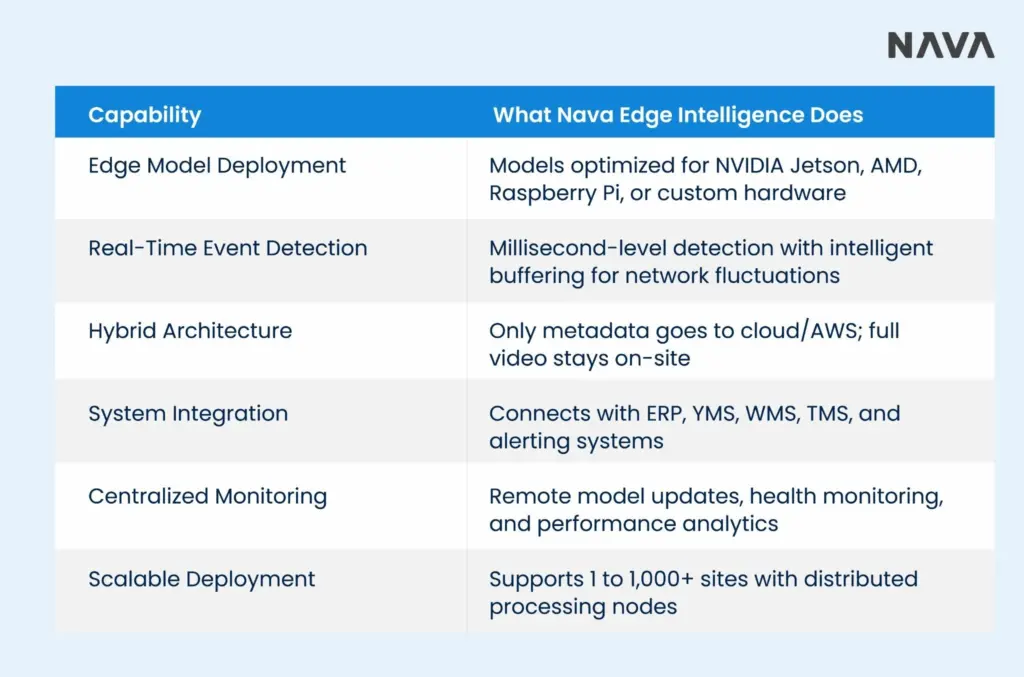
NAVA's edge models are trained and tuned for challenging real-world conditions: low light, weather changes, dynamic workflows, and mixed equipment types. This matters because a model that performs well in a controlled demo may degrade significantly in an active yard with dust, rain, and forklift congestion.
For deployment details and case studies, visit the Learn more about NAVA Edge Intelligence
Edge AI is the right architecture for real-time industrial events. Cloud computer vision still has a role in specific scenarios:
The practical answer for most large industrial operations is a hybrid model. Edge handles real-time detection and local action. Cloud handles aggregation, reporting, and model management. This is the architecture around which NAVA's Edge Intelligence platform is built.
Before choosing a vision AI solution, whether edge, cloud, or hybrid, use this checklist:
A vendor who struggles to answer the accuracy and integration questions clearly is optimizing for demos, not deployments.
| Metric | Edge AI Result | Cloud Only Result |
| Average Detection Latency | 35-60 ms | 350-800 ms |
| Bandwidth Reduction | 80-95% | Baseline |
| Uptime During Outages | Continued operation | Zero detection |
| Cloud Compute Cost (50 cameras) | 60-70% lower | Baseline |
| False Positive Rate (outdoor) | 5-8% | 12-18% |
NAVA offers a zero-cost Proof of Concept for industrial operations. We assess your existing camera infrastructure, identify the highest-impact use cases, and deploy a working edge AI model at your site, with no obligation to proceed.
Book your Zero-Cost PoC with NAVA. No simulated demos, no generic footage, just real performance tested directly in your own operational environment. See exactly how it works where it matters most.