Blog
How Long Does Computer Vision AI Deployment Actually Take?
By Rakesh· July 8, 2026· 7 min read
Summarize this post with

Loading insights...
LoadingSummarize this post with
Most AI deployments don’t fail because of the technology, they fail because timelines spiral out of control. This blog reveals what computer vision AI deployment actually takes and how NAVA Vision AI helps enterprises go live faster using existing CCTV infrastructure, without the delays of custom AI development.
Every vendor says deployment is fast. Enterprise teams find out the hard way that fast is relative.
The typical computer vision deployment fails not because the AI models are weak, but because the deployment itself is underplanned. Infrastructure gaps, integration mismatches, and undefined success metrics add weeks or months to every rollout.
This Blog gives you the real timeline: what a well-run deployment looks like, where delays happen, and why AWS-based computer Vision AI platforms are shortening the curve significantly.
Short answer: 4 to 12 weeks for a structured rollout on existing CCTV. Longer if you need new hardware, WMS integrations, or custom model training.
Here is the range by deployment type:
| Deployment Type | Typical Timeline | Key Dependency |
| Existing CCTV, pre-built models, cloud | 2 to 4 weeks | Network access and camera calibration |
| Existing CCTV, pre-built models, edge | 4 to 8 weeks | Edge hardware procurement and setup |
| New camera infrastructure required | 8 to 16 weeks | Physical installation and cabling |
| Custom model training required | ~ 12 weeks | Dataset collection, labeling, training cycles |
| Enterprise multi-site rollout | 3 to 6 months | Site-by-site staging and integration governance |
The fastest deployments use pre-built AI models on a Vision AI platform connected to existing cameras. NAVA's four-step process covers camera onboarding, model activation, dashboard integration, and ROI tracking without requiring custom development.
Most delays in enterprise AI deployment are not technical. They are organizational. Here is where time actually gets lost:
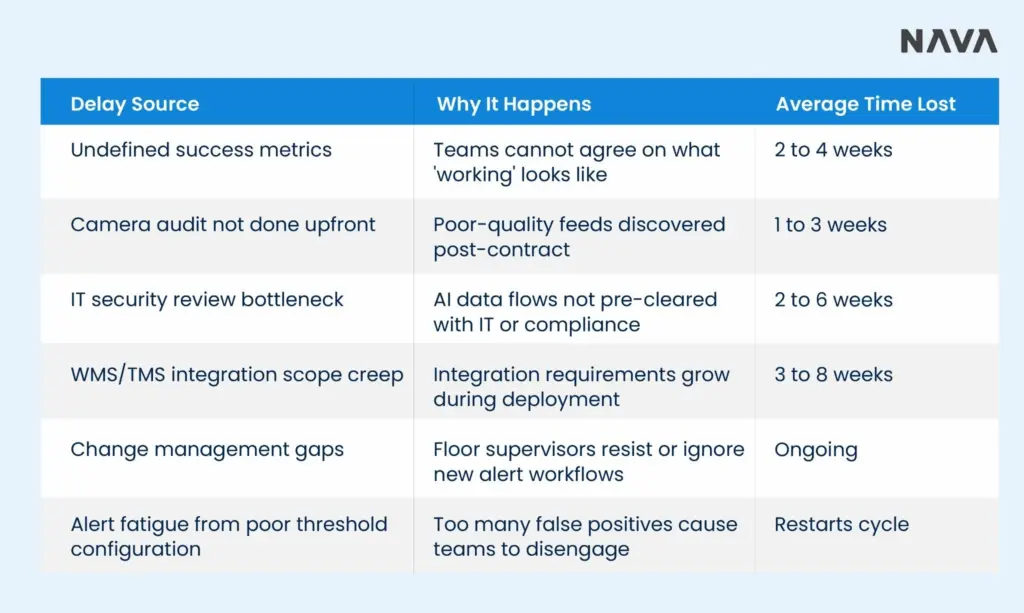
The pattern is consistent: projects that define scope, success criteria, and integration requirements before kickoff deploy significantly faster. According to a 2024 Verdantix survey, enterprise AI projects with a formal pre-deployment readiness assessment deployed 47 percent faster than those that did not.
This is what a well-structured computer vision deployment looks like on existing CCTV infrastructure using a pre-built Vision AI platform:
Full operational handover at week 8. ROI reporting begins at week 12 with sufficient baseline comparison data.
Architecture choice is the single biggest variable in deployment timeline after infrastructure readiness. It also has major implications for compliance and operational cost.
| Factor | Cloud Only Processing | Edge Intelligence Processing |
| Deployment speed | Faster initial setup (2 to 4 weeks) | Slightly longer (4 to 8 weeks with hardware) |
| Detection latency | 200ms to 2 seconds | Under 50ms, often under 10ms |
| Bandwidth requirement | High (continuous video stream) | Low (metadata and events only sent to cloud) |
| Data privacy compliance | Requires video leaving site | Raw video stays on-site, GDPR and SOC 2 aligned |
| Cloud cost over time | Scales with camera volume | Lower ongoing compute cost post-deployment |
| Connectivity dependency | High (downtime = no detection) | Low (operates independently if cloud disconnects) |
For logistics yards, manufacturing floors, ports, and energy sites where milliseconds matter, edge processing is not optional. NAVA's Edge Intelligence service runs Vision AI models directly onsite, so detection happens instantly regardless of network conditions.
Privacy-sensitive industries (healthcare, finance, government) almost always require edge deployment because raw video cannot leave the facility. NAVA's Edge Intelligence ensures raw video stays on-site with encrypted metadata transmitted to cloud dashboards.
AWS infrastructure changes the deployment equation in two specific ways: procurement speed and model reliability.
On procurement: NAVA's Vision AI solutions are available directly on AWS Marketplace. For enterprises already running on AWS, this removes the procurement and legal review cycle entirely. Deployment can begin within days of a purchase decision rather than weeks.
On model reliability: NAVA's AI models on AWS Bedrock are production-tested across logistics, manufacturing, and industrial environments. Enterprise teams are not deploying experimental models. They are activating detection pipelines that have been calibrated against real operational data.
What AWS computer vision deployment typically looks like end-to-end:
For enterprises evaluating AWS-based Vision AI options, AWS Marketplace's Vision AI listings include ANPR AI, SafetyView AI, CollisionView AI, DockView AI, DamageView AI, InventoryView AI, and TheftProtectionView AI, each deployable independently or as a unified platform.
Founders and operations leaders who answer these questions before kickoff cut their deployment timeline by 30 to 50 percent:
| Readiness Area | Questions To Answer | Risk If Skipped |
| Camera infrastructure | What resolution, how many feeds, what coverage gaps exist? | Recalibration delays post-contract |
| Network architecture | Edge, cloud, or hybrid? Bandwidth available per site? | Latency or compliance issues discovered late |
| Integration scope | Which systems need to connect: WMS, TMS, YMS, EHS? | Integration scope creep and timeline extension |
| Success metrics | What does 'deployed and working' mean in measurable terms? | No baseline for ROI reporting or go-live criteria |
| Compliance requirements | GDPR, SOC 2, HIPAA, ISO 27001 constraints on data flow? | Security review holds deployment mid-process |
| Change management plan | Who receives alerts? What workflows change? Who trains the team? | Low adoption post-deployment |
The fastest way to validate deployment timeline for your specific environment is a scoped proof of concept against your actual CCTV infrastructure. NAVA offers a zero-cost POC for qualified facilities, covering camera assessment, model activation, and a live detection demonstration within two weeks.
No new hardware required. No long procurement cycle. A clear picture of what deployment looks like in your operation before committing to full rollout.
Most teams spend 6 to 8 weeks asking vendors the wrong questions. You now know the right ones.
NAVA's zero-cost POC runs against your actual cameras, your actual facility, and delivers a live detection demonstration in two weeks, not a slide deck.
Book your Zero-Cost POC and know exactly what deployment looks like before you commit.