Blog
Forklift Pedestrian Safety: How Vision AI Prevents Collisions in Real Time (2026 Guide)
By Rakesh· June 25, 2026· 8 min read
Summarize this post with

Loading insights...
LoadingSummarize this post with
Forklift and pedestrian incidents continue in warehouses because most teams lack visibility into how risk develops during daily operations. Safety measures guide behavior but do not consistently capture near-miss events or recurring risk patterns. Vision AI addresses this gap by turning existing camera feeds into continuous safety data, enabling earlier risk detection and action before incidents occur.
The core issue is not the absence of safety measures, but the lack of visibility into how risk develops across daily operations. Existing controls guide behavior and respond to immediate danger, but they do not show how often unsafe interactions occur, where risk tends to concentrate, or whether conditions change over time.
As a result, near-miss events and recurring unsafe interactions remain largely unmeasured, making it difficult to understand where risk is building and where action is needed.
Vision AI changes how safety is managed in practice. By using existing camera infrastructure to continuously monitor interactions, systems such as SafetyView AI capture near-miss events, identify recurring unsafe interactions, and support earlier intervention.
In a high-velocity warehouse, forklift safety issues are rarely isolated events. They are symptoms of a "visibility gap", the space between safety protocols on paper and the reality of a busy floor.
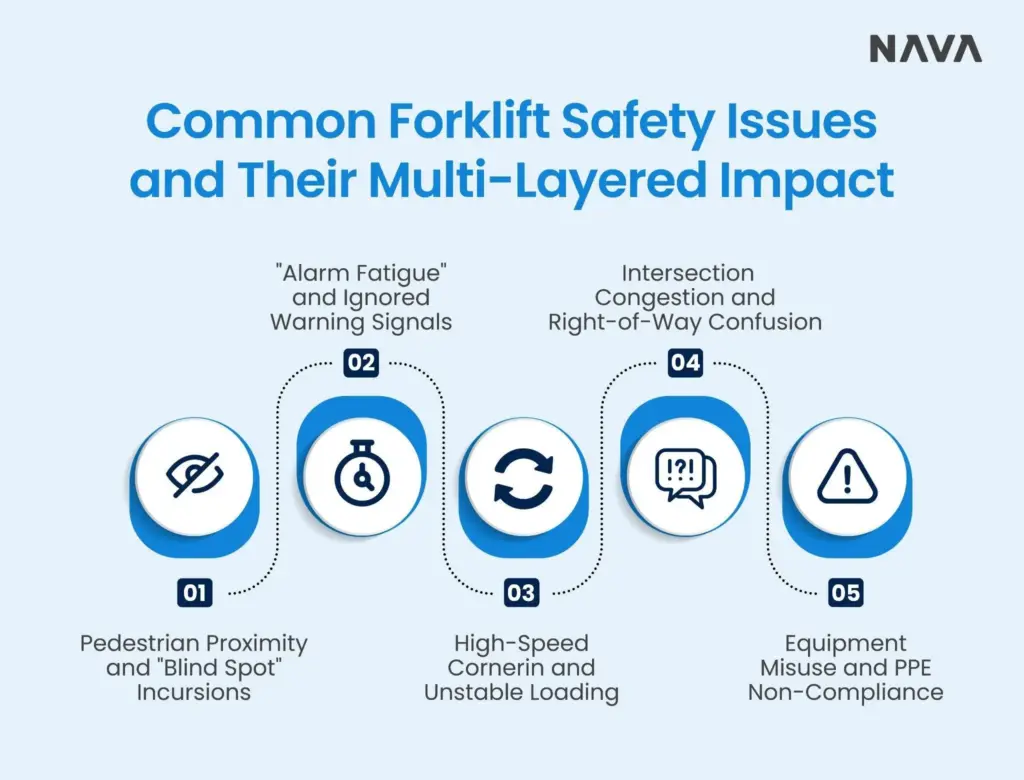
Despite floor markings and mirrors, pedestrians and forklifts frequently occupy the same space simultaneously.
Most warehouses rely on blue lights, backup beepers, and sirens.
The pressure to meet "Units Per Hour" (UPH) targets often leads to aggressive driving.
Intersections are the "danger zones" of the warehouse, especially during shift changes or peak seasons.
Most industrial facilities aren't neglecting safety; they are simply outgrowing manual oversight. You likely already have:
The Problem: OSHA reports approximately 85 fatalities and 34,900 serious injuries involving forklifts annually. These numbers remain stagnant because traditional tools only record accidents, not the thousands of near-misses that precede them.
In real operating conditions, safety measures such as training programs, physical barriers, and warning systems do not always perform as consistently as expected, particularly in environments with continuous movement and multiple shifts.
The table below summarizes where common safety measures are effective and where those measures fall short in dynamic environments.
| Safety Measure | What It Addresses | Operational Limitation |
|---|---|---|
| Operator Training | Awareness and safe behavior | Depends on consistent human attention and response |
| Physical Barriers | Separation of people and equipment | Limited to fixed zones, does not adapt to movement |
| Warning Systems | Immediate hazard alerts | Reacts to proximity, not context or direction of travel |
| CCTV Monitoring | Incident review and investigation | Requires manual review, not designed for real-time action |
| Safety Audits and Reports | Compliance and periodic assessment | Snapshot-based, not continuous or event-driven |
Near-miss events are the most valuable safety signal available, and the most consistently unmeasured.
A near-miss is not just a close call. It is evidence that the conditions for a serious incident already exist in your facility:
When these conditions are not captured and addressed, they repeat.
Traditional safety systems are not built to record near-misses reliably. Voluntary reporting depends on a worker or supervisor noticing an unsafe interaction, judging it significant, and choosing to log it, all in the middle of a busy operational shift. In practice, this means:
The gap between what is reported and what is actually occurring is significant. Safety managers are making prioritization and intervention decisions based on a partial picture of on-the-floor conditions.
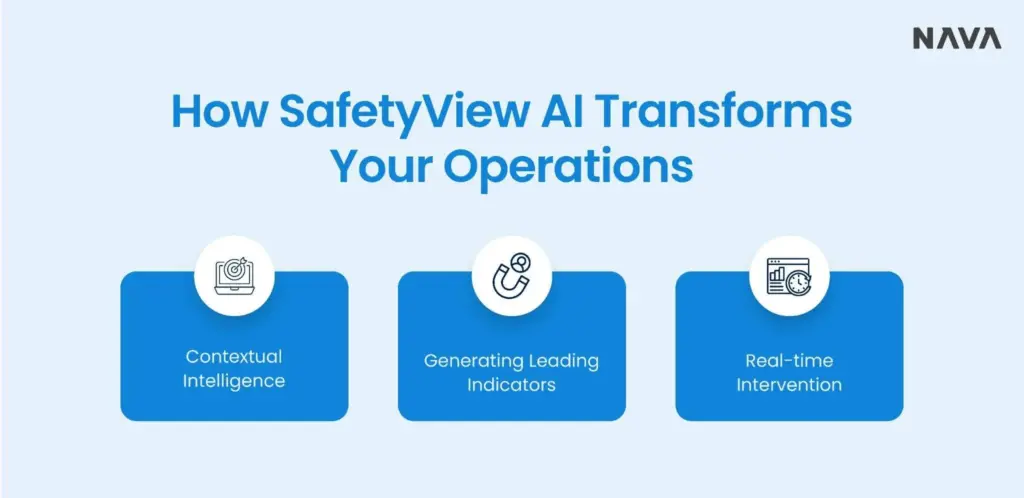
Unlike standard proximity sensors that beep at everything, SafetyView AI understands context.
The system distinguishes between a forklift moving away from a worker and one on a collision course at an intersection. This reduces false alarms and ensures that when an alert sounds, it matters.
We shift your KPIs from Lagging Indicators (how many people were hurt last month) to Leading Indicators (how many near-misses we prevented this morning).
When a zone violation occurs, SafetyView AI can:
To improve forklift pedestrian safety:
AI-powered forklift safety improves:
Forklift pedestrian safety is not just about rules; it’s about visibility.
Without real-time insight, risks build unnoticed until an incident occurs.
AI-powered forklift safety changes this by turning existing cameras into continuous monitoring systems. Instead of relying on assumptions, teams can detect unsafe interactions, track near-misses, and act before incidents happen.
Platforms like NAVA SafetyView AI make this possible without requiring new hardware, giving organizations a scalable way to improve both safety and operational efficiency.
The result is simple: fewer blind spots, faster response, and safer warehouse environments.
Ready to add a more secure layer to your forklift operations?


