Blog
7 Machine Vision Systems for Industrial Quality Inspection
By NAVA Software· August 5, 2026· 15 min read
Summarize this post with

Loading insights...
LoadingSummarize this post with
I've walked enough plant floors to know how quality inspection used to work. A worker pulls a handful of parts off the line. They look for obvious defects. Everything else passes through on faith.
That approach made sense once. Production ran slower. Tolerances were looser. Nobody was checking every single unit, because nobody needed to.
Today's lines move too fast for that. A single missed defect can trigger a recall, a safety incident, or a warranty claim that costs far more than the part itself. Sampling a handful of units and hoping the rest hold up is not a strategy anymore.
Machine vision systems fix this by giving your line a set of digital eyes that never blink, never get tired, and never miss a frame. Cameras, sensors, and AI models work together to inspect every unit that passes through, in real time, at a level of consistency no manual process can touch.
Here are seven machine vision systems I see industrial teams rely on for quality inspection. I'll walk through what each one does best, where it falls short, and where the technology is headed next.
A few forces are pushing quality inspection toward automation:
These pressures explain why machine vision has moved from a niche automation add-on to a core part of quality control strategy across manufacturing, warehousing, logistics, and energy operations.
Each of these systems is suited to a different kind of inspection problem. Most industrial lines combine two or more of them.
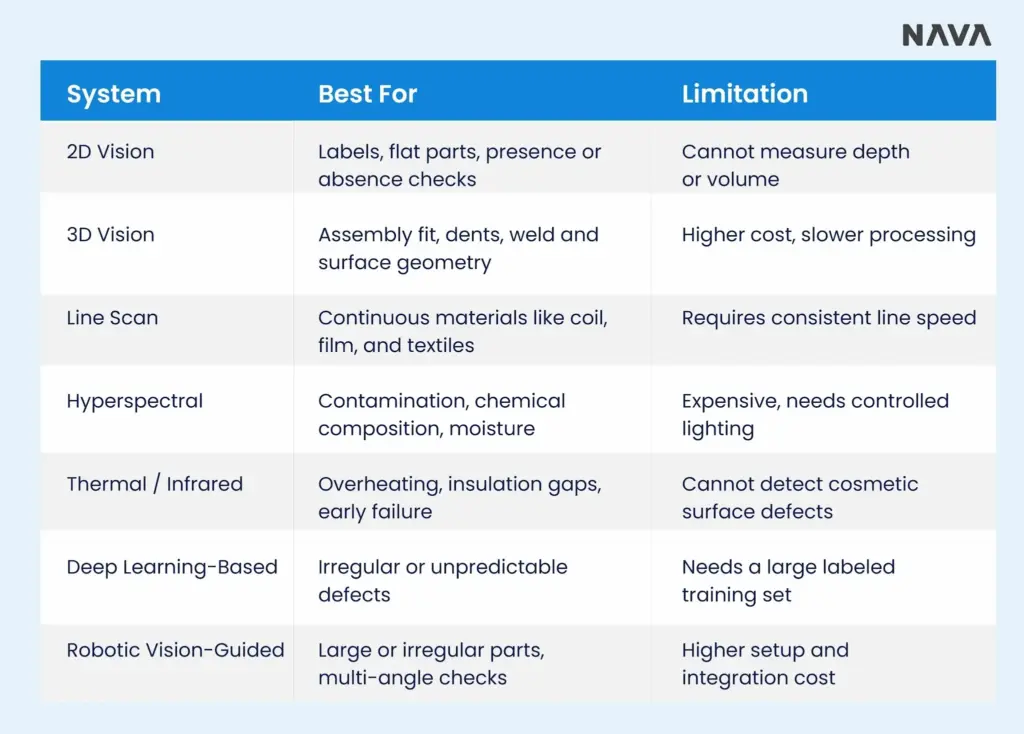
2D vision is the most common starting point for quality inspection. A camera captures a flat image of a part, and software checks it against a reference for size, shape, color, label placement, or surface marks. It is fast, affordable, and well suited to flat or predictable surfaces such as labels, PCBs, and packaging.
Key Capabilities
| Pros | Cons |
| Low hardware and integration cost | Cannot capture depth or volume |
| Fast enough for high-speed lines | Struggles with reflective or textured surfaces |
| Simple to set up and calibrate | Sensitive to lighting changes |
| Mature technology with wide vendor support | Limited to flat or near-flat geometries |
3D systems add depth data using stereo cameras, laser triangulation, or structured light. This makes them effective for measuring volume, verifying assembly fit, checking weld seams, and detecting dents or warping that a flat 2D image would miss entirely.
Key Capabilities
| Pros | Cons |
| Catches defects invisible to 2D cameras | Higher hardware and setup cost |
| Accurate on curved or complex geometries | Slower frame rates than 2D systems |
| Less sensitive to color and finish variation | More complex calibration process |
| Reliable dimensional measurement without contact | Generates larger data volumes to process |
Instead of capturing a full frame at once, a line scan camera captures the product one thin line at a time as it moves past on a conveyor. This is the standard approach for continuous materials such as textiles, printed sheets, metal coil, and packaging film, where a full-frame camera cannot keep up with the length of the material.
Key Capabilities
| Pros | Cons |
| Handles continuous material without coverage gaps | Requires precise line-speed synchronization |
| Consistent resolution across the full width | Needs stable, uniform lighting |
| Scales to very high line speeds | Less suited to discrete, individual parts |
| No image stitching or overlap errors | Higher integration complexity with encoders |
These systems capture wavelengths of light beyond what the human eye or a standard camera can see. They are used to detect contamination, moisture content, chemical composition, or early-stage material defects that are invisible under normal lighting, which is why they show up often in food safety and pharmaceutical inspection.
Key Capabilities
| Pros | Cons |
| Detects issues invisible to standard cameras | High hardware and licensing cost |
| Strong fit for food safety and pharma compliance | Requires controlled lighting and environment |
| Non-contact and non-destructive testing | Slower data processing than standard imaging |
| Catches problems before they become visible defects | Needs specialized expertise to operate and interpret |
Thermal cameras read heat signatures instead of visible light. On a production line, this helps detect overheating components, incomplete welds, insulation gaps, or early bearing failure before the defect becomes visible or the equipment fails outright.
Key Capabilities
| Pros | Cons |
| Catches failures before visible or physical damage | Cannot detect cosmetic or surface defects |
| Works in low light or complete darkness | Lower image resolution than optical cameras |
| Strong fit for predictive maintenance programs | Readings affected by ambient temperature |
| Non-contact and safe around moving equipment | Higher cost per camera than standard optical units |
Traditional machine vision relies on fixed rules: a defect either matches a known pattern or it does not. Deep learning-based systems are trained on thousands of labeled images so they can recognize irregular, unpredictable defects such as scratches, cracks, or cosmetic flaws that do not follow a fixed shape. These models improve over time as more data is fed into them, and they generalize better to product variation.
Key Capabilities
| Pros | Cons |
| Handles irregular and unpredictable defects well | Needs a large, well-labeled training dataset |
| Accuracy improves over time with more data | Longer initial setup and training time |
| Fewer false rejects than rigid rule-based systems | Requires ongoing model monitoring and maintenance |
| Adapts to product variation without reprogramming | Less explainable than straightforward rule-based logic |
These systems pair a vision model with a robotic arm or automated guided vehicle so the inspection point can move to the product, rather than the product moving past a fixed camera. This is common for large or irregularly shaped parts such as aerospace components, automotive bodies, and heavy equipment, where a stationary camera cannot capture every angle.
Key Capabilities
| Pros | Cons |
| Covers every angle on large or irregular parts | Higher setup and integration cost |
| Combines inspection with material handling in one pass | More moving parts to maintain over time |
| Flexible enough for varied product lines | Slower cycle time than fixed-camera systems |
| Reduces manual repositioning of heavy parts | Requires safety guarding around robotic motion |
Most manufacturers already have cameras installed across their production floors, docks, and yards. The gap is not hardware, it is turning that existing footage into structured, real-time intelligence instead of recordings nobody watches until after something goes wrong.
NAVA Vision AI is built specifically to close that gap. It runs on top of existing camera infrastructure, whether cloud, edge, or hybrid, and applies the same deep learning and computer vision principles described above to real operational problems.
Rather than replacing a plant's cameras, NAVA converts what those cameras already see into event-driven alerts, dashboards, and audit trails that plant, safety, and supply chain leaders can act on immediately.
NAVA's platform is organized into seven modules across two intelligence tracks, Safety & Compliance Intelligence and Operational Intelligence, each targeting a specific inspection or monitoring need across manufacturing, warehousing, logistics, mining, and energy operations.
SafetyVision AI continuously monitors workplace activity using existing camera infrastructure to identify safety risks, near misses, and unsafe behaviors while work is happening, rather than after an incident report is filed.
ComplianceVision AI replaces point-in-time audits with continuous visibility into how operating procedures are actually followed on the floor, rather than discovered weeks later during a scheduled review.
SiteAccess AI automates truck access authorization, driver verification, and visitor management at every entry point, replacing manual gate checks with a continuous, logged process.
DockVision AI tracks truck arrivals, loading activity, and dwell time to surface exactly where dock operations slow down, turning bottlenecks into something visible in real time instead of in a postmortem.
YardVision AI continuously monitors trailer locations, yard movements, and asset utilization, replacing the hours teams spend physically locating trailers with a live view of the yard.
InventoryVision AI automates cycle counts and inventory location validation using the cameras already installed above the racks, with no shutdowns and no manual recounts required.
DamageVision AI automatically identifies product, pallet, and trailer damage, creating visual evidence for investigations and claims the moment damage occurs, rather than after a customer complaint surfaces.
For quality inspection specifically, DamageVision AI is the closest parallel to the vision systems described above. Used alongside SafetyVision AI and DockVision AI, it gives operations leaders a single, continuous view of quality, safety, and throughput from the same camera feeds they already have running.
| Module | Intelligence Track | What It Does | Problems Solved | Business Outcomes |
| SafetyVision AI | Safety & Compliance Intelligence | Continuously monitors workplace activity to identify safety risks, near misses, and unsafe behaviors while work is happening | PPE non-compliance; restricted area violations; forklift-pedestrian interactions; unsafe worker behavior; slip, trip & fall event | Improve workplace safety; reduce incident risk; strengthen safety culture; improve audit readiness; enable earlier intervention |
| ComplianceVision AI | Safety & Compliance Intelligence | Replaces point-in-time audits with continuous visibility into how operating procedures are actually followed. | Manual compliance inspections; SOP deviations; limited audit evidence; slow investigations; contractor compliance gaps | Improve compliance; reduce manual inspections; strengthen audit readiness; improve investigation quality; increase accountability |
| SiteAccess AI | Operational Intelligence | Automates truck access authorization, driver verification, and visitor management at every entry point. | Manual gate processing; truck verification delays; unauthorized access; limited entry-point visibility | Faster gate processing; reduced entry delays; stronger site security; complete access audit trail |
| DockVision AI |
A few questions help narrow down which system, or combination of systems, makes sense for a given inspection point:
Most industrial quality programs do not rely on a single system in isolation. A production line might use 2D vision for label checks, deep learning models for cosmetic defects, and thermal imaging for equipment health, all feeding into one dashboard. That is the direction the industry is heading: fewer isolated point solutions, and more unified platforms like NAVA Vision AI that pull every camera feed into one operational picture.
Machine vision has moved well past simple pass or fail checks. Between 2D and 3D imaging, line scan cameras, hyperspectral sensors, thermal detection, deep learning models, and robotic vision-guided systems, manufacturers now have a full toolkit for catching defects that manual inspection would miss or catch too late.
The real advantage comes from connecting these capabilities to the cameras already running on the floor.
That is the problem NAVA Vision AI was built to solve, turning existing camera infrastructure into continuous, real-time operational intelligence across safety, quality, dock operations, and inventory, without a rip-and-replace of hardware that is already in place.
See What Your Cameras Are Already Missing
Book a Discovery Workshop and get a straight answer on where NAVA Vision AI fits your operations, no commitment required.
[ Book Your Discovery Workshop → ]
One call. One walkthrough of your floor, your dock, your yard. We map the highest-value use case for your existing cameras and show you exactly what it would catch on day one.
| Operational Intelligence |
| Tracks truck arrivals, loading activity, and dwell time to surface where dock operations slow down. |
| Long truck turnaround times; dock congestion; high dwell times; manual dock monitoring |
| Increase throughput; improve dock utilization; reduce dwell time; improve labor productivity |
| YardVision AI | Operational Intelligence | Continuously monitors trailer locations, yard movements, and asset utilization. | Trailer search time; yard congestion; limited trailer visibility; asset location challenges | Improve yard visibility; reduce trailer search time; improve asset utilization; reduce congestion |
| InventoryVision AI | Operational Intelligence | Automates cycle counts and inventory location validation with no shutdowns and no manual recounts. | Time-consuming cycle counts; inventory inaccuracies; warehouse shutdown for counts; manual reconciliation | Improve inventory accuracy; reduce stock count disruption; accelerate cycle counts; improve warehouse planning |
| DamageVision AI | Operational Intelligence | Automatically identifies product, pallet, and trailer damage, creating visual evidence for investigations and claims. | Manual damage inspections; product damage disputes; missing visual evidence; slow claim processing | Reduce operational losses; improve accountability; accelerate investigations; improve claims management |


