
Blog
5 Best Compliance Management Software Platforms for Industrial Enterprises
By NAVA Software· July 30, 2026· 12 min read
Summarize this post with

Loading insights...
LoadingSummarize this post with
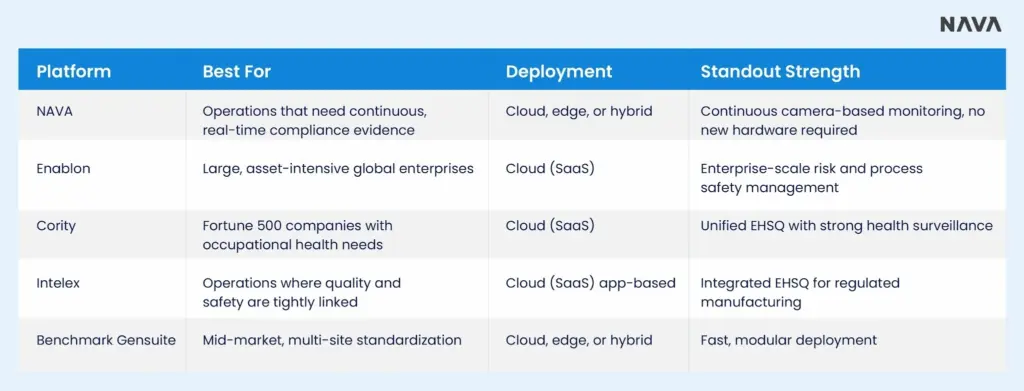
Industrial enterprises need compliance management software that centralizes audits, incident reporting, and regulatory tracking across every site. This guide compares five leading platforms, Enablon, Cority, Intelex, Benchmark Gensuite, and NAVA, each suited to different operational needs. It closes with a buyer's checklist and implementation tips to help teams choose the right fit.
Compliance in industrial environments no longer lives in a filing cabinet. It runs across manufacturing lines, warehouses, mines, and energy sites.
It touches everything from OSHA recordkeeping to ISO audits, chemical management, and multi-site regulatory reporting. When that work is scattered across spreadsheets and email chains, gaps show up in the worst possible way, during an audit, an inspection, or an incident investigation.
That is exactly the problem compliance management software is built to solve. The right platform centralizes obligations, automates evidence collection, standardizes processes across facilities, and gives compliance teams a single source of truth.
Non-compliance costs organizations millions annually once fines, remediation, business disruption, and lost revenue are factored in. Industrial operations carry extra exposure because a missed inspection or an undetected SOP deviation can turn into a safety incident, not just a paperwork problem.
That risk is a big part of why compliance management software has shifted from a nice-to-have for large enterprises to a baseline requirement across manufacturing, warehousing, mining, and energy.
This guide breaks down five of the best compliance management software platforms built for industrial enterprises. Each section covers what the platform does well, who it fits best, and what to weigh before committing to it.
Compliance management software is a centralized system for tracking regulatory requirements, managing policies and controls, running audits and inspections, documenting corrective actions, and reporting on compliance performance across sites.
For industrial enterprises specifically, this usually means Environmental, Health, and Safety (EHS) compliance, often bundled with quality management as EHSQ.
Unlike generic GRC tools built for financial services or SaaS security compliance, industrial compliance platforms are designed around the realities of physical operations.
Shift-based workforces, hazardous materials, multi-site standardization, and frontline workers who need mobile, offline-capable tools all shape how these platforms work.
A strong compliance management software platform typically includes:
NAVA Vision AI is an AWS-powered compliance management software platform built for industrial, manufacturing, warehousing, and energy operations.
Instead of relying on scheduled audits and manual checklists, it uses a facility's existing camera infrastructure to monitor safety and compliance continuously, in real time.
That makes it one of the more distinctive entries in the compliance management software category. Where most platforms manage documentation and workflow, NAVA generates the evidence itself, directly from the floor.
Traditional compliance software depends on someone logging what happened after the fact. An inspection completed, a PPE check performed, a restricted zone cleared, all of it typically relies on manual entry. NAVA closes that gap by watching the floor continuously instead of waiting for the next scheduled audit.
NAVA is best suited to industrial enterprises that already run camera systems for security and want to extend that infrastructure into active compliance monitoring.
It fits manufacturing plants, distribution centers, equipment yards, and energy sites where PPE compliance, restricted zone breaches, and safety procedure adherence are hard to verify with periodic audits alone.
NAVA's regulatory strength comes through its Safety Compliance Agent, part of its agentic intelligence layer built on AWS Bedrock.
Rather than storing regulatory frameworks and audit schedules the way a traditional GRC platform does, NAVA continuously verifies whether safety and compliance procedures are actually being followed on the floor.
| Compliance Area | How NAVA Monitors It |
| PPE compliance | Detects missing or improper personal protective equipment in real time |
| Restricted zone breaches | Flags unauthorized entry into hazardous or controlled areas |
| Safety procedure adherence | Verifies that documented procedures are followed during operations |
| Damage and incident documentation | Automatically detects and records damage events as they occur |
| Vehicle and equipment safety | Monitors for collision risk and unsafe equipment movement |
Process safety, in NAVA's model, is handled through dedicated Vision AI modules rather than a single centralized workflow engine. Each module targets a specific operational risk area, using cameras already in place across the facility.
| Seven Modules | Process Safety Function |
| SafetyVision AI | Continuously monitors workplace activity to identify safety risks, near misses, and unsafe behaviors while work is happening. |
| ComplianceVision AI | Replaces point-in-time audits with continuous visibility into how operating procedures are actually followed |
| SiteAccess AI | Automates truck access authorization, driver verification, and visitor management at every entry point. |
| DockVision AI | Tracks truck arrivals, loading activity, and dwell time to surface exactly where dock operations slow down. |
| YardVision AI | Continuously monitors trailer locations, yard movements, and asset utilization, reducing trailer search time and yard congestion. |
| InventoryVision AI | Automates cycle counts and inventory location validation using existing cameras, with no shutdowns or manual recounts. |
| DamageVision AI | Automatically identifies product, pallet, and trailer damage, creating visual evidence for investigations and claims. |
Enablon, a Wolters Kluwer business, is one of the most widely deployed compliance management software platforms among large, asset-intensive enterprises. It brings compliance, risk, and sustainability management together under one system, built for organizations managing complex, multi-jurisdictional obligations across many facilities.
| Category | Details |
| Best for | Global manufacturers, energy companies, and other asset-intensive organizations that need enterprise-wide visibility and governance. |
| Regulatory depth | Broad regulatory content covering multiple countries and frameworks, saving internal research and mapping work for cross-border operations. |
| Process safety focus | Deep process safety management capabilities, particularly valuable for chemical, oil and gas, and hazardous process operations. |
| Sustainability and ESG | Strong ESG and sustainability reporting paired with core compliance modules, covering both regulatory and investor-facing needs. |
| Scalability | Configurable workflows that scale across hundreds of sites without losing consistency, built for global standardization. |
| Considerations | High implementation complexity. Typically needs dedicated internal resources or a partner to configure and maintain effectively. |
Cority positions itself as a unified EHSQ platform, combining environmental, health, safety, and quality management with a particular strength in occupational health.
For industrial enterprises where health surveillance and clinical workflows matter as much as safety audits, Cority is frequently the platform of choice.
| Category | Details |
| Best for | Large enterprises in regulated sectors such as manufacturing, healthcare-adjacent operations, and government contractors. |
| Regulatory depth | Strong compliance and risk management modules under one roof, trusted across heavily regulated industries with formal compliance functions. |
| Process safety focus | Solid safety management, but the platform's real differentiator is occupational health, including industrial hygiene and exposure tracking. |
| Sustainability and ESG | Health and safety data feed into broader ESG and workforce wellbeing reporting, useful for enterprises reporting to investors and regulators alike. |
| Scalability | Built for Fortune 500 scale, with reporting structured for both operational teams and executive leadership. |
| Considerations | Feature depth can be more than smaller operations need. Best suited to organizations with a dedicated compliance function. |
Intelex is often the platform recommended when quality and safety are operationally inseparable, common in food and beverage, pharmaceutical, and aerospace manufacturing.
It is positioned as an EHSQ specialist rather than a pure safety or pure quality tool.
| Category | Details |
| Best for | Regulated manufacturers where a quality deviation and a safety incident can trace back to the same root cause. |
| Regulatory depth | Strong audit and inspection tools with mobile support, plus configurable CAPA workflows that adapt to plant-specific processes |
| Process safety focus | Safety management is tightly integrated with quality management, so root cause investigations cover both in one record. |
| Sustainability and ESG | ESG reporting is available but is not the platform's core strength compared to its EHSQ integration. |
| Scalability | Scales well across regulated manufacturing environments with multiple plants and shared quality standards. |
| Considerations | Organizations that only need safety or only need quality may find a narrower point solution faster to deploy. |
Benchmark Gensuite has built its reputation on speed and flexibility, with an app-based, modular architecture.
Organizations can start with a single compliance workflow and expand as needs grow, without committing to a massive upfront implementation.
| Category | Details |
| Best for | Mid-market industrial enterprises that need multi-site standardization without Tier 1 enterprise complexity. |
| Regulatory depth | Solid core regulatory tracking, audit, and inspection modules, with strong mobile tools for frontline teams. |
| Process safety focus | Process safety capability is available as a module, though not as deep as Enablon or VelocityEHS for high-hazard operations. |
| Sustainability and ESG | ESG reporting can be added as a module once core compliance workflows are running. |
| Scalability | Modular design lets organizations add capabilities incrementally, with an active user community driving continuous improvement. |
| Considerations | Modularity requires a clear rollout plan, otherwise teams risk ending up with disconnected modules instead of one system. |
Every platform above is capable. The right one depends on your specific operational profile.
Before choosing, work through these questions:
| Requirement | Why It Matters | Platforms Best Suited |
| Multi-country regulatory coverage | Standardizes compliance across global operations | Enablon, Cority , NAVA |
| Integrated quality and safety | Reduces duplicate systems for regulated manufacturers | Intelex |
| Fast, modular rollout | Gets teams to value without a long implementation | Benchmark Gensuite |
| Chemical and process safety depth | Critical for hazardous material handling | Enablon, NAVA |
| Mobile-first frontline tools | Drives adoption where compliance actually happens | Benchmark Gensuite, NAVA |
Choosing the right platform is only half the job. How you roll it out determines whether it actually reduces compliance risk.
A few practices consistently separate successful deployments from stalled ones:
Even the strongest compliance management software depends on people to log what happened. An inspection completed, a PPE check performed, a restricted area cleared, all rely on manual entry.
That data entry step is where gaps quietly form. Audits confirm what already went wrong instead of catching it in the moment, because the software is only as current as the last manual entry.
This is where a newer category of tools is starting to complement traditional compliance platforms rather than replace them. As covered above, ComplianceVision AI from NAVA Vision AI is a good example, feeding continuous visual evidence back into the compliance record instead of relying solely on point-in-time audits.
For industrial enterprises already running an EHSQ platform, that kind of continuous visual verification can turn periodic compliance checks into an ongoing, evidence-backed process. It is not a replacement for a compliance management system of record. It is an added layer of real-time evidence that makes the system of record more accurate.
There isn't a single best compliance management software platform for every industrial enterprise. Enablon and Cority suit large, complex, multi-site organizations. Intelex fits regulated manufacturers where quality and safety intersect.
Benchmark Gensuite works well for mid-market teams that need to move fast. NAVA Vision AI leads for enterprises that need real-time visibility into safety and compliance procedures using cameras they already have.
The common thread across all five is that they turn compliance from a reactive, audit-day scramble into a continuous, documented process. Pairing that system of record with real-time visual verification closes the last gap, making sure what's recorded actually reflects what's happening on the floor.
Before signing a contract, run a short pilot if the vendor allows it. The best compliance management software for your operation is the one your teams will actually use every day, not just the one with the longest feature list.
Ready to Close the Visibility Gap? Talk to NAVA Vision AI about a pilot for your site and see what continuous compliance monitoring looks like in practice.