Blog
7 Questions Every Buyer Must Ask Before Choosing an AI-Powered Computer Vision Solution
By Rakesh· August 6, 2026· 10 min read
Summarize this post with

Loading insights...
LoadingSummarize this post with
AI computer vision promises real-time visibility, fewer incidents, and automated workflows. But most buyers discover the real problems 6 months after deployment.
False alerts pile up. Teams ignore the dashboards. The ROI never materializes.
These 7 questions cut through the sales pitch and tell you whether a vendor can actually deliver in your environment, not just in their demo room.
The demo looked great. Real-time detection, clean dashboards, smooth integrations. Then you deployed it across your facility and everything changed.
Real environments are messy. Forklifts move fast. Lighting shifts. Workers do not follow scripted paths. The AI that performed at 96% accuracy in the vendor demo now fires false alerts every 20 minutes.
| Deployment Problem | Business Impact |
| False alerts from poor real-world conditions | Alert fatigue: teams stop trusting and stop using the system |
| No integration with existing workflows | Manual processes continue; AI adds cost without reducing labor |
| Weak scalability architecture | Pilot works at one site, rollout fails at three |
| Requires full camera replacement | Budget doubles; deployment timeline triples |
The problem is not AI technology. It is a vendor selling detection AI as operational intelligence. Those are not the same product.
NAVA Vision AI is built as an operational intelligence platform. It connects detection to workflow action across your entire facility, not just your demo camera.
Is your facility ready for AI? Request a free CCTV readiness assessment.
This is the first question most buyers forget to ask. Then they receive a proposal that includes full camera replacement across 12 facilities.
Camera replacement is not a software cost. It is a capital expenditure that takes 6 months to approve and 3 months to install, and it eliminates any chance of fast ROI.
A real operational computer vision platform integrates with what you already have. Before you go further with any vendor, verify these three things:
If the answer involves 'we recommend upgrading your cameras for optimal performance,' that is a sales strategy, not a technology constraint.
False positives are the silent killer of AI adoption. No executive will say 'our AI failed.' They will say 'the team stopped using it.'
Alert fatigue is a documented problem. Forrester's 2024 Operations AI Report found that 67% of operations teams ignore AI alerts within 3 months of deployment because the signal-to-noise ratio destroys trust in the system.
Real facility conditions that no vendor demo accounts for:
Before any commitment, ask these questions directly:
A vendor who hands you a single accuracy percentage without context is not being transparent. That number reflects their environment, not yours.
There is a significant difference between a system that sends a notification and a system that triggers a workflow. Most buyers discover this difference 4 months post-deployment.
By then, the team is still manually creating incident reports from AI alerts. The AI did not save time. It created a second inbox.
| Basic Detection AI | Operational AI |
| Sends an alert to a phone or email | Triggers a workflow: ticket created, supervisor notified, incident logged |
| Reactive: flags a problem after it happens | Preventive: flags patterns before they become incidents |
| Manual reporting is required after detection | Automated reporting built into the detection event |
| Data sits in a dashboard that no one checks | Data feeds directly into shift planning and compliance records |
Operational AI connects detection to action. A PPE violation triggers a supervisor alert and logs an incident report at the same time. A SiteAccess detection at the dock gate logs vehicle arrival and starts a dwell time timer automatically. Dock analytics feed directly into shift planning.
That is the difference between surveillance and intelligence.
Pilot success at one site means nothing if the solution cannot scale. Multi-site deployment is where most AI vendors hit a wall.
Configuration becomes manual. Reporting becomes inconsistent. The IT team ends up managing separate dashboards for separate sites, and no one has visibility across the operation.
What to confirm before signing a multi-site contract:
Ask the vendor this directly: 'Show me how a 10-facility rollout works operationally.' If they have not done one, your deployment becomes their test case.
This is the question vendors dislike. Not because they lack an answer, but because most of them have the wrong one.
Features are not KPIs. 'Real-time detection' is not a KPI. 'Fewer PPE violations' is a KPI. 'Reduced dock dwell time by 18 minutes per truck' is a KPI. 'Lower damage claim disputes' is a KPI.
| AI Use Case | KPI Impacted | 2025 Industry Benchmark |
| PPE monitoring | Compliance violations reduced | Up to 62% fewer violations (EHS Today, 2025) |
| Dock analytics | Dwell time per vehicle | 14-22 min reduction per truck movement |
| SiteAccess automation | Gate processing speed | 40% faster gate throughput in logistics hubs |
| Damage detection | Claims dispute rate | 35% reduction in disputed cargo claims |
If a vendor cannot tie their solution to a specific operational KPI, with real numbers from real deployments, you are buying a dashboard. Dashboards do not reduce costs.
Most vendors disappear after go-live. This is the most predictable failure pattern in enterprise AI, and the most avoidable.
Models drift over time. Environments change. Cameras get repositioned. A seasonal lighting shift can drop detection accuracy by 15% with no warning and no automatic correction.
Before signing any contract, get answers to these questions in writing:
Post-deployment support is not a nice-to-have. It is the difference between a 12-month ROI and a product that sits unused by month four.
Demos prove nothing. Case studies prove something. Before-and-after metrics from live facilities prove everything.
Before committing the budget, ask for:
Many AI computer vision companies invest more in demo environments than in actual customer deployments. A polished UI is not proof of operational value.
Operational proof matters more than presentation quality. If a vendor cannot show you real results from real facilities, you are being asked to fund their next case study.
Request an operational ROI assessment from NAVA Vision AI.
The purchase price is not the total cost. Here is what most buyers find 6 months into deployment that was never in the original proposal:
| Hidden Cost | Operational Impact | Typical Budget Overrun |
| Camera replacement required | Increased CAPEX; deployment delayed 3-6 months | 15-40% above original estimate |
| Integration with existing WMS/ERP | Workflow delays; manual workarounds continue | Varies; often billed as 'custom development.' |
| Recalibration after model drift | Accuracy drops; team confidence drops with it | Not covered in standard SLAs |
| Dashboard adoption failure | AI generates data; nobody acts on it | Months of wasted subscription cost |
| Multi-site rollout complexity | 3-month project becomes 18 months | Project management costs double |
Ask every vendor to itemize post-deployment costs before you sign. The vendors who refuse to do this are the same ones who bill for it later.
What Enterprises Should Actually Look For
The right AI computer vision solution does not sell you cameras or dashboards. It sells you operational outcomes that show up in your P&L.
Look for a platform that connects detection to action across your full facility operation:
NAVA Vision AI is built for facilities that operate in real conditions, not controlled demo environments. It works with your existing CCTV, scales across multiple sites, and connects every detection event to a measurable operational outcome.
AI adoption in facilities and logistics is accelerating. Buyers are also getting more skeptical, and for good reason.
The question is no longer whether AI can detect things in a camera feed. It can. The question is whether a specific vendor can prove their system delivers measurable outcomes in environments like yours.
Operational ROI, deployment realism, and post-go-live support separate vendors that deliver from vendors that demo well.
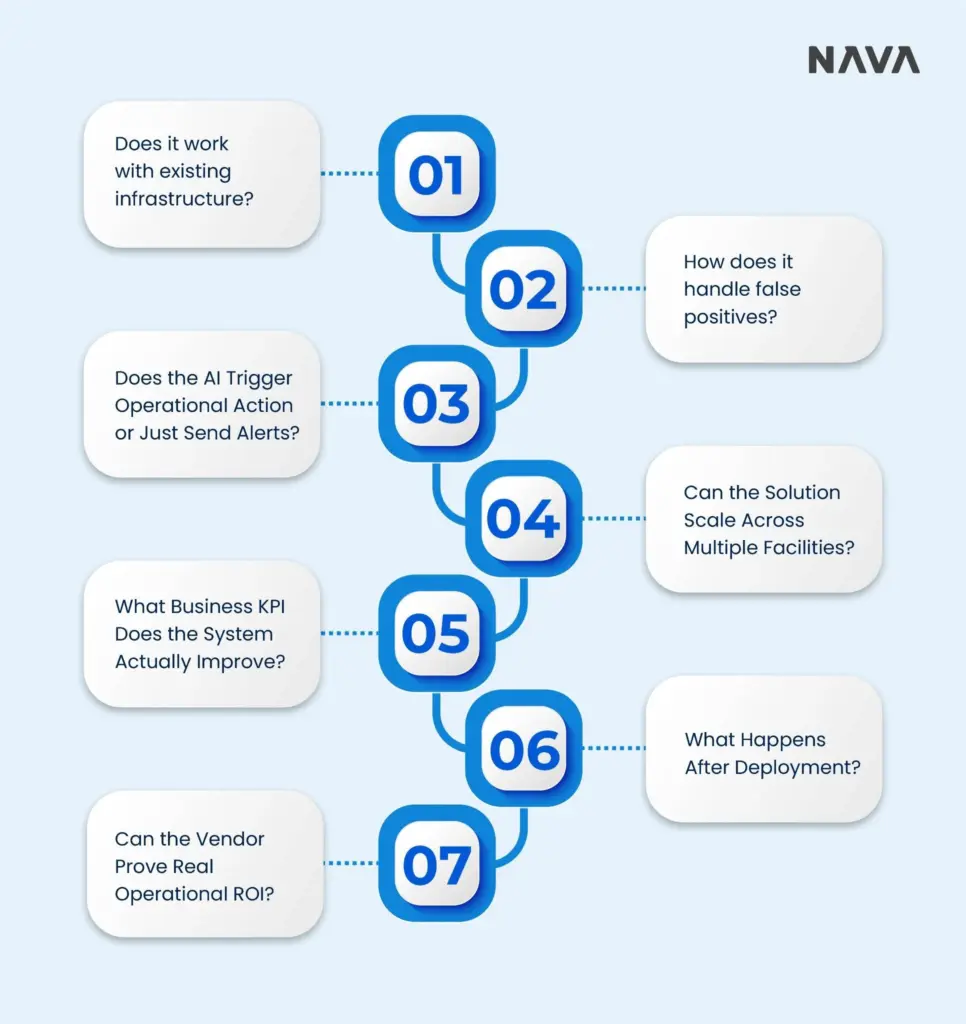
Ask these 7 questions before you commit. If a vendor cannot answer all of them with documented evidence from live deployments, you have your answer.
Ready to evaluate your facility? Request a free operational assessment and zero-cost proof of concept from NAVA Vision AI.