Blog
Computer Vision in AI: How Vision AI & Deep Learning Enable Real-Time Decisions
By Rakesh· June 24, 2026· 7 min read
Summarize this post with

Loading insights...
LoadingSummarize this post with
Your cameras are already recording what happens on the floor. Vision AI reads that footage continuously in real time and turns it into decisions, alerts, and operational intelligence your team can act on immediately.
Computer vision in AI is transforming how machines interpret the physical world. Instead of simply recording video, modern systems use AI and computer vision to analyze camera feeds in real time, turning visual data into actionable insights.
In the past, industrial cameras were passive observers. They recorded events but became useful only after something went wrong. A forklift moving toward a worker at a blind corner would be captured, but not prevented.
This is the gap Vision AI solves.
By combining computer vision in AI with deep learning, cameras evolve from recording devices into intelligent systems that can detect risks, identify patterns, and trigger actions as events unfold.
The shift is simple but powerful: from seeing what happened → to understanding what is happening now.
Computer vision in AI is a field that enables machines to interpret and understand visual data from images or video.
Using deep learning models, computer vision systems can:
In industrial environments, this allows organizations to convert raw camera footage into structured data that supports safety, operations, and decision-making.
How deep learning teaches machines to see
Traditional motion detection reacts to pixel changes. If enough pixels shift from frame to frame, it flags movement. That is it. It has no concept of what moved, why it moved, or whether it matters.
Deep learning works differently. It identifies objects like forklifts, pallet jacks, workers, trailers, zones, and tracks them across frames. More importantly, it evaluates the relationships between those objects. Proximity. Direction. Speed. Duration. Context.
This is what allows a vision AI system to distinguish between normal and abnormal.
The system understands all three, not because it was programmed with static rules, but because it learned what these situations look like from real data.
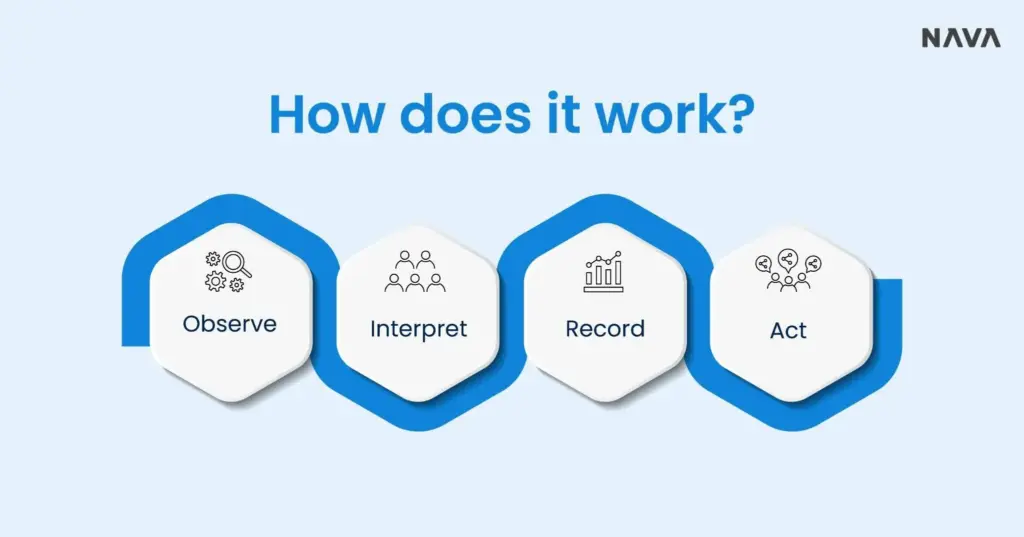
Understanding a situation is only valuable if something happens next. Vision AI converts every interpreted condition into a structured event, a time-stamped, location-tagged record that includes what objects were involved, what type of event occurred, and how long it lasted.
This event data flows immediately to dashboards, alert systems, and enterprise platforms. The result is a continuous real-time loop: observe, interpret, record, alert.
Camera feeds are processed continuously across every monitored zone simultaneously.
Deep learning models identify objects, relationships, and whether a condition is normal or anomalous.
Each condition is logged as a structured event with full context, time, location, objects, and severity.
Alerts fire, dashboards update, and teams can intervene before a situation escalates.
This loop runs without pause. No shift change, no fatigue, no lapse in attention.
A single human observer cannot monitor a multi-zone warehouse floor and track every moving element at once. A vision AI system does this as standard, covering an order of magnitude more ground with consistent accuracy.
The core system remains the same. What changes is how it’s applied.
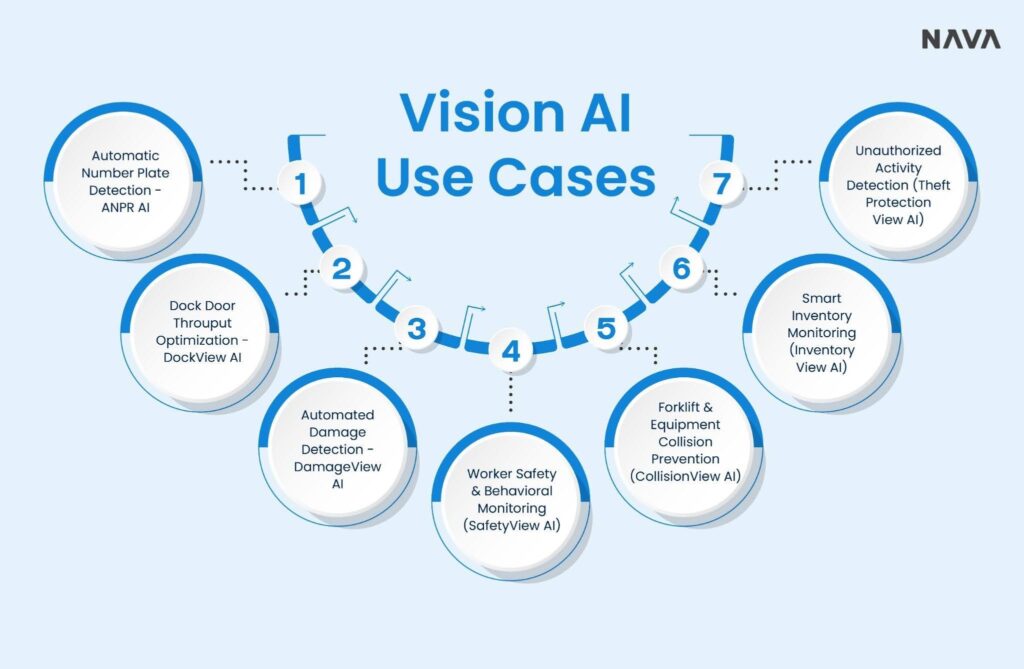
Since the underlying system is consistent, expanding from one use case to additional areas requires no new infrastructure, just configuration. This is a practical advantage for operations that want to start with safety monitoring and grow into broader operational intelligence over time.
Industrial environments are not static. Lighting shifts between shifts. Traffic patterns change as throughput grows. New equipment enters the floor. A vision AI system that was accurate on day one needs to stay accurate on day 90 and day 900.
Deep learning makes this possible through continuous model refinement. When detection is corrected, or new examples are logged from the live environment, the model updates. Accuracy compounds over time rather than degrading.
This also changes how operations teams approach safety and performance reviews. Instead of investigating incidents after they occur, they work from a live stream of leading indicators, near-miss events, idle patterns, and compliance deviations that make problems visible before they become outcomes.
One of the first questions teams ask: do we need to replace our cameras?
In most cases, no.
Modern computer vision AI platforms are designed to work on existing CCTV infrastructure. The intelligence layer sits on top of your current system, turning passive video into real-time operational insight.
Platforms like NAVA Vision AI take this further by combining safety detection with operational visibility across yards, docks, and facility workflows without requiring the deployment of new hardware.
This lowers the barrier to entry significantly:

Computer vision in AI is changing how operations move from observation to action. Instead of relying on recorded footage and delayed analysis, organizations can now detect risks, inefficiencies, and deviations in real time.
By combining computer vision in AI with deep learning, camera systems become active intelligence layers—continuously interpreting what’s happening across safety, workflows, and asset movement. This shift enables faster decisions, fewer blind spots, and measurable improvements in both safety and operational performance.
Platforms like NAVA Vision AI demonstrate how this can be achieved without replacing existing infrastructure. By working on current CCTV systems, they make real-time visibility accessible without heavy upfront investment or disruption.
The result is simple: better awareness, faster response, and smarter operations.
Ready to see what your cameras can actually do?
Run a quick evaluation with NAVA Vision AI and uncover real-time insights from your existing setup.


