
Blog
Retail AI Vision Solutions in 2026: Use Cases, ROI Explained
By NAVA Software· July 1, 2026· 14 min read
Summarize this post with

Loading insights...
LoadingSummarize this post with
Retail AI Vision Solutions are transforming existing CCTV infrastructure into real-time operational intelligence systems that monitor dock activity, inventory movement, worker safety, damage detection, and operational workflows across warehouses, manufacturing sites, and retail distribution environments.
Most warehouses, distribution centers, and retail operations run on camera systems that see everything but understand nothing.
The footage is there of docks being loaded, forklifts moving through tight intersections, and pallets sitting in the wrong staging area.
All of it recorded. Almost none of it acted on. That gap between camera coverage and operational insight is where millions in recoverable costs quietly accumulate every year.
Retail AI Vision Solutions exist to close it, not by replacing existing infrastructure or requiring significant upfront capital, but by activating what organizations already have. They convert passive CCTV feeds into real-time workflow intelligence that monitors operations continuously and flags problems as they form.
This article covers where that technology is being deployed in 2026, which use cases are delivering the fastest ROI, and where the category is headed next.
Four forces are driving this market faster than most operations leaders anticipated:
By most industry estimates, nearly 99% of enterprise video data is never analyzed. It sits on servers, unreviewed, accessed only when something has already gone wrong.
That is not a technology problem. It is a design problem. Most camera systems were built for security review, not workflow intelligence. The footage exists. The insight does not.
The cost of that gap shows up across operations every day.
Each of those situations is a recoverable cost if the right live operational insight exists to prevent it.
Warehousing and logistics operations across North America and Europe are running with fewer staff against higher throughput expectations. The numbers do not add up without automation supporting them.
According to NVIDIA’s industry data, 9 in 10 retailers plan to increase their AI budgets in 2026, with computer vision, agentic AI, and physical automation at the center of that investment. Labor pressure is not easing. Organizations are closing the gap with technology instead.
Cameras represent one of the most underutilized automation assets already inside most facilities. Activating them is increasingly the more logical step than replacing people.
CCTV was designed for one job: record and review. A guard monitors a live feed intermittently. Footage gets pulled after an incident. A manager investigates.
That model worked at a different scale. It does not work now. As facilities grow, more shifts, more docks, more zones, more SKUs, manual monitoring creates more blind spots, not fewer.
The ceiling is structural. More cameras do not solve the problem if every camera still requires a human to interpret what it sees. That is where the category shift toward retail AI Vision Solutions begins.
Understanding the category clearly matters before evaluating specific applications. Retail AI Vision Solutions sit at the intersection of computer vision and operational workflow automation. That is a more specific positioning than “AI-powered cameras”, and the difference is commercially important.
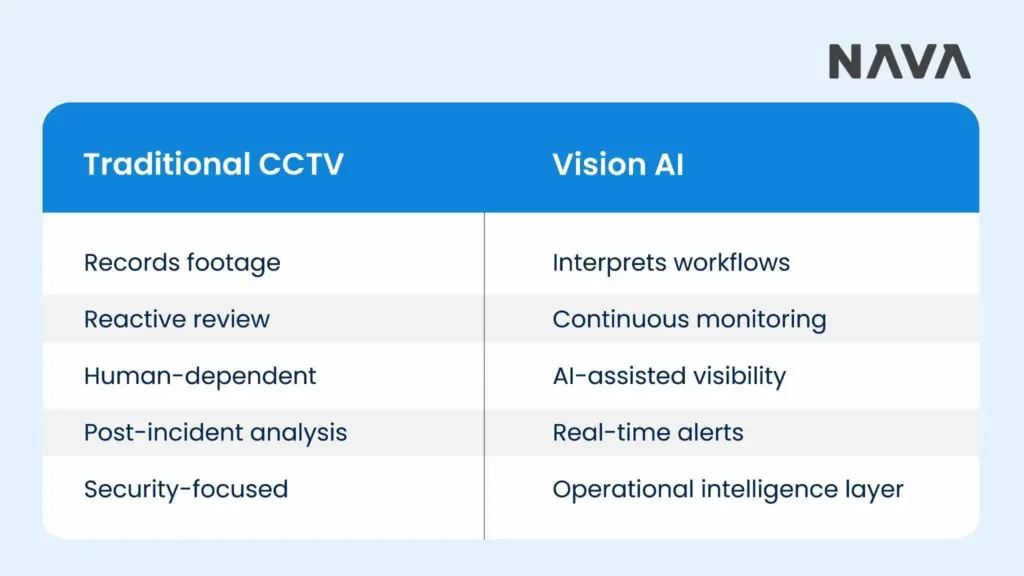
Traditional CCTV captures. Vision AI interprets.
A CCTV system records a forklift moving near a pedestrian zone. A Vision AI system detects that proximity in real time, generates an alert before a near-miss forms, and logs the event automatically for safety review. Same camera. Entirely different outcome.
This is why computer vision in retail is moving beyond surveillance into execution-layer monitoring. The footage was always there. The automated interpretation layer was not. Adding it changes what operations teams can see, and how quickly they can act.
CCTV is reactive. Vision AI is proactive.
One generates footage that requires human review. The other generates decisions like alerts, compliance flags, workflow triggers, and performance dashboards continuously, across every shift, without fatigue or error from inattention.
For operations leaders managing multi-site environments, the practical difference is significant. Vision AI does not miss a shift. It does not lose concentration at 3 am. It processes every feed simultaneously. Human monitoring at that scale is not a realistic alternative.
One of the more commercially significant details about modern Vision AI platforms is that they do not require new hardware.
Existing CCTV feeds (regardless of brand, model, or installation age) are calibrated and onboarded. AI models deploy against those feeds. The infrastructure investment organizations have already made a significant investment that has become the foundation for a new intelligence layer.
That changes the ROI conversation significantly. A proof-of-concept deployment is no longer contingent on capital expenditure. It can begin with cameras that are already running today.
The operational mechanics matter less than the strategic shift they enable. But understanding the deployment model helps frame how quickly these platforms can move from pilot to production, and why the barrier to starting is lower than most organizations expect.
Modern Vision AI platforms follow four operational phases:
What matters operationally is not the process. It is the speed. Platforms like NAVA Vision AI are designed for rapid proof-of-concept deployment, using existing infrastructure to demonstrate measurable workflow impact before full-scale rollout is committed. That low entry point is a significant commercial differentiator in a market still maturing.
Most early conversations about computer vision in retail started on the shop floor. That remains an active and commercially important application area particularly for grocery, convenience, and large-format retail environments where shelf performance and shrinkage are constant pressure points.
Poor inventory accuracy is a problem most retailers know they have and struggle to measure in real time. Studies show that inventory accuracy averages as low as 65% across many retail operations. Raising that figure to 93% can improve sales by approximately 9% purely through reducing stockouts.
Vision AI monitors shelves continuously. Empty bays are detected as they form. Misplaced products are flagged. Slow-moving SKUs are visible without manual audits or scheduled counts.
The result is faster replenishment cycles, better planogram compliance, and fewer manual touchpoints per shift driven by cameras already covering the floor.
Self-checkout shrinkage has become one of the most discussed cost pressures in brick-and-mortar retail. The challenge is not that people are dishonest. The challenge is that traditional checkout monitoring cannot keep pace with transaction volumes.
Vision AI models monitor checkout behavior continuously, detecting unscanned items, flagging unusual interactions, and alerting staff without requiring constant human supervision. Shrinkage drops. Monitoring scales without adding headcount.
Foot traffic data has operational value that most retailers do not fully extract. Vision AI tracks movement patterns, peak zone activity, queue lengths, and aisle dwell time all from cameras already in place.
For workforce planning, that means smarter staffing decisions tied to actual traffic rather than scheduled assumptions. For category management, it reveals which zones drive engagement and which do not. The data exists in the footage. It just was not being read.
The Vision AI market has moved well past early-adopter territory. Several distinct provider categories now serve the retail, logistics, and industrial segments with meaningfully different approaches to the problem and different commercial profiles.
These platforms position Vision AI as a multi-use-case operational layer. Rather than solving one specific problem, they deploy across dock management, safety compliance, damage detection, inventory visibility, and workflow analytics from a single connected platform.
NAVA Vision AI sits within this category built on AWS-native infrastructure, supporting both edge and cloud deployment, and designed to integrate with existing WMS, TMS, and YMS systems. What distinguishes these platforms commercially is the scope of the intelligence they generate. A single connected camera network becomes a source of execution-layer insight across multiple operational domains.
The global AI in retail market is projected to reach $20 billion in 2026, growing at nearly 30% annually. Operational intelligence platforms are a significant driver of that growth, particularly in industrial and logistics environments.
A focused segment of the market builds specifically for EHS use cases: PPE detection, restricted-zone monitoring, incident logging, and automated compliance reporting. These solutions often deploy alongside broader platforms as specialist safety modules.
Many workplace safety services are now expanding into AI-assisted continuous monitoring. The gap between traditional audit-based tools and Vision AI-powered workplace safety compliance systems is becoming commercially visible to procurement teams evaluating both.
Specialized providers focus on dock management, automated vehicle recognition, freight scanning, or inventory counting. These are typically narrow-use-case solutions deployed within WMS platforms or as standalone modules inside distribution center environments.
According to Roboflow’s 2026 Vision AI industry report, computer vision has clearly moved from observation into high-stakes operational decision-making. Organizations are no longer treating it as a pilot program. It is entering production environments as core infrastructure. That maturity shift is visible in procurement patterns, with operations increasingly seeking platforms that cover multiple use cases rather than single-point solutions.
The ROI case for Vision AI is not theoretical. It is emerging in specific, measurable operational areas. Understanding where it surfaces fastest helps operations leaders prioritize deployment and build the internal business case.
| Operational Area | Common Problem | Vision AI Impact |
| Dock Operations | Delays and idle time | Faster throughput |
| Damage Detection | Claims disputes | Automated visual evidence |
| Worker Safety | Blind-spot risk | Continuous monitoring |
| Inventory Tracking | Manual audits | Workflow visibility |
Dock efficiency improvements produce fast, compounding returns. When dwell time decreases, throughput increases. When dock activity is continuously monitored, scheduling accuracy tightens, and labor deployment improves.
For high-volume distribution operations, even modest improvements in dock cycle time across multiple doors produce significant throughput gains over a quarter. The cameras do not need to be new. The scheduling intelligence just needs to start.
Freight damage claims drain operational time and create quite a financial exposure. Vision AI creates automatic, time-stamped visual records of every asset entering and leaving a facility.
Disputed claims decrease. Resolution time drops. Manual inspection costs fall or disappear entirely. For operations handling high-value freight at scale, the financial recovery from reduced claim exposure can fund broader platform deployment within a single financial year.
A single serious workplace incident costs far more than the event itself. Lost productivity, insurance impacts, regulatory penalties, and operational disruption compound across months.
Proactive safety monitoring reduces incident frequency. That reduces compounds. Operations with strong workplace safety compliance records carry lower insurance costs and face fewer regulatory audits both of which have measurable financial value beyond incident prevention.
Manual inventory audits are resource-intensive and point-in-time by design. Vision AI provides continuous visibility instead. When inventory discrepancies are detected as they form rather than discovered weeks later during a cycle count, correction cycles shrink, fulfillment accuracy improves, and customer satisfaction holds.
For distribution centers handling thousands of SKUs across multiple zones, that compounding accuracy improvement represents significant financial value in both cost reduction and protected revenue.
The conversation around Vision AI is shifting. Detection and alerting, while still commercially valuable, are no longer the ceiling of what these platforms deliver. The next phase involves prediction, autonomous workflow action, and deeper integration into core operational decision-making infrastructure.
The most significant near-term evolution is the move from detecting problems to forecasting them.
Rather than alerting operators after a bottleneck has formed or a safety risk has appeared, predictive models will forecast where those situations are likely to emerge.
The cameras are already recording the data that makes this possible. The intelligence layer required to interpret it predictively is now within commercial reach for operations willing to move beyond reactive monitoring.
AI agents are moving Vision AI beyond alerting into autonomous operational decisions.
Platforms built on agentic AI infrastructure like NAVA’s AI agents built on AWS Bedrock are already automating repetitive decisions: triggering reorder processes, adjusting dock schedules, escalating safety compliance events, and reallocating labor without human initiation.
This is not a future concept. It is entering production environments now, across logistics and industrial operations at scale.
The practical implication is an operational model where Vision AI does not just report what happened. It responds to it.
The broader strategic evolution is a reclassification of what cameras are.
They are no longer surveillance devices. They are operational sensors. The visual data they generate is becoming a core input into scheduling systems, safety management frameworks, inventory strategy, and supply chain performance reporting.
Organizations that recognize that shift early will operate with a structural information advantage over competitors still treating camera infrastructure as passive security hardware.
The physical world is becoming readable, queryable, and actionable at scale. The question is not whether this transition is happening. It is how quickly operations leaders choose to lead rather than follow.
The core points worth carrying from this article:

Schedule a Zero-Cost POC today and see how you can transform your retail operations using Vision AI solutions.


