
Blog
Workplace Safety Inspection Checklist: Best Practices Using Vision AI
By NAVA Software· July 16, 2026· 9 min read
Summarize this post with

Loading insights...
LoadingSummarize this post with
Manual safety inspections leave coverage gaps between walkthroughs. This guide covers a five-domain workplace safety inspection checklist and where Vision AI fits in as a continuous monitoring layer.
Most safety programs have a checklist. The problem is not the checklist itself; it is how inspections happen. A site supervisor walks the floor once a week, checks boxes on a clipboard or a mobile app, and files the report. Between those inspections, gaps accumulate.
This is not an argument against checklists. Structured inspection frameworks are essential. They create accountability, establish a documented baseline, and satisfy regulatory requirements.
The issue is frequency and coverage. Manual walkthroughs are snapshots. A site that processes hundreds of vehicle movements, pallet shifts, or machine cycles per day cannot be meaningfully assessed by a weekly walkthrough.
Vision AI changes the inspection model from periodic to continuous. It does not replace the checklist; it runs it on every relevant event, across every camera feed, all day.
This blog covers how a modern workplace safety inspection program should be structured, what to include in each inspection category, and where a Vision AI solution fits into the workflow without adding overhead.
A comprehensive safety inspection spans five core domains. Each domain carries distinct risk profiles and requires specific checklist items.
| Domain | Primary Risk Areas | Inspection Frequency |
| PPE Compliance | Head, eye, foot, and hand protection; high-visibility vests; respiratory protection | Continuous / Per shift |
| Machinery and Equipment Zones | Unauthorized access to restricted machine areas; lockout/tagout compliance; pinch points | Continuous / Event-triggered |
| Forklift and Vehicle Movement | Pedestrian proximity, speed in designated zones, path deviation, near-miss events | Continuous |
| Fire Safety and Emergency Egress | Blocked exits, fire extinguisher obstruction, aisle clearance, emergency lighting | Weekly + Continuous |
| Hazardous Materials Handling | Proper storage, labeling, spill containment, exposure in restricted zones | Daily / Per handling event |
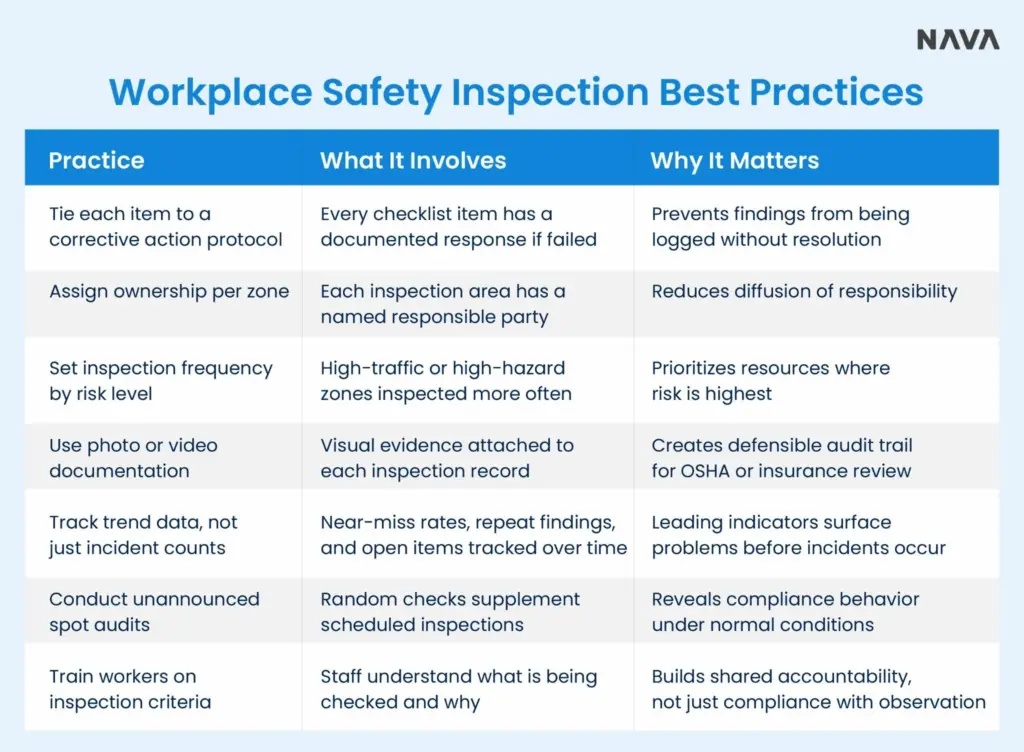
The following checklists are structured around observable, verifiable conditions. Each item should be tied to a corrective action protocol and a responsible party.
Personal protective equipment is the first line of defense against workplace injuries. Use this checklist to verify that required PPE is worn correctly and consistently.
| Checklist Item | Pass Condition | Common Failure Mode |
| Hard hats worn in designated zones | 100% compliance among personnel present | Workers removing headgear in warm areas |
| High-visibility vests in active vehicle lanes | All pedestrians wearing vests at all times | Vests removed after clocking in |
| Safety footwear in production areas | Steel-toe or equivalent confirmed at zone entry | Compliance drops during shift changes |
| Eye protection near machinery | Goggles or safety glasses worn at all times | Workers lifting eyewear between tasks |
| Gloves for material handling | Appropriate glove type per material class | Wrong glove type or no gloves on short tasks |
| Respiratory protection in chemical zones | Correct respirator type fitted properly | Improper fit or missing in low-traffic areas |
Machinery-related incidents often result from unauthorized access or missing safeguards. This checklist helps maintain safe operating conditions around equipment.
| Checklist Item | Pass Condition | Common Failure Mode |
| Zone perimeter markings are visible | Floor markings clear, no paint wear or obstruction | Markings worn over time, not refreshed |
| Restricted zone access logged and authorized | No unauthorized personnel within zone during operation | Workers taking shortcuts through machine areas |
| Lockout/tagout procedures followed for maintenance | Locks applied, tags signed before work begins | Tags present but locks missing |
| Guards and barriers in place on active machines | All physical guards secured, no improvised removals | Guards removed for maintenance and not replaced |
| Machine operating status clearly displayed | Status boards or lights accurate and visible | Status not updated after shift changes |
Vehicle movement remains one of the highest-risk activities in industrial environments. Use this checklist to identify behaviors and conditions that increase collision risk.
| Checklist Item | Pass Condition | Common Failure Mode |
| Pre-shift forklift inspection completed | Documented check of brakes, forks, lights, horn | Inspections skipped during busy periods |
| Speed limits observed in indoor zones | Speed within posted limits at all times | Speed increases during peak activity |
| Pedestrians maintain safe distance from forklifts | Minimum 3-foot separation enforced | Workers cross active forklift paths |
| Load limits not exceeded | No loads above rated capacity | Overloads to reduce trip count |
| Seatbelts worn during operation | Operator buckled at all times | Seatbelts ignored on short runs |
| Designated pedestrian walkways used | No pedestrian traffic in vehicle lanes | Walkways blocked; personnel detour into lanes |
Emergency preparedness depends on clear escape routes and accessible fire protection equipment. This checklist verifies readiness in the event of an emergency.
| Checklist Item | Pass Condition | Common Failure Mode |
| All emergency exits unobstructed | Clear path with no stacked materials or equipment | Pallets or equipment placed near exits |
| Fire extinguishers accessible and inspected | Monthly inspection tags current, no obstructions | Equipment placed in front of extinguisher cabinets |
| Aisle widths meet code requirements | Minimum width maintained throughout shift | Temporary storage narrows aisles over time |
| Emergency exit signs illuminated | All signs lit and visible from 50 feet | Bulb outages not reported promptly |
| Assembly points communicated and clear | Signage posted, no obstruction at assembly areas | Assembly areas used for temporary staging |
Improper chemical storage and handling can create significant safety and compliance risks. Use this checklist to confirm safe hazardous material management practices.
| Checklist Item | Pass Condition | Common Failure Mode |
| All containers properly labeled | GHS labels intact, legible, and correct | Labels damaged or missing on secondary containers |
| Spill kits stocked and accessible | Kits present at each hazmat storage area | Kits depleted and not restocked after use |
| Incompatible materials stored separately | Chemical segregation per SDS requirements | Mixed storage due to space constraints |
| PPE available at hazmat handling stations | Correct PPE type posted and available at point of use | PPE stored elsewhere and not used at point of task |
| Hazmat handling logs current | Logs updated within 24 hours of each handling event | Backfilled logs; gaps in documentation |
A checklist is only as effective as the system around it. These practices improve inspection reliability and compliance rates across industrial and warehouse environments with industrial Edge AI.
Vision AI does not require a separate inspection process. It integrates into your existing camera infrastructure and runs inspection logic continuously against live video feeds.
For each of the five checklist categories above, Vision AI adds persistent coverage where manual inspection is inherently intermittent.
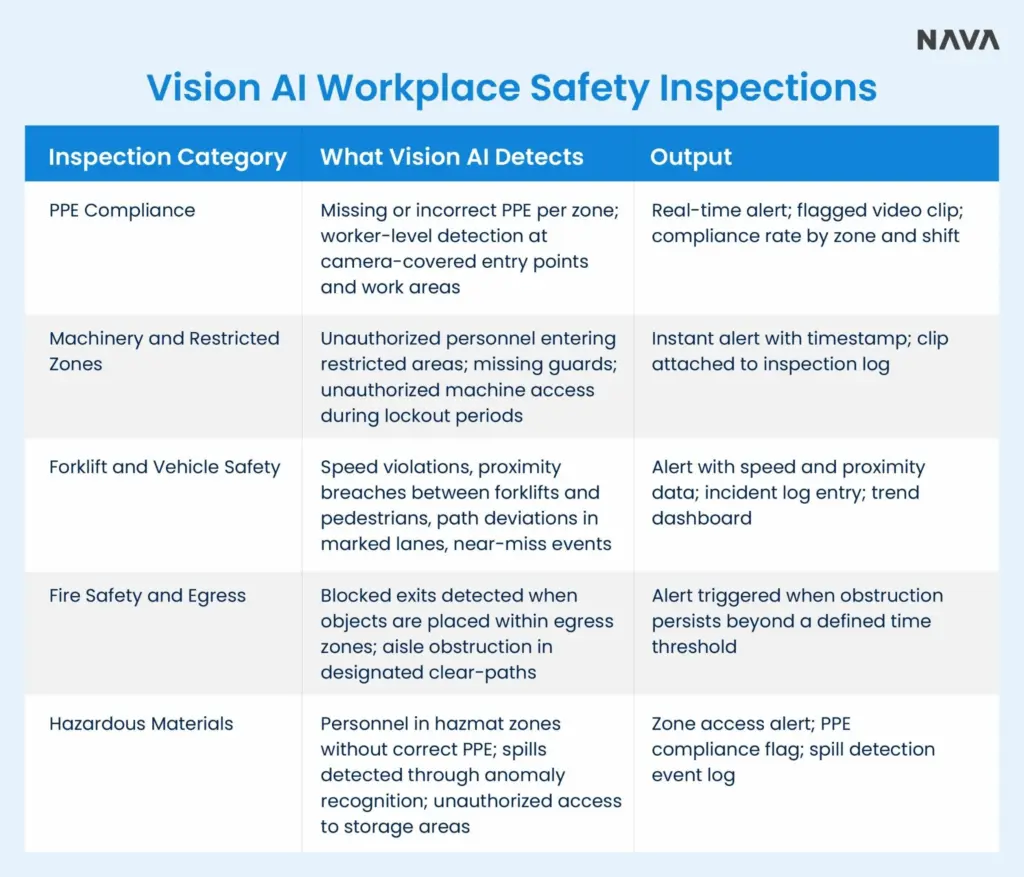
The practical value is in what happens with detection data. Rather than a weekly inspection report, safety teams receive a continuous feed of flagged events with video evidence, zone-level compliance rates, and trend data across shifts and weeks.
This changes the management question from 'what happened during last Tuesday's inspection' to 'what are the patterns showing us about risk across the last 30 days.'
NAVA's SafetyVision AI and DamageVision AI are purpose-built for the inspection categories above. They run on existing CCTV infrastructure without rip-and-replace, connect to WMS, YMS, and TMS systems, and deliver alerts and compliance dashboards through an AWS-native architecture.
NAVA's SafetyCompliance Agent handles continuous PPE and zone monitoring. DamageVision AI handles vehicle proximity, speed, and near-miss detection in yards and indoor operations. Both are available on AWS Marketplace for direct procurement without a lengthy vendor process.
For operations teams evaluating how Vision AI fits into their safety program, NAVA offers a zero-cost proof of concept on existing camera infrastructure. It covers 30 days of live detection across your highest-risk inspection zones, with a full performance report at completion.
A workplace safety inspection program is only as strong as its coverage. Checklists define what good looks like. Scheduled walkthroughs create accountability. But neither solves the core problem: most risk accumulates between inspections, not during them.
Vision AI closes that gap without replacing the inspection infrastructure already in place. It runs the same checklist logic continuously, across every camera-covered zone, and produces the kind of trend data that shifts safety management from reactive reporting to proactive risk reduction.
The five domains covered here : PPE compliance, restricted zone access, vehicle movement, fire egress, and hazardous materials handling, all have conditions that Vision AI can monitor at scale. Combined with structured manual inspections and clear corrective action protocols, continuous monitoring gives operations teams a complete picture of site safety, not just a snapshot.
See what continuous monitoring looks like on your site. NAVA's zero-cost proof of concept runs for 30 days on your existing camera infrastructure, covering your highest-risk zones with a full performance report at completion. Start your POC on AWS Marketplace.


