Blog
Workplace Safety Software vs Vision AI Solutions: Which Actually Prevents More Incidents?
By Rakesh· July 17, 2026· 9 min read
Summarize this post with

Loading insights...
LoadingSummarize this post with
Workplace safety software helps organizations manage planned safety through compliance tracking and corrective action workflows. Vision AI Solutions improve workplace safety compliance by detecting near-misses, PPE violations, forklift proximity events, and unsafe behavior in real time across active operational environments. This guide compares traditional workplace safety software with Vision AI to determine which technology offers the better ROI.
Your workplace safety program looks solid on paper. Audits are scheduled. Corrective actions are tracked. Inspections are documented. But somewhere between the last inspection and the next one, a forklift moves too close to a pedestrian zone. A worker enters a restricted area without PPE. A near-miss happens, and nobody reports it.
That gap is where most operational incidents actually form. And it is the gap that workplace safety software alone was never designed to close.
This is not a critique of safety software. It is a structural reality.
Traditional safety platforms manage planned safety effectively.
What they cannot do is continuously observe what is happening on your floor during live operations. That is a fundamentally different problem, and it requires a different layer in your safety stack.
Read this blog further to understand the difference between traditional workplace safety software and Vision AI solutions, and learn how Vision AI outperforms traditional workplace safety practices.
Most organizations running structured safety programs are already doing the right things. They have workflows, documentation, and accountability systems in place. But those systems are built around what gets reported. That is a significant limitation.
OSHA estimates that for every workplace fatality, there are hundreds of near-misses that go unreported.
Traditional workplace safety compliance programs are built on lagging indicators:
These are valuable. But they tell you what already happened. They do not tell you what is happening right now, during the shift, on the floor.
Workplace safety software has genuinely transformed how organizations structure their safety programs. The ability to digitize audits, track corrective actions, manage compliance documentation, and run training workflows has made safety programs faster, more consistent, and more defensible.
The core strength of workplace health and safety software is systematic risk management. It gives EHS leaders a structured environment for;
It creates accountability across departments and ensures that identified risks move through defined resolution workflows.
For operations leaders managing regulatory requirements across multiple sites, that planning layer is non-negotiable. Compliance documentation, audit trails, and corrective action records are foundational to any defensible safety program. No Vision AI platform replaces that.
The problem is not what safety software does. It is what it cannot see.
Between audits, between inspections, and between reported incidents, operations continue.
These events happen across hundreds of shifts every year and most of them never enter your safety software.
This is the execution-level risk problem. Your safety software knows what risks exist based on what has been identified and reported. It does not know what is occurring in real time across active operations without real-time object detection. That distinction matters more than most organizations acknowledge.
Consider shift overlap periods, among the highest-risk windows in any facility.
None of that shows up in your incident log unless someone reports it. And underreported near-misses are not a people problem.
They are a systems problem. Your current workplace safety services and software infrastructure were not built to capture them automatically.
This is where the category of Vision AI Solutions enters the conversation, not as a replacement for workplace safety software, but as a fundamentally different operational layer.
Platforms in this space, including SafetyVision AI from NAVA Vision AI, are built to do one thing that traditional safety tools cannot: continuously monitor what is happening during live operations.
SafetyVision AI works by analyzing existing camera infrastructure and detecting the following;
It does not wait for a report. It does not require a supervisor to observe and document. It operates continuously, surfacing operational risk as it forms.
This changes the operational intelligence available to EHS leaders and operations managers. Instead of reviewing what went wrong after the fact, your team receives real-time alerts when exposure events occur.
Instead of auditing behavior periodically, you have continuous behavioral monitoring across the facility. That is not a feature upgrade; it is a different architecture for safety operations.
The shift toward leading indicators is one of the most widely discussed challenges in modern EHS strategy. Everyone agrees that leading indicators matter. Fewer organizations have the infrastructure to actually capture them at scale.
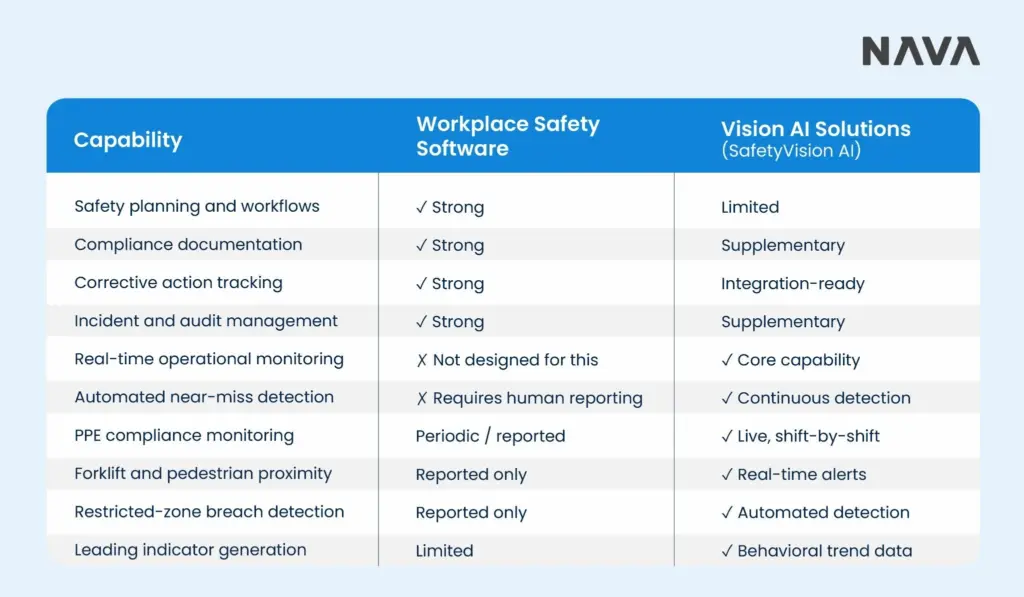
Lagging indicators like incident rates, days away from work, and OSHA recordables are outputs. They measure what has already happened.
Leading indicators are inputs:
They tell you where incidents are likely to form before they do.
The challenge is that capturing leading indicators at scale requires continuous observation. A monthly audit gives you a snapshot. A weekly inspection gives you another. But operational behavior between those checkpoints is invisible to your safety record unless something goes wrong.
SafetyVision AI generates leading indicator data automatically. PPE compliance rates by shift, by zone, by team. Near-miss frequency trends. Proximity event patterns around heavy equipment. That operational intelligence feeds directly into the planning layer, informing where corrective actions, training, and procedural changes are most needed.
SOPs are written for ideal conditions. Operations happen in real conditions. That gap between how work is planned and how work actually gets done is where most behavioral risk accumulates.
Workplace safety compliance is most often measured against documented procedures.
These are compliance measures against plans. They say nothing about whether workers followed those plans during live execution.
Observed safety is different. It asks what actually happened during operations, not what the procedure required, but what the worker did in the moment under real operational pressure.
That requires visibility that no compliance document, audit, or inspection workflow can provide.
SafetyVision AI is built for observed safety. It monitors actual worker behavior during active operations, not theoretical behavior against written standards. For EHS leaders trying to close the gap between planned safety and execution-level reality, that distinction is the core strategic argument for adding Vision AI to their safety stack.
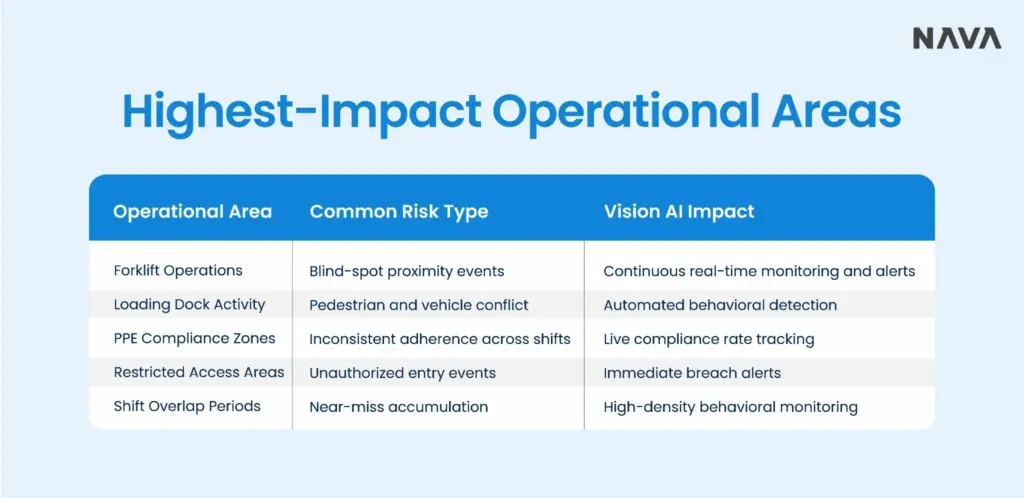
Organizations that deploy Vision AI Solutions typically identify measurable impact quickly in specific operational areas. The combination of high activity volume and historically low observability makes these zones the highest-priority targets.
The direction is clear. Workplace safety services are evolving from periodic compliance management toward continuous operational intelligence. Regulatory pressure is increasing. Incident cost exposure is growing. And the infrastructure to support continuous monitoring of existing camera systems, edge computing, and AI-powered detection is already in place in most enterprise facilities.
The organizations that will lead on safety outcomes over the next five years are not simply those with the best safety software. They are the ones who build layered safety stacks, with planning and compliance managed through traditional workplace health and safety software and execution-level visibility maintained through platforms like SafetyVision AI.
Predictive safety operations require behavioral data at scale. That data can only be generated through continuous monitoring during live operations. Periodic audits and incident reports will always have a role. But they cannot generate the volume or consistency of behavioral insight needed to shift from reactive safety to predictive safety.
Most organizations with structured safety programs already manage workplace safety compliance effectively. Audits run. Corrective actions are closed. Training gets tracked. That foundation is solid and non-negotiable.
What most programs do not have is continuous visibility into what is actually happening during live operations between audits, between inspections, and between the incidents that get reported. That execution-level gap is where operational risk accumulates, and where leading indicator data is lost.
Workplace safety software is the planning layer. SafetyVision AI is the execution visibility layer. The question is not which one you need. It is whether you can afford to run one without the other.
Schedule a Zero-Cost POC today and see how you can transform your workplace safety culture with Vision AI.


