Blog
5 AI Compliance Monitoring Solutions for Industrial Facilities
By NAVA Software· August 24, 2026· 9 min read
Summarize this post with

Loading insights...
LoadingSummarize this post with
Manual audits and periodic walkthroughs leave gaps, and in an industrial facility, a missed gap can mean an injury, a citation, or a shutdown. This guide breaks down five AI compliance monitoring solutions that catch risks in real time, from camera-based safety monitoring to predictive maintenance and integrated dashboards. Find out which approach fits your facility's biggest risk, before it becomes an incident report.
A worker skips a lockout-tagout step. A gas leak goes undetected for an extra hour. A forklift clips a pedestrian lane nobody flagged in time. On their own, these moments seem small until they trigger a shutdown, an OSHA citation, or worse.
That's the trouble with traditional compliance oversight. Manual inspections and periodic audits capture a snapshot, not the full picture. Between walkthroughs, paperwork, and shift changes, gaps open up, and safety teams are often left reacting to incidents rather than catching them early.
AI compliance monitoring offers a different approach. By tapping into existing camera infrastructure, applying computer vision AI, and generating real-time alerts, these systems help plants move from periodic checks to continuous, data-driven oversight, flagging risks as they emerge rather than after the fact.
But not all platforms work the same way. Here are five AI compliance monitoring solutions worth knowing, and how each fits different industrial environments.
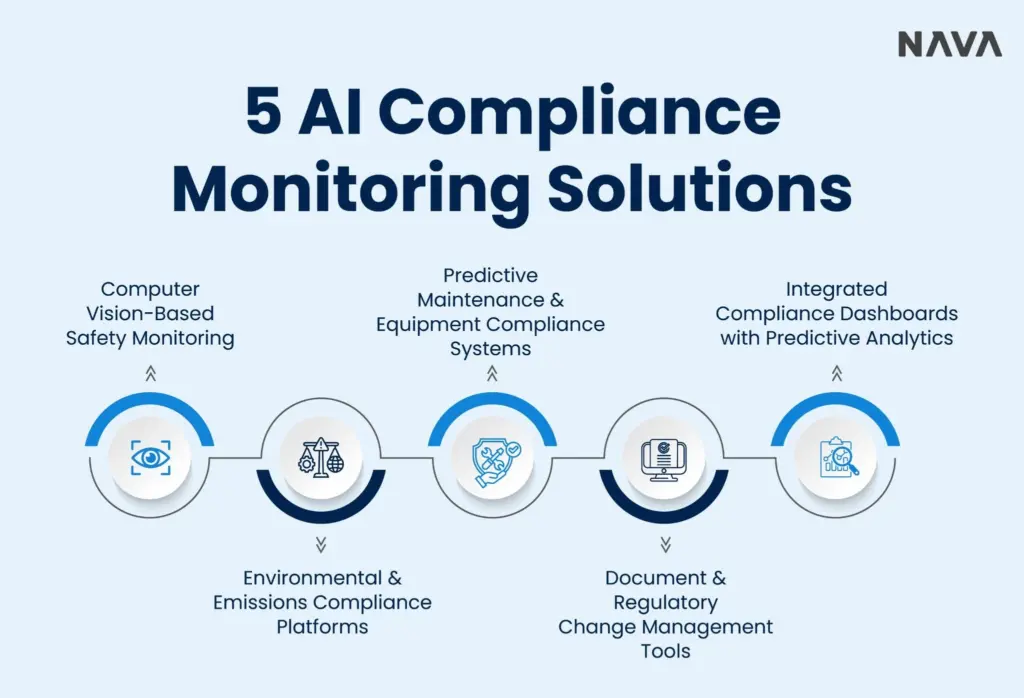
The five AI compliance monitoring solutions for industrial facilities are: computer vision AI -based safety monitoring, environmental and emissions compliance platforms, predictive maintenance and equipment compliance systems, document and regulatory change management tools, and integrated compliance dashboards with predictive analytics.
Together, they help facilities move from periodic manual checks to continuous, real-time compliance oversight.
Computer vision-based safety monitoring uses AI-enabled cameras to observe operations in real time and flag conditions that put workers at risk.
The system continuously scans the facility, detecting whether employees are wearing required PPE and whether anyone has entered a restricted or high-hazard zone.
Moreover, it monitors whether unsafe behaviors such as improper lifting, missing guardrails, or blocked emergency exits are occurring in real time.
Many of these platforms are designed to work with cameras already installed on-site, which reduces the need for extensive new hardware.
Why it matters: This approach gives safety teams visibility into conditions as they happen, not just during scheduled inspections.
Faster detection means faster intervention, which can reduce the likelihood of incidents and strengthen documentation for compliance reporting and audits.
Environmental and emissions compliance platforms use AI and sensor data to help facilities stay within regulatory limits for air quality, emissions, and waste.
These systems continuously collect data from monitoring equipment across a site, comparing readings against permitted thresholds and regulatory requirements.
When a metric trends toward a limit or a threshold is exceeded, the platform can alert environmental and compliance teams before the issue escalates into a reportable violation.
Some platforms also help consolidate environmental data for internal tracking and sustainability reporting.
Why it matters: Environmental violations can carry significant regulatory penalties and reputational consequences.
Continuous monitoring gives facilities an earlier opportunity to correct course, and centralized data simplifies the reporting process when regulators or auditors request documentation.
Common use cases
Equipment rarely fails without warning. The problem is that those warnings can be easy to miss.
Predictive maintenance systems analyze vibration, temperature, pressure, runtime, and other equipment data to spot changes that suggest wear or developing faults. That gives maintenance teams a chance to investigate before a machine reaches the point of failure.
For safety-critical equipment, this also matters from a compliance standpoint. A machine does not need to stop working to become a risk. It may continue running while temperatures, pressure levels, or other operating conditions gradually move outside acceptable limits.
Catching that drift early is often more useful than discovering it during the next scheduled maintenance check.
Why it matters: A breakdown can mean lost production, emergency repairs, and a safety issue at the same time. Early warnings give maintenance teams more room to plan repairs and deal with equipment problems before they create a larger operational or compliance issue.
Common use cases
A facility can have strong safety procedures and still run into compliance trouble because someone missed a renewal date.
Permits expire. Certifications need to be renewed. Regulations get updated. Keeping track of all of that through spreadsheets and calendar reminders becomes difficult once several facilities, teams, or regulatory bodies are involved.
Document and regulatory change management tools help teams keep those requirements in one place. They can track upcoming expiration dates, surface relevant regulatory updates, and organize the documentation needed when an inspection or audit comes around.
That sounds administrative, but it is often where avoidable compliance problems start.
Why it matters: Missing a regulatory update or certification deadline is rarely a complex technical failure. More often, the information was scattered or nobody saw it in time. Better tracking gives compliance teams a clearer view of what needs attention before an auditor is the one pointing it out.
Common use cases
Most facilities do not have a shortage of compliance data. They have a problem making sense of it.
Safety alerts may live on one platform. Environmental readings are stored somewhere else. Maintenance teams have their own systems, while incident reports may still be managed separately.
Integrated compliance dashboards bring those signals together so teams are not comparing five different reports just to understand what is happening across a site.
Predictive analytics can then help uncover patterns that are easy to miss when each data source is reviewed on its own. Maybe near-misses keep increasing around one production area. Perhaps PPE violations are more common during a certain shift. Repeated equipment alerts may point to a problem that deserves attention before the machine actually fails.
Those patterns are where a dashboard starts becoming useful rather than just another reporting screen.
Why it matters: Compliance problems often build gradually. When information stays separated across systems, the pattern may not become obvious until something goes wrong. A shared dashboard gives operations, safety, and leadership teams a better view of where attention is needed and what could become a problem next.
Common use cases
Most industrial facilities already have cameras covering the production floor, loading dock, warehouse, and yard. The problem is that footage often becomes useful only after something goes wrong.
NAVA Vision AI changes that. It uses existing camera feeds as a live compliance signal, giving safety and operations teams visibility into what is happening while there is still time to act. Here is how that fits into the five compliance approaches covered above.
NAVA's SafetyVision AI removes the need to build a separate camera-based monitoring layer. It works with cameras already installed on-site to spot PPE violations, restricted-zone entries, and forklift-pedestrian conflicts as they happen.
That matters because finding a safety violation during next week's walkthrough does nothing to prevent today's incident.
ComplianceVision AI automates verification of SOPs, inspections, and regulatory requirements so compliance gaps are surfaced continuously, not after an audit.
Problems it solves:
Business outcomes:
Safety monitoring, equipment oversight, and compliance reporting often end up scattered across separate tools. That fragmentation makes it harder to see what is happening across the facility as a whole.
NAVA Vision AI brings those signals into one platform. The model is closer to an integrated compliance dashboard, but the underlying data comes from live operational activity captured by cameras rather than reports assembled after the fact.
Facilities should not have to replace a working camera network just to add AI monitoring. NAVA Vision AI works with existing IP cameras, RTSP streams, and VMS platforms, so teams can add the software without installing another layer of camera hardware. Depending on the site's infrastructure and security requirements, deployment can run in the cloud, at the edge, or through a hybrid setup.
AI compliance monitoring doesn't replace safety teams or compliance officers; it gives them better visibility and faster information to act on. The systems covered here are built to support human judgment, not substitute for it.
Facilities that adopt these tools early tend to build stronger safety records and walk into audits with documentation already in hand, rather than scrambling to assemble it after the fact.
There's no single right answer, though. The best fit depends on what a facility is actually up against, whether that's floor-level safety risks, emissions thresholds, aging equipment, or a regulatory environment that keeps shifting. Matching the solution to the specific risk is what makes the investment worthwhile.