Blog
7 Computer Vision Use Cases Transforming Manufacturing and Logistics
By NAVA Software· October 1, 2026· 11 min read
Summarize this post with

Loading insights...
LoadingSummarize this post with
Computer vision transforms existing camera feeds into real-time operational insights for manufacturing and logistics teams. This blog explores seven use cases, including quality inspection, worker safety, inventory tracking, and yard monitoring, and explains how organizations can start with one high-impact process and scale from there.
Manufacturing and logistics operations generate massive amounts of visual data every day.
Most facilities already run cameras. Few use that footage as an operational intelligence source.
That gap is where computer vision creates immediate value.
Computer vision applies AI-powered visual analysis to your existing camera feeds. It turns raw footage into structured data on:
Teams can act on that data as it happens instead of reviewing recordings after an incident already occurred.
This blog covers seven use cases where computer vision solutions deliver measurable results in manufacturing and logistics environments.
Each one maps to a specific operational challenge, not a general AI capability.
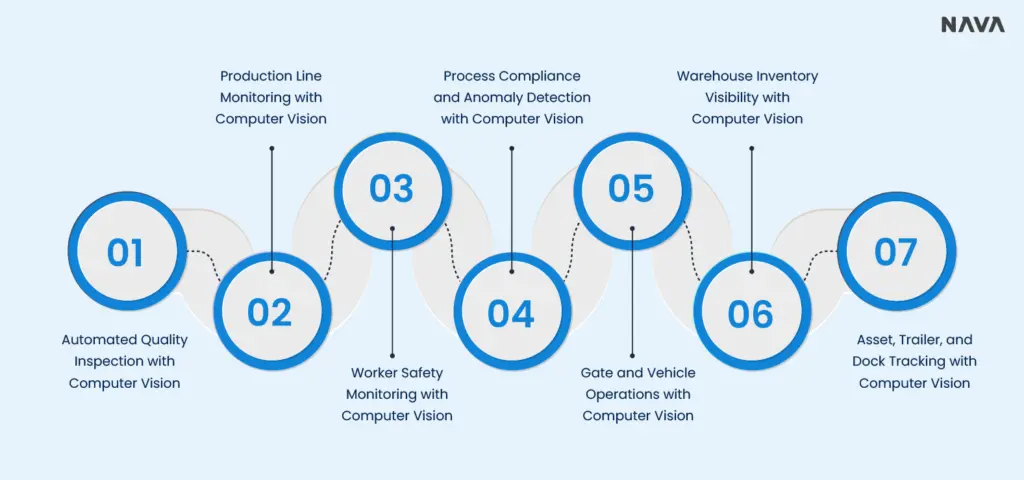
Computer vision in manufacturing and logistics is used to automate quality inspection, monitor production lines, improve worker safety, track inventory, detect process deviations, automate gate operations, and monitor assets across warehouses and yards.
Traditional cameras record events for later review.
Computer vision interprets visual data in real time. It detects objects, activities, anomalies, and process deviations automatically, without a person watching the feed.
That shift changes what a camera network is for. It stops being a record of what already happened and becomes a live source of operational data.
Facilities turn to computer vision to address recurring operational problems that manual processes cannot solve at scale.
| Challenge | How Computer Vision Helps |
| Quality issues | Flags defects and inconsistencies as products move down the line |
| Safety incidents | Detects PPE gaps, restricted zone violations, and unsafe behavior in real time |
| Manual inspections | Replaces visual spot checks with continuous automated monitoring |
| Inventory inaccuracies | Tracks stock levels and movement without manual counts |
| Yard congestion | Monitors vehicle and container flow through gates and yards |
| Process bottlenecks | Identifies where workflow deviates from standard operating procedure |
| Compliance monitoring | Creates a documented, auditable record of safety and process adherence |
| Labor-intensive audits | Cuts the hours spent walking the floor or yard to check on things manually |
Manual inspection checks a sample and assumes the rest of the batch matches. That assumption breaks when defects are intermittent, inspectors tire late in a shift, or line speed outpaces human attention. The result is escapes that reach customers and rework that surfaces too late to trace.
Computer vision inspects every unit that passes the camera. Models trained on your product images compare each item against a known-good reference and flag deviations in real time, so the line can reject, divert, or stop before a bad batch builds up.
| What it detects | Why it matters |
| Surface defects (scratches, dents, discoloration) | Stops cosmetic rejects before they ship |
| Structural defects (cracks, deformation) | Catches failures that affect product integrity |
| Missing components | Prevents incomplete assemblies from leaving the line |
| Dimensional errors | Flags parts outside tolerance at the point of production |
| Label mismatches | Reduces mislabeling, recalls, and compliance exposure |
Most plants learn about lost output at the shift end, when the count comes in short. By then, the cause (a slow station, an idle machine, a starved downstream cell) has cost hours of throughput and is harder to reconstruct.
Vision-based line monitoring watches stations, machines, and work-in-progress in real time. It measures cycle times against baseline, detects when equipment sits idle, and spots material piling up between stations, then alerts supervisors within minutes.
| What it tracks | Operational outcome |
| Cycle-time drift | Surfaces slowdowns before they compound across the line |
| Idle machines | Identifies unplanned stops and underused capacity |
| Downtime events | Builds an accurate downtime record without manual logging |
| Bottlenecks | Shows which station constrains throughput |
| Queue buildup | Flags WIP accumulation between stations |
Safety audits and walkthroughs only capture a snapshot of what is happening on the floor. They do not show what happens between inspections, when unsafe behavior, near misses, or blocked exits can occur without anyone noticing. By the time an incident triggers a review, the opportunity to prevent it has already passed.
Vision AI provides continuous monitoring across the facility. It checks PPE compliance, identifies restricted zone violations, detects unsafe behavior and proximity risks, and captures video evidence so safety teams can review events and take action.
| What it monitors | Safety outcome |
| PPE compliance (hard hats, vests, gloves, eyewear) | Enforces PPE rules across every shift, not just audit days |
| Unsafe behavior | Flags risky actions for coaching before an injury |
| Near misses | Captures leading indicators that manual reporting misses |
| Blocked exits and forklift proximity | Addresses high-severity hazards as they occur |
SOPs define how work should happen. Proving it happened that way, on every shift and at every site, is harder. Skipped steps and unauthorized access tend to surface only after a quality failure or an audit finding.
Vision AI compares observed activity against defined process steps. It detects deviations, missed steps, and unauthorized entry, then groups repeat patterns by shift, line, or location so managers can see where drift is systemic.
| What it detects | Compliance outcome |
| SOP deviations | Identifies where work departs from the defined process |
| Missed process steps | Catches omissions that lead to defects or safety gaps |
| Unauthorized access | Controls who enters regulated or sensitive areas |
| Repeat deviations by shift or location | Points training and process fixes at the right team |
Manual gate check-in is a common source of truck queues. Guards read plates, record container and trailer IDs by hand, and key data into the YMS, which slows turnaround and introduces transcription errors.
Vision AI reads license plates and container or trailer IDs as vehicles approach. It verifies them against expected arrivals, automates check-in and check-out, and hands off location data to yard tracking once the vehicle is inside.
| Capability | Operational outcome |
| License plate recognition | Removes manual plate entry at the gate |
| Container and trailer ID capture | Improves record accuracy for every movement |
| Automated check-in and check-out | Shortens gate queues and processing time |
| Yard tracking handoff | Links gate events to on-site location |
Cycle counts consume labor and still leave gaps between counts. Misplaced pallets, inaccurate SKU counts, and poor slotting decisions lead to picking errors, emergency searches, and stock that exists in the WMS but not on the shelf.
Vision AI monitors storage locations and stock movement through camera feeds. It counts SKUs, verifies pallet placement, and flags inventory that sits in the wrong location, giving teams a current view without walking the aisles.
| What it tracks | Inventory outcome |
| SKU counts | Reduces reliance on manual cycle counts |
| Pallet placement | Improves location accuracy against the WMS |
| Stock movement | Shows how inventory flows through the facility |
| Storage utilization | Informs slotting and capacity planning |
| Misplaced inventory | Flags items before they cause pick failures |
In a busy yard, finding trailers, containers, and forklifts when you need them should not depend on radio calls or outdated tracking boards.
Yet that is still how many teams operate. The result is predictable: dock doors sit unused while trucks wait, returnable assets disappear into the yard, and schedulers make decisions without a clear view of what is happening.
Vision AI changes that by creating real-time visibility across yard and dock operations. It tracks mobile assets, shows which doors are occupied or available, and gives schedulers accurate location data and dwell times to assign resources more effectively.
| What it tracks | Operational outcome |
| Trailer and container location | Ends manual yard searches |
| Forklift location | Improves equipment allocation across zones |
| Returnable items (pallets, racks, totes) | Reduces asset loss and replacement cost |
| Dock occupancy | Shows door availability in real time |
| Dock scheduling | Aligns appointments with actual door status |
The seven use cases above are not unique to one vendor. They reflect where computer vision is already delivering value across manufacturing and logistics operations.
NAVA Vision AI is one platform built around this same set of problems, deploying as purpose-built modules on top of a facility's existing camera infrastructure rather than requiring new hardware or a rebuilt network.
Quality & Compliance
Safety
Yard & Logistics
Warehouse
Teams evaluating computer vision for their own operations don't need to start with all of these at once. A single module deployed against one high-cost process, usually safety or quality, is typically enough to validate the approach before expanding further.
NAVA Vision AI is available through AWS Marketplace for teams that want to run that kind of proof-of-concept.

Operational benefits:
Financial benefits:
A Vision AI solution is becoming a core operational technology for manufacturing and logistics organizations.
The highest value comes from solving specific operational challenges. It does not come from deploying AI broadly across a facility with no clear target.
Organizations that convert visual data into operational intelligence gain greater visibility, efficiency, safety, and control across their operations.
The seven use cases above are a starting point for identifying where that value applies to your own facility or yard.
Ready to turn your existing cameras into operational intelligence?
Contact our team to find the right starting point for your facility.