Blog
4 Industrial Vision AI Solutions That Reduce Safety Incidents
By Rakesh· September 3, 2026· 7 min read
Summarize this post with

Loading insights...
LoadingSummarize this post with
Waiting for a violation report is too late. Vision AI catches risk the moment it happens, using cameras you already have. This guide breaks down four leading platforms NAVA Vision AI, Protex AI, Intenseye, and Visionify so you can see how each compares on detection, deployment, and fit. Whether you need pure compliance monitoring or a platform that also automates forklift, dock, and gate operations, there's a clear pick here for your floor.
A missed near-miss can turn into a serious injury. On most industrial sites, safety still relies on scheduled walk-throughs, manual checklists, and supervisors who can't be everywhere at once. By the time a violation gets logged, the risky moment has already passed.
Vision AI changes this. It turns a facility's existing cameras into a 24/7 monitoring layer that catches risk as it happens, not after the fact.
The question isn't whether Vision AI works; it's which platform fits your floor. Here's how four leading solutions compare, and which one might be the right call for your site.
Vision AI for industrial safety isn't a single product category; it's a competitive field, with each platform taking a slightly different approach to the same core problem: catching risk before it becomes an incident. AI compliance monitoring solutions can help organizations detect safety violations, monitor workplace compliance, and respond to risks in real time.
Before diving into the details of each platform, here's a quick side-by-side comparison to help you see how they stack up.
| Platform | Core Focus | Key Strength | Best Fit |
| NAVA Vision AI | Safety + operations automation (forklift, dock, gate, asset security) | Combines compliance detection with realtime operational modules on AWS infrastructure | Forklift-heavy, dock-driven facilities wanting value beyond compliance |
| Protex AI | Compliance-oriented safety intelligence | Privacy-first, edge-processing architecture with deep EHS integrations | Large enterprises wanting a mature, compliance-focused platform |
| Intenseye | Comprehensive EHS management | Monitors 50+ safety indicators, no facial recognition, 200+ camera models supported | Global, multi-site enterprises needing a full EHS management layer |
| Visionify | Manufacturing-focused hazard detection | Fast deployment (weeks, not months) with broad out-of-box coverage | Manufacturing sites wanting a quick pilot with minimal setup |
Here's how four of the more established names stack up.
NAVA Vision AI turns a facility's existing CCTV or IP cameras into a real-time safety and operations layer. No new hardware is required. Built on AWS, the platform watches live feeds continuously and flags risk the moment it happens.
What you get:
Customizable detection rules built around your site's actual policies
Real-time alerts routed to supervisors and safety teams
Dashboards that show where risk concentrates across shifts and locations
A zero-cost proof of concept to validate results before a full rollout
Strengths
Best fit
Industrial, construction, oil & gas, manufacturing, energy, and logistics sites that already run AWS or want an AWS-native safety stack, especially those needing edge deployment for remote/low-connectivity locations and deep backend integration (SCADA/ERP/EHS) rather than a plug-and-play SaaS alert tool.
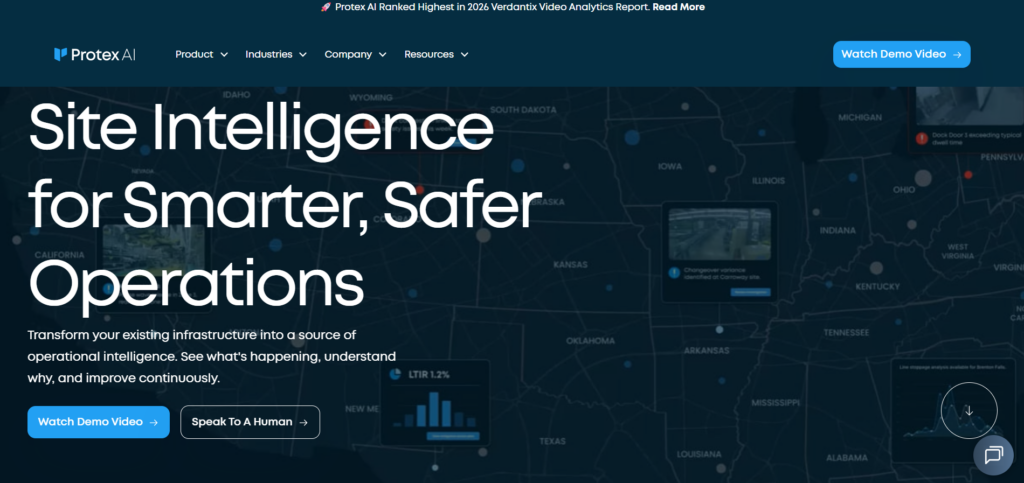
Protex AI, founded in Dublin, turns a facility's existing CCTV network into a real-time safety and operations intelligence layer, with no new hardware required.
Its computer vision models watch for PPE non-compliance, forklift-pedestrian conflicts, restricted-area breaches, poor ergonomics, and housekeeping hazards, with detection-to-alert times of just a second or two.
Strengths
Best fit: Large, established enterprises that want a mature, compliance-oriented safety platform with heavy EHS system integration.
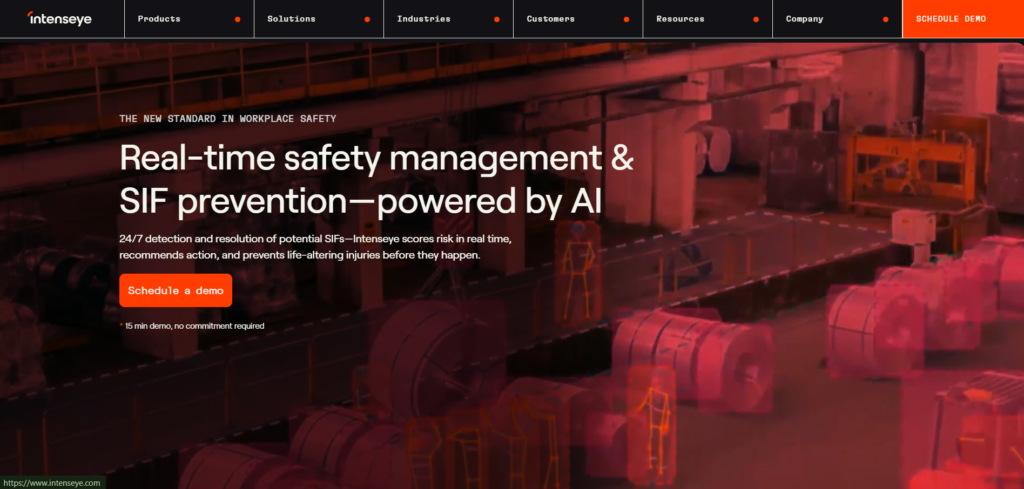
Intenseye is an EHS platform built for large, multi-site global enterprises. It monitors 50+ safety indicators through computer vision. These include PPE and restricted-zone violations, ergonomics using RULA/REBA-based posture analysis, electrical hazards, and vehicle-pedestrian proximity.
The platform is designed to avoid facial recognition as part of its privacy approach. It connects with over 200 camera models.
Strengths
Best fit: Global enterprises that need a comprehensive EHS management layer on top of safety detection, not just alerts.
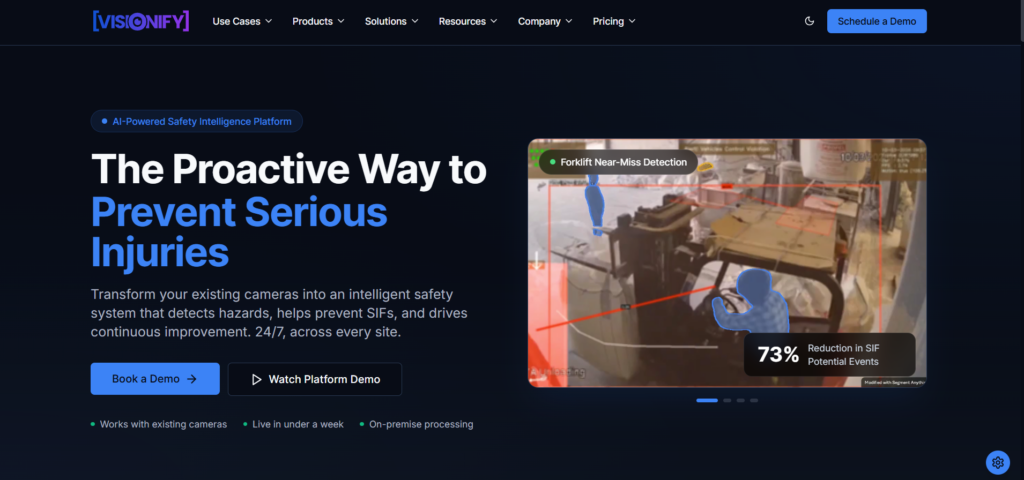
Visionify positions itself as a manufacturing-focused Vision AI safety platform. It detects a wide range of hazards. This includes PPE compliance, slips and falls, forklift near-misses, fire and smoke, chemical spills, restricted-area access, and lone-worker safety.
The platform emphasizes fast deployment, often measured in weeks rather than months. It does this without lengthy custom model training.
Strengths
Best fit: Manufacturing sites that want to get a safety pilot running quickly with minimal setup overhead.
Traditional safety monitoring depends on manual checks and reacts only after something goes wrong. AI Computer Vision solutions monitor your entire site around the clock and catch risks the moment they happen. For facilities serious about reducing incidents, Vision AI is the clear upgrade.
| Category | Traditional Safety Monitoring | Vision AI |
| Monitoring | Manual, shift-based checks | 24/7 real-time automated monitoring |
| Response | Reactive, after an incident is reported | Proactive, flags risk in real time |
| Coverage | Limited by available staff | Full-site, multi-camera coverage |
| Data insights | Delayed, manual reports | Real-time dashboards |
| Integration | Standalone CCTV, used for after-the-fact review | Works with existing CCTV infrastructure |
NAVA Vision AI stands out by combining safety monitoring with operations automation in one platform. It uses your existing CCTV cameras; no new hardware needed. Unlike compliance-only tools, it covers PPE detection, forklift collision prevention, dock monitoring, gate automation, and asset protection. This makes it a real-time strong fit for forklift-heavy, dock-driven facilities that want value beyond safety compliance alone.
How it compares: Protex AI and Intenseye are strong, established options for enterprise EHS teams focused on safety monitoring and compliance reporting. Visionify has carved out a niche in manufacturing-specific safety use cases.
NAVA Vision AI takes a broader approach. It combines safety detection with operations automation, covering forklift safety, dock monitoring, and yard and gate automation in one platform. That makes it a strong fit for facilities running forklift-heavy or dock-driven operations that want value beyond compliance alone.
Core modules:
PPE compliance, hazard zone detection, and behavior monitoring each solve a different point of failure. Together, they cover most of what manual monitoring can't keep up with.
The common thread is visibility: catching what's happening on the floor in the moment, not after it becomes an incident report.
Workplace safety is shifting from reactive documentation to predictive, data-driven prevention. Sites that adopt vision AI now build a real-time understanding of where risk lives, before it costs them a person, a shift, or a claim.
Curious what vision AI could catch on your floor? Get in touch to schedule a walkthrough.